

By the middle of the 20th century, the cultural rivalry between the United States and the Soviet Union extended far beyond the realm of politics or military might—it was a battle for the global imagination. As the USSR dismissed American culture as a “bathtub civilisation,” many Europeans derided it as a mere “British isotope.” Keen to shed this image, the US government began investing heavily in cultural diplomacy, determined to showcase its intellectual and artistic vitality to the world.
Out of this drive emerged a range of ambitious programs—some overtly diplomatic, others quietly ideological. Among the most fascinating was the Franklin Book Program (FBP), a New York–based non-profit founded in 1952 that used books as instruments of soft power. Supported by the US government yet operating through private publishers and universities, the Franklin Program aimed to “assist developing countries in the creation, production, distribution, and use of books and educational materials.” Behind that benign mission lay a broader Cold War strategy: to win hearts and minds through the printed word.
Books as Weapons in the Battle of Ideas
During the Cold War, books were not merely objects of learning; they were weapons of persuasion. The booming US publishing industry, which had industrialised book production during World War II, now turned its energies to exporting American values abroad. By translating American works of science, literature, and social thought into local languages, Washington sought to promote liberal democracy, scientific rationality, and the idea of a modern, progressive society.
The transnational production process was astonishingly complex: Bangla calligraphy was sent to New York for printing, then shipped back to Chittagong for binding and sale
The Franklin Book Program was at the heart of this project. Between 1952 and 1979, it operated in 15 countries across Asia, Africa, and the Middle East, producing over 3,000 translated titles in languages ranging from Arabic and Persian to Urdu and Bangla. Its founding director, Datus C Smith, Jr, of Princeton University Press, famously argued that “if you make ideas work for democracy, you won’t have to shoot the cannons at all.”
Franklin Comes to Pakistan
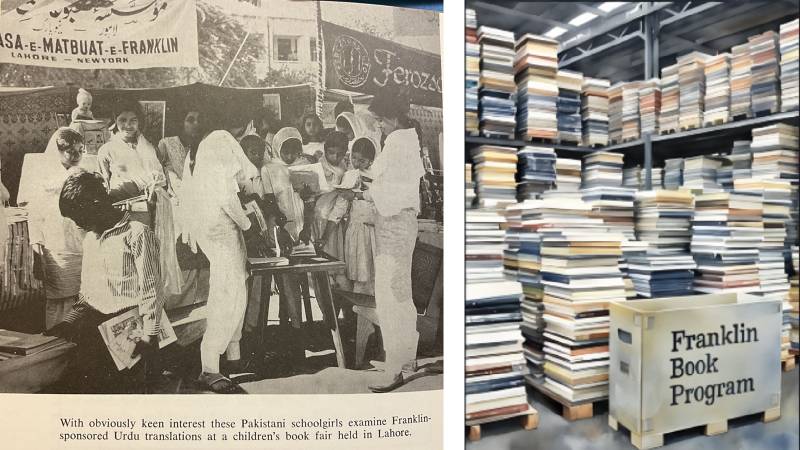
Pakistan was among the earliest countries to host the program, after Egypt and Iran. Its strategic location and status as the world’s largest Muslim-majority nation made it an ideal site for American cultural engagement. The Franklin office in Lahore, established in 1954, and the Dhaka office, opened in 1956, became centres of intense translation, publishing, and intellectual exchange.
Over two decades, Franklin Pakistan published more than 700 titles—over 400 in Urdu and over 300 in Bangla—covering subjects from science and economics to literature and education. The program collaborated with hundreds of local publishers and translators, and involved prominent intellectuals, judges, and government officials. Each translated book was not just a vehicle for American ideas but a site of negotiation, where global ideologies encountered local aspirations.
In East Pakistan (now Bangladesh), Franklin’s work intersected with the region’s language movement and debates over cultural identity. Translating American books into Bangla was both a modernisation effort and an act of linguistic assertion—a way to legitimise Bangla as a language of knowledge and nationhood. In West Pakistan, the Urdu translations provided access to scientific and literary materials for a growing educated public, while reinforcing the cultural dominance of Urdu within national discourse.
The Politics of Translation
While Franklin was an arm of American soft power, its impact in Pakistan cannot be reduced to propaganda. The program built publishing infrastructure, trained local editors, designers, and printers, and raised professional standards in the book trade. It also created new publics—teachers, parents, and students eager to read contemporary works in their own languages.
Yet the program’s operations were tightly controlled from New York. Every field office—from Lahore to Dhaka—was subject to detailed bureaucratic oversight, with decisions on book selection and production often dictated by US managers. Local staff were expected to avoid politics and maintain cordial relations with the Pakistani state, which itself kept a close watch on foreign publishing activities. Customs officials at Karachi port inspected Franklin consignments for “objectionable” material, particularly photographs and maps deemed politically sensitive.
Despite these constraints, Franklin Pakistan carved out a space where ideas could circulate, albeit within limits. Its books—distributed through state schools, libraries, and bookshops—offered glimpses of a wider intellectual world, even as they served US strategic goals.
Modernisation and Control
Franklin’s arrival coincided with Pakistan’s post-independence modernisation drive, much of it guided by American aid and expertise. Alongside programs such as Fulbright scholarships, USAID development missions, and Harvard economists advising the Planning Commission, the Franklin Book Program represented the cultural arm of US-sponsored modernisation. It sought to create a rational, educated, and liberal middle class—viewed as a bulwark against communism in the Muslim world.
But Franklin’s cultural diplomacy was always entangled with local politics. Language, in Pakistan, was a deeply political issue. The state’s promotion of Urdu as a national language was contested by Bengali intellectuals in East Pakistan and by regional movements elsewhere. Franklin’s translations, though framed as educational, became part of this larger struggle over linguistic hierarchy and cultural sovereignty.
A Global “Franklin Family”
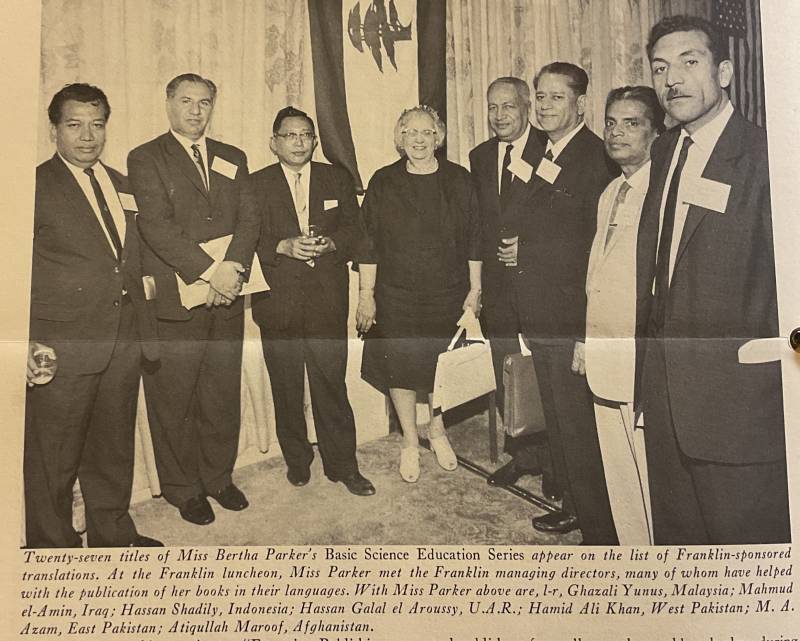
Despite its political undertones, the Franklin Book Program fostered remarkable collaboration across the Muslim world. Its field offices in Cairo, Tehran, Lahore, and Dhaka often worked in concert, sharing resources and experiences. Books such as Tocqueville’s Democracy in America and the Viking Encyclopedia were simultaneously adapted into Arabic, Persian, Urdu and Bangla editions.
In some cases, the transnational production process was astonishingly complex: Bangla calligraphy was sent to New York for printing, then shipped back to Chittagong for binding and sale. The result was a hybrid object—an American text reborn as a local artifact.
Legacy and Reassessment
Today, the Franklin Book Program lives on in archives and memories—its administrative records preserved in American repositories, and its books still found in Pakistani libraries and homes. While critics have rightly viewed it as an instrument of US cultural influence, its impact is more complex. Franklin not only advanced American strategic interests but also helped lay the foundations of Pakistan’s modern publishing industry and broadened access to global knowledge in Urdu and Bangla.
The program illustrates that Cold War battles were not fought solely with armies or economies, but also on library shelves, in classrooms, and in the hands of readers. Its legacy in Pakistan is twofold: it transmitted American ideals and knowledge while simultaneously nurturing a vibrant local print culture. In an era when ideas can cross oceans and borders, Franklin’s story is a striking reminder of the transformative power of books—both as instruments of influence and as catalysts for intellectual growth.