

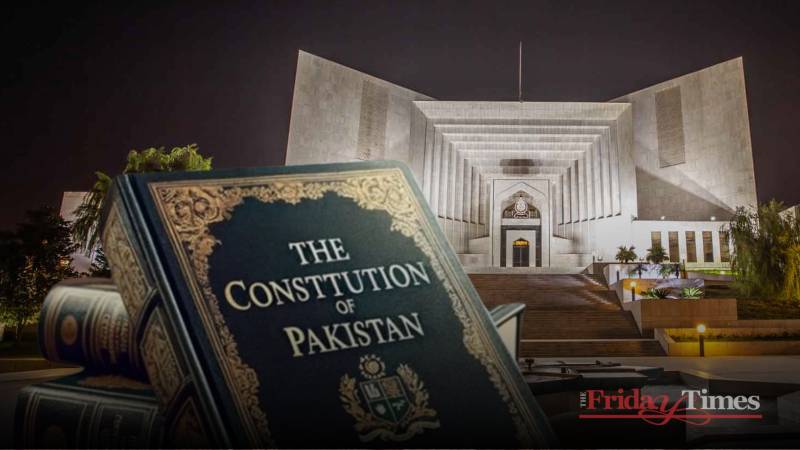
More than three dozen of members of civil society Monday approached the Supreme Court challenging the vires of 26th Constitutional Amendment, requesting to issue directions for independent inquiry into the manner in which votes were procudred for the purpose.
The petition filed by Advocate Muhammad Saqib Jillani on behalf of civil society's members has requested the top court to declare that the 26th amendment was passed in a manner contrary to the Constitution and law and is thus has no legal effect and to strike down all acts, decisions, notifications, proceedings or superstructure by any person, authority or body that is based on the same.
The petitioners have further requested the top court to declare that sections 7, 14, 17 and 21 of the 26th Constitutional Amendment are substantively ultra vires and void ab initio being violative of the independence of judiciary.
The petition also prayed the top court to declare that sections 7, 14, 17 and 21 of the said amendment are required to be interpreted harmoniously and in light of the salient and essential provisions of the Constitution guaranteeing the independence of judiciary and trichotomy of powers and to avoid conflict with the same; and make clarificatory interpretation of the same as stated in the grounds above.
The petition also prayed the top court to declare that Section 27 of the amendment is substantively ultra vires and void ab initio and violates a salient feature of our Constitution namely federalism and strike down the same along with any act or superstructure based thereon.
"The 26th Constitutional Amendment is not a validly passed law as there are serious allegations that two crucial votes for the passage of the 26th Constitutional Amendment were obtained through coercion," the petition contended.
According to the petition, immediately after casting his vote Qasim Ronjhoo submitted his resignation to the Chairman Senate.
"Similarly, there were reports that another Senator Mrs. Naseema Ahsan’s son had been abducted so as to coerce her to vote for the 26th Constitutional Amendment."
"It is pertinent to mention that the head of Baluchistan National Party – Mengal (BNP – Mengal), to which the above-named Senators belonged, confirmed that its members were compelled to cast vote in favor of the 26th Constitutional Amendment through threats and abductions. Both senators also made public statements in this regard."
"The Petitioners demand that a thorough inquiry into this matter be undertaken under the supervision of the Supreme Court itself and if the crucial votes for the passage of the 26th Constitutional Amendment have been obtained through coercion then the Supreme Court may make a declaration that the 26th Constitutional Amendment has not been validly passed and therefore the same has no legal effect."
It is further contended that at the time of the said Act’s passage in Senate, the province of Khyber Pakhtunkhwa was under-represented by half i.e. 11 members.
"This was on account of mala fides of the ECP which refused to hold Senate elections for Khyber Paktunkhwa (whilst holding them for all other provinces)."
The petition stated that the lack of representation at such a large scale from the Senate which is the symbol of the federation does not bode well for harmony among the federating units especially when a significant constitutional amendment is being proposed in the constitution.
"The mala fide halving of the representative strength of a whole province in Senate is something quite different, in nature and effect, to incidental vacancies in individual seat/s covered by in Article 67 of the Constitution. This is not a question of a mere irregularity of parliamentary procedure and hence the ouster clause in Article 69 is not applicable. In any event, as is well settled, Article 69 does not protect acts that are mala fide, without jurisdiction or corum non judice."
The petition stated that ECP’s willful defiance of the Supreme Court’s directive on reserved seats deprived a party and a federating unit of proper representation in the National Assembly’s deliberations on the 26th Amendment.
"This was not a procedural irregularity or incidental vacancy but a deliberate act to manipulate the Assembly’s composition."
It added that the Bill was rushed through the National Assembly, introduced late at night as a Supplementary Order without prior publication in the Official Gazette or referral to a Standing Committee, violating Assembly Rules, further contending that it was considered the same day instead of allowing the required two-day gap, without the Speaker’s direction.
"The session continued past midnight, ending early morning. Given such a process, which undermines Article 19-A, the Court must intervene."
It next contended that Section 7(iii) & (iv) of the 26th Amendment, allowing a Special Parliamentary Committee to select the Chief Justice from the three senior-most judges, threatens judicial independence.
"This politicizes the appointment, potentially pressuring judges to appease the executive," stated the petition, adding that a Chief Justice appointed by an executive-led committee would lack perceived impartiality, weakening trust in the judiciary.
It is further contended that Section 7(ii) of the 26th Amendment shifts the Judicial Commission’s composition from a judiciary-dominated body (6:3) to one controlled by non-judicial members (5:8), threatening judicial independence.
By allowing the executive to nominate and vote on judicial appointments, the amendment risks filling the bench with government-aligned judges, undermining impartiality, it said.
This compromises the judiciary’s ability to fairly resolve disputes, especially cases involving fundamental rights under Article 10A, it added, further contending that the amendment weakens fair trial rights, endangering the constitutional guarantee of equal citizenship and the broader fundamental rights framework.
The petition stated that while judicial accountability is necessary, given past instances of judges legitimizing military coups and undermining democracy, the 26th Amendment does not address this issue.
"Instead, it seeks to place the judiciary under executive and establishment control, ensuring continued political influence over judges. Rather than promoting accountability, the amendment reinforces past patterns of judicial subservience."
The petition stated that Sections 14 and 17 of the 26th Amendment undermine judicial independence by allowing an executive-controlled Judicial Commission to select judges for constitutional benches.
These benches, with exclusive authority over constitutional and fundamental rights cases, would be subject to political influence, compromising impartiality and eroding public trust in the judiciary, it stated.
The petition, however, stated that legislators can contribute to judicial appointments by assessing integrity and public reputation, but competence must not be secondary to political acceptability.
"The 26th Amendment gives disproportionate weight to the executive, creating partisan dominance in the Judicial Commission. Just as Article 213 ensures balance in ECP appointments, judicial appointments must also safeguard impartiality to uphold constitutional principles."
The petition further contended that Section 13 of the 26th Amendment removes the Supreme Court’s suo moto powers under Article 184(3), weakening fundamental rights enforcement, especially for vulnerable communities lacking legal access.
"This limits justice to those who can afford legal proceedings, disproportionately affecting marginalized groups."
"Shifting Article 199 remedies to executive-influenced constitutional benches further undermines human rights protections."
"The amendment appears designed to shield the government from scrutiny and accountability."
The petition further contended that the 26th Amendment disrupts the constitutional balance by weakening the separation of powers and checks and balances among the executive, legislature, and judiciary.
"This undermines oversight, accountability, human rights protections, and the rule of law, increasing the risk of state power abuse."