

Among the iconic images that have come to represent critical historic events, there is that heart-stopping Pulitzer Prize-winning photograph titled ‘The Struggling Girl’. It is that of a severely malnourished child, collapsed face down on the dust, with a vulture watching and waiting ominously from just a few metres away. Also known as ‘The Vulture and the Little Girl’, this deeply disturbing picture has become identified with the catastrophic famine that occurred during the Sudanese civil war in 1993. South African photojournalist Kevin Carter, who was on an assignment to report on the famine, chanced upon the horrifying scene and captured it on film. The child, later identified as a boy named Kong Nyong, survived the incident.
The photographer didn’t. Bearing witness to such abject human deprivation and degradation comes at a price. Kevin Carter gassed himself within a few months of receiving a Pulitzer Prize for this photograph. He drove up to an area near the river in Johannesburg where he used to play as a little boy. He taped one end of a hose to the exhaust pipe of his red Nissan pickup truck, fed the other end through the passenger-side window, climbed in and turned on the engine. He was 33 years old. An excerpt from the suicide note that he left behind reads: “I am haunted by vivid memories of killings and corpses and anger and pain… of starving or wounded children.”
Carter’s photograph, first published in March 1993 in The New York Times, drew both acclaim and criticism; acclaim for capturing so masterfully the stark reality of famine; criticism for the fact that Carter took a photo of the child instead of helping it. Carter later revealed that he was instructed to avoid touching the victims of famine for fear of spreading disease. As such, he had taken the shot, waited for a while for the vulture to spread its wings. When it didn’t, he had shooed it off before walking away.
Except, there is no walking away. It’s unconscionable to leave starving children to their fate. Our humanity will not permit it. That is the life lesson, if one chooses to learn.
If the blockade is not lifted and children don’t have access to food, an estimated 71,000 children under the age of five are expected to be acutely malnourished over the next eleven months
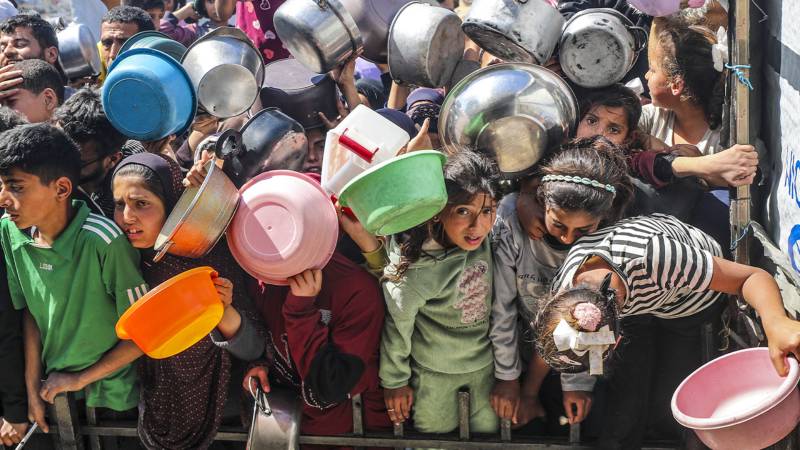
And, to not forget. Today, Gaza is on the brink of a man-made famine. We are witnesses to the misery of thousands of Palestinian children who are starving. Israel holds the entire civilian population of Gaza collectively responsible for the massacre conducted by Hamas on 7 October 2023. But, even in a war there are rules: starving innocent children is a crime against humanity.
Since 2 March this year, Israel has blocked humanitarian aid from reaching Gaza. The latest food security analysis was released on 12 May by the Integrated Food Security Phase Classification (IPC) partnership, of which WHO is a member. “We do not need to wait for a declaration of famine in Gaza to know that people are already starving, sick, and dying, while food and medicines are minutes away across the border,” said WHO Director-General Dr Tedros Adhanom Ghebreyesus. “Today’s report shows that without immediate access to food and essential supplies, the situation will continue to deteriorate, causing more deaths, and descent into famine.” Three-quarters of Gaza’s population are at ‘Emergency’ or ‘Catastrophic’ food deprivation, the worst two levels of IPC’s five-level scale of food security and nutritional deprivation.
The situation is grim, particularly for children. If the blockade is not lifted and children don’t have access to food, an estimated 71,000 children under the age of five are expected to be acutely malnourished over the next eleven months. The long-term impact from malnutrition can last a lifetime in the form of stunted growth, impaired cognitive development, and susceptibility to disease. An entire generation is at risk of being blighted. Since the beginning of the blockade, 57 children—likely to be an underestimate—have died from the effects of malnutrition. The number is likely to increase rapidly.
The Gaza Humanitarian Foundation (GHF), a US- and Israeli-backed group that bypasses traditional international relief agencies, began to hand out aid in distribution centres in Gaza from 26 May 2025. They have now closed their aid centres until further notice. This happened after a series of deadly shootings that led to the death of 110 Palestinians, as of 8 June, in the areas where the GHF were operating.
It’s over three months of blockade and ensuing conditions of starvation bordering on famine in Gaza. At this critical juncture, Civilians of Conscience, who refuse to merely bear witness to this demoralising tragedy unfolding before our eyes, have begun to organise and try to breach the Gaza blockade. Their aim is to deliver humanitarian aid to the people of Gaza, albeit a symbolic amount. Their greater purpose is to redirect international attention towards Israel’s unconscionable war strategy of blocking international humanitarian aid to starve the people of Gaza. The latest attempt in this direction was by twelve international activists and journalists of the Freedom Flotilla Coalition, including Greta Thunberg. Their unarmed boat Madleen, carrying items like rice and baby formula, was intercepted in international waters by Israeli commandos; the illegally abducted activists are being deported.
I applaud the valiant efforts of the Civilians of Conscience. They have injected the impetus of human responsibility towards the Gazans that the world has visibly abandoned. “The moment we stop trying is when we lose our humanity,” asserted Greta Thunberg, while explaining her reason to participate in the Madleen mission. As we have learnt, resigning ourselves to the role of helpless onlookers will extract a heavy toll. It’s time to act. There is a Sindhi saying: ‘look at the allegiance of the grass on the riverbank! It will either save the drowning man (who is clutching the grass desperately) or sink with him.’ We humans must rise to that kind of resolute standard of absolute fidelity towards life.