

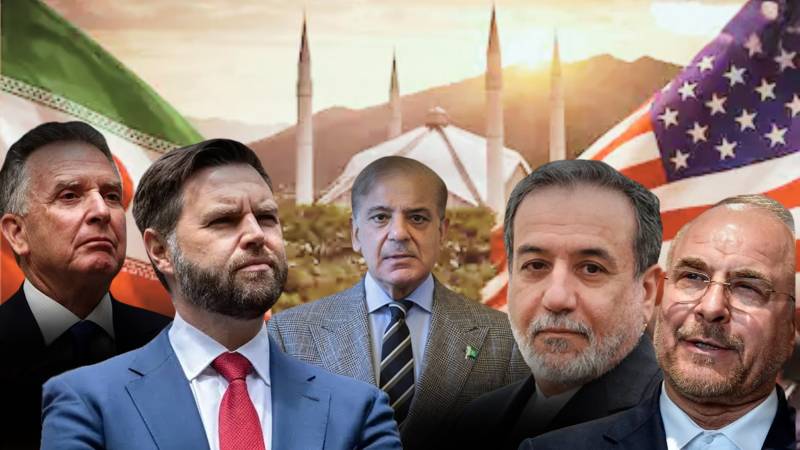
US Vice President JD Vance arrived in Islamabad on Saturday, leading a senior American delegation for unprecedented direct negotiations with Iranian officials, marking the highest-level engagement between Washington and Tehran in decades.
The Iranian delegation, headed by Parliament Speaker Mohammad Baqer Ghalibaf and including Foreign Minister Abbas Araghchi, was received earlier at Nur Khan Air Base by Pakistan’s Deputy Prime Minister and Foreign Minister Ishaq Dar, National Assembly Speaker Sardar Ayaz Sadiq, Chief of Defence Forces and Chief of Army Staff Field Marshal Asim Munir, and Interior Minister Mohsin Naqvi.
The talks are taking place under a fragile two-week ceasefire brokered by Pakistan following six weeks of conflict triggered by coordinated US-Israeli strikes on Iran in February 2026. The war had significantly escalated regional tensions, disrupted global shipping routes, and unsettled energy markets.
Prime Minister Shehbaz Sharif has described the Islamabad negotiations as a “make-or-break” opportunity to secure a permanent ceasefire and prevent further escalation in the Middle East.
The brief but intense conflict began on February 28 after US and Israeli strikes targeted Iran’s military infrastructure and nuclear facilities, reportedly killing senior leadership figures and prompting Tehran to respond with missile attacks and regional operations. These developments disrupted maritime traffic in the Strait of Hormuz and expanded hostilities involving Israel and Iran-backed groups in Lebanon.
Ahead of the talks, Mohammad Baqer Ghalibaf said Washington must honour prior commitments, including the unfreezing of Iranian assets and guarantees over the ceasefire in Lebanon, warning that negotiations would not proceed unless conditions were met. Iran’s proposals also include expanded control arrangements over the Strait of Hormuz, transit toll mechanisms, and a comprehensive lifting of sanctions.
On the American side, JD Vance said he expected “positive engagement” but warned that any Iranian attempt to “play” the United States would be met with a firm response. Washington’s proposed framework includes limits on uranium enrichment, restrictions on ballistic missile development, sanctions relief mechanisms, and the reopening of key maritime routes.
Despite the ceasefire, significant disagreements persist over Iranian access to frozen assets, continued sanctions on its energy sector, and whether the truce fully extends to Lebanon and other regional flashpoints.
Officials say both sides remain far apart on core issues, but the Islamabad talks could lay the groundwork for sustained diplomatic engagement in an otherwise volatile regional environment. Pakistan’s mediation effort has been broadly welcomed internationally as a rare diplomatic opening amid rising great-power tensions.