

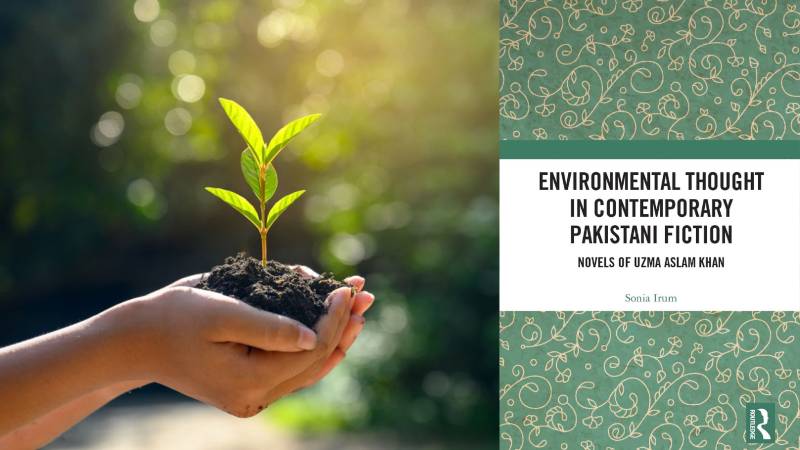
In literary studies, the environment has long existed in the background: often serving as a green backdrop for the main drama of human politics, love, and loss. Over the long twentieth century, however, more scholars have tried to put the natural world at the heart of literary analysis. Yet, these efforts remain rare in work emerging from the postcolonial South, with examinations of Pakistan being even fewer. Sonia Irum’s debut monograph fills this gap with both clarity and conviction.
Her focus is on Uzma Aslam Khan, one of Pakistan’s foremost Anglophone novelists. Irum argues that Khan’s fiction, from The Story of Noble Rot (2001) to Thinner than Skin (2012), binds humans and landscape, gender and geology, faith and fault lines into an ecological vision. Reading Khan through this lens, she presents Pakistan not as a geopolitical flashpoint but as an ecological organism whose crises are both material and moral.
Irum contends that Khan’s novels reveal a distinctive ecocritical consciousness, shaped by legacies of empire, militarism, and modernisation. This is not the preservationism of Western pastoral, nor is it the alarmism of climate fiction. Instead, her ecocriticism navigates the intersection of postcolonial survival and planetary ethics.
Reimagining Ecocriticism
Although Pakistan faces melting glaciers, vanishing rivers, and desertification, its literature seldom foregrounds ecology. Her first chapter, “Postcolonial Ecocriticism,” reconstructs the field’s evolution from Euro-American roots to its “third wave,” associated with Scott Slovic and Joni Adamson, which integrates colonised ecologies into global discourse. Within this frame, Pakistan emerges as a case of “environmental underrepresentation.”
Irum juxtaposes Western environmentalism, Rachel Carson’s Silent Spring, and Wangari Maathai’s Green Belt activism with postcolonial concerns. Western discourse, she argues, often casts the global South as a catastrophe rather than a source of theory. Pakistani writers, internalising that gaze, sometimes reproduce it. As she observes sharply, “While the world and the writers were writing about terrorism, they forgot to address the terrorism done to the land where people live—the home of the people they were writing about.”
Reading Uzma Aslam Khan
Four chapters trace an ecological arc across Khan’s fiction. The Story of Noble Rot is read as a parable of moral and ecological decay, its vineyards and orchards mirroring a corrupted elite. Trespassing (2003) expands the vision to geopolitics: Karachi’s coasts and Punjab’s burnt fields become sites of ecological grief. The title’s resonance, Irum suggests, lies in the multiple trespasses: human, military, corporate, upon the earth itself.
In The Geometry of God (2008), Khan’s palaeontologist heroine Amal unearths fossils while negotiating religious orthodoxy. For Irum, fossil excavation becomes an act of recovering “suppressed histories of the land,” linking knowledge, gender, and faith.
Irum’s criticism nearly becomes moral philosophy, using literature for reflection rather than simple illustration
Thinner than Skin (2012) turns to Pakistan’s northern mountains, where snow leopards and glaciers mirror fragile human attachments. Khan, Irum writes, “gives voice to the nonhuman, the Other,” turning landscape into a moral participant rather than décor. Collectively, these readings establish Khan as “the first woman author from Pakistan to discuss ecological politics in literary works.”
Between Nation and Planet
Irum’s innovation lies in her ability to think on a large scale. She insists that nature must be read not as local colour or national allegory, but as a networked system. Pakistan’s environment is shaped by “intersections of Western imperialism, militarism, state policies, capitalism, consumerism, and global climate change.” Her analysis aligns with the “planetary turn” in literary studies, yet it remains rooted in local textures: rivers, mountains, cities, where greed and hope coexist.
She discusses consumerism as ecological pathology, drawing on Deleuze and Guattari’s idea of libidinal investment to link desire and destruction. Invoking Theodore Roszak’s “epidemic psychosis of our time,” she points to the delusion that humanity owes its planet nothing. At these moments, Irum’s criticism nearly becomes moral philosophy, using literature for reflection rather than simple illustration.
If the study occasionally leans too heavily on theory, it is an understandable excess in a field still consolidating itself. The prose remains lucid, its scholarly scaffolding visible but purposeful.
Literary Activism
One of the book’s strongest claims is pedagogical: environmental awareness begins in the classroom. Drawing on her research at Royal Holloway, Irum insists, “Creative literary writings about the natural environment can become part of the solution.” She imagines curricula where ecocriticism is not imported, but becomes a local method for seeing the land anew.
What distinguishes her work is an ethics of attention, focusing on comparatively neglected writers, overlooked themes, and the silent agency of the nonhuman world
Her conviction is personal. Recalling her return from the UK to an ecologically indifferent Pakistan, she writes, “No positive actions can be taken unless people become aware and active in demanding a healthy living and a natural environment that is safe and sustainable.” Such lines reveal the activist beneath the academic, combining intellectual argument with lived urgency.
In this, she recalls earlier moral critics Arnold, Ruskin, who believed culture could reform perception. For Irum, losing ecological connection is akin to losing part of being Pakistani: patriotism and planetary ethics are inseparable.
Contexts and Comparisons
Placing Irum’s work within the broader South Asian and postcolonial context highlights its novelty. From Arundhati Roy’s The God of Small Things to Amitav Ghosh’s The Hungry Tide, South Asian fiction has turned to rivers and deltas, yet Pakistan has remained largely absent. Irum explains this through politics and language: the country’s global image of extremism and its limited Anglophone output.
Her intervention performs a double recovery: of Khan’s ecological vision and of Pakistan’s place in global ecocriticism. She aligns Pakistani fiction with African and Latin American traditions through concepts such as “ecological debt” and “indigenous knowledge.” The result is a manifesto for a Global South ecocriticism that reads environmental damage as inseparable from colonial and capitalist exploitation. The North, she suggests, imagines the world as a resource; the South, as relation.
The Style of Thought
To write about ecology risks, either moral preaching or abstraction. Irum largely avoids both. Her prose, though academic, has clarity and rhythm. “The natural world … is not just the outer manifestation of the ‘environment’ of human beings, but it also exists in their souls and minds.” This sentence captures the lyrical undertone of her argument and her faith in literature’s moral reach.
At times, she might have pressed harder on form on how Khan’s stylistic opulence complicates her ecological sincerity, but her purpose is foundational, not revisionary.
Toward a New Canon
By its conclusion, Irum’s study has effectively founded a subfield: Pakistani ecocriticism. It identifies an author, defines a corpus, outlines theory, and gestures toward future work. She concludes that Pakistani fiction can “reshape how nature is viewed in contemporary Pakistani society.” Khan emerges as a novelist of border ecologies, exploring glaciers and frontiers, as well as the entanglement of humans and nonhumans.
The book’s apparatus: a six-page bibliography, ample notes, and a full index, confirms its scholarly rigour. Yet it speaks beyond academia. Readers of global environmental thought will find a voice that bridges literature, politics, ecology, and ethics; readers of Pakistani fiction will discover a new interpretive horizon grounded in soil, water, and wind, rather than in religion or geopolitics.
The Ethics of Attention
Amitav Ghosh once wrote that “the climate crisis is also a crisis of imagination.” Irum’s study answers that lament. By placing Uzma Aslam Khan at the heart of an emergent ecological canon, she demonstrates that the imagination of climate thrives beyond the West, in landscapes that have long been ignored.
What distinguishes her work is an ethics of attention, focusing on comparatively neglected writers, overlooked themes, and the silent agency of the nonhuman world. She invites us to read the Pakistani novel not only as a political allegory but as environmental scripture: a record of how people inhabit, exploit, and sometimes redeem the earth.
One finishes the book with gratitude that such scholarship can still be written with moral seriousness and stylistic grace. Environmental Thought in Contemporary Pakistani Fiction reminds us that literature remains one of the few ways by which humanity can think about its place on the planet.
It is, in short, a significant book: one that deserves to be read well beyond its immediate field. Sonia Irum’s study stands as proof that even in an age of climate collapse, the novel continues to imagine the world as both wound and wonder.