

Nationalism has often been portrayed as an ideology of emotion, sentiment, and belonging: a force of unity or division depending on historical context. Yet, beyond its political manifestations, nationalism can also be examined as a dialectical process that evolves through contradictions, oppositions, and syntheses within the life of a nation.
Contrary to the assumption that dialectics and nationalism are in contradiction, they are, in fact, deeply interwoven. Dialectical reasoning, which perceives reality as a process of constant movement and transformation through internal contradictions, allows us to comprehend nationalism not as a fixed doctrine but as a dynamic historical force shaped by material, cultural, and political conflicts.
Dialectics, in philosophy, means understanding change through contradictions. Every idea, society, or system carries within itself opposing tendencies: old versus new, freedom versus control, unity versus diversity. Change happens when these opposites clash and produce something new. The German philosopher Hegel first explained this as a spiritual process, while Karl Marx turned it into a social and material one. Marx showed that history moves forward because of conflicts between classes and material forces, between workers and capitalists, colonisers and the colonised.
When we apply dialectical thinking to nationalism, we see that nations also develop through contradictions. A nation is not a fixed or eternal thing; it is something that becomes real through struggle. Nationalism arises when people who have been divided, exploited, or ignored begin to see themselves as one community with a shared destiny. It carries two forces within it, a struggle for freedom and a search for unity, and these two often pull in different directions.
In history, nationalism has led to both liberation and oppression. It united colonised peoples against imperial powers, but it has also created divisions within countries. For example, the anti-colonial movements in India, Africa, and Latin America were not mere copies of Western nationalism. They were shaped by local realities, the clash between colonial rule and indigenous identity. When people in these regions fought for independence, they were not only demanding political freedom but also trying to rebuild their sense of self and community.
Every generation must reinterpret what the nation means: who belongs, what justice demands, and how to live together
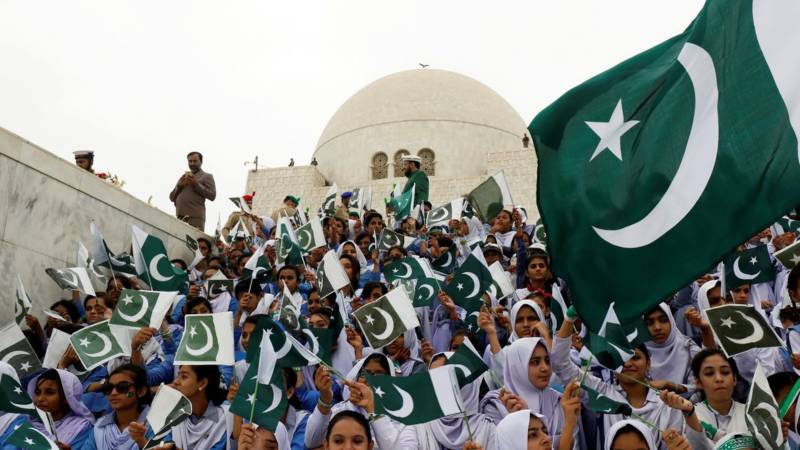
In South Asia, the creation of Pakistan in 1947 reflected a dialectical moment: it was both a rejection of British colonialism and an assertion of a distinct Muslim identity. Yet soon after independence, new contradictions emerged, between centralisation and provincial autonomy, religion and democracy, nationalism and pluralism. These tensions did not mean failure; they showed that Pakistan’s national identity was still in the process of becoming.
If we look at the country today, we can see these dialectics still alive. The people of Balochistan demand greater control over their resources, while those in Khyber Pakhtunkhwa and Gilgit-Baltistan seek recognition and development. Sindh expresses cultural pride through its language and heritage, while Punjab is often seen as the centre of political and economic power. The Urdu-speaking nation in Karachi, with its migration history, brings yet another dimension to the national question. Kashmir, divided and disputed, stands as a painful symbol of freedom incomplete.
Each of these struggles reveals the living contradictions of nationalism, between the promise of equality and the reality of exclusion, between the idea of one Pakistan and the diversity of its peoples. A dialectical view helps us see that these conflicts are not just regional or ethnic problems; they are part of the historical process through which nations evolve. Out of these contradictions may come a deeper, more inclusive idea of what it means to be Pakistani.
The same pattern can be seen elsewhere. In Europe, nationalism grew out of the conflict between feudal empires and the rise of modern capitalism. The French Revolution’s call for liberty and equality inspired nations everywhere, yet it also gave birth to wars of expansion. In Africa, leaders like Kwame Nkrumah and Julius Nyerere used nationalism to unite diverse tribes and languages after colonialism, though their countries later faced internal divisions. In the Arab world, Pan-Arab nationalism tried to merge local and regional identities, but also met contradictions between unity and sovereignty.
Everywhere, nationalism shows this dual character; it unites and divides, liberates and restricts. It can become a movement of justice, or turn into a tool of power. What matters is how societies resolve their internal contradictions.
Dialectics also helps us understand the relation between nationalism and universalism, between love for one’s own people and respect for all humanity. While nationalism stresses the particular “our land, our people”, universalism reminds us that every struggle for freedom is part of a larger human story. When South Asian nations fought for independence, they were not only freeing themselves; they were also affirming the universal value of dignity and self-rule. As Karl Marx said, “A nation cannot be free if it oppresses other nations.” True nationalism, then, points towards a higher form of solidarity, an internationalism that respects the freedom of all.
Nationalism also has material roots. It does not grow from feelings alone but from changes in society, from how economies and classes develop. The shift from feudalism to capitalism, for instance, created modern nations by breaking down small loyalties and connecting people through trade, industry, and the state. But capitalism also produced new tensions, between globalisation and local identity, rich and poor, centre and periphery. These contradictions still shape the politics of nationalism today, including in Pakistan, where economic inequality, regional imbalance, and class struggle continue to influence national debates.
In the end, the dialectics of nationalism remind us that a nation is never complete. It is a living organism, constantly shaped by conflict and renewal. Every generation must reinterpret what the nation means: who belongs, what justice demands, and how to live together. Nationalism is not a static ideology but a moving history, a story of difference and unity, of pain and hope, of becoming and belonging.