

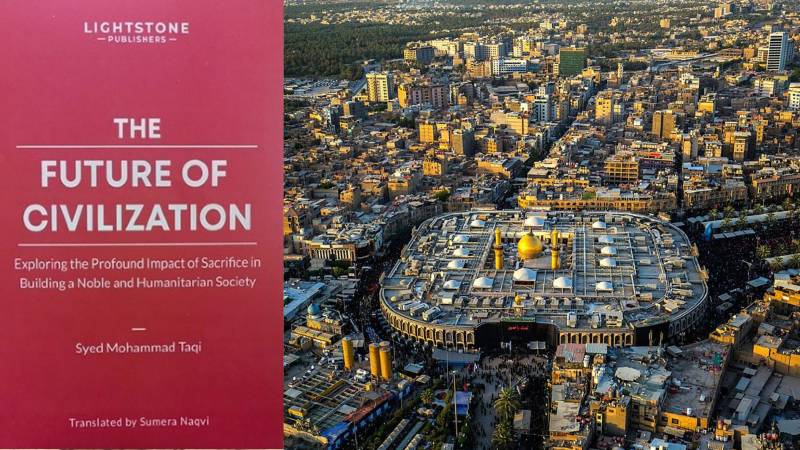
My most recent read is The Future of Civilisation: Exploring the Profound Impact of Sacrifice in Building a Noble and Humanitarian Society by Syed Muhammad Taqi (1917–1999). Taqi, a Pakistani philosopher, intellectual, and writer, left behind a rich body of work covering history, culture, religion, politics, economics, sociology, literary criticism, and constitutional theory. Alongside his intellectual pursuits, he also served as a journalist and editor at Jang for 25 years. His home was renowned for its evening gatherings, which functioned almost like a lyceum, drawing the country’s leading thinkers and writers into stimulating discussions.
This book is a recent English translation of Karbala – Tehzeeb ka Mustaqbil (1980) by his granddaughter, Sumera Naqvi. In it, he constructs an argument for universal morality rooted in civilisational values, using the teachings and symbolism of Karbala as his foundation. The result is both timely and profound, offering reflection on an event that is too often reduced to ritualised mourning and stripped of its intellectual depth.
The translator notes that he leaned toward left-wing values, something visible in his writings. Quoting from one of his articles: “Freedom of expression, as well as freedom of acquiring knowledge and understanding, are on the one hand the assertion of the right of the man to present something from his point of view and on the other hand the realisation of the right of the other man to have free access to understand things from their own position and angle.”
With this spirit in mind, Taqi reinterprets Karbala not simply as a historical tragedy but as a story of civilisational values, retold with fresh understanding and contemporary application. Public discourse around Karbala often stops at lamenting the brutality of Yazid’s regime and praising the innocence and piety of the Ahl al-Bayt (the Prophet’s family). While acknowledging the sheer barbarity of the Umayyad government, he goes beyond conventional narratives. His angle is both nuanced and philosophical, bringing into play broader questions of morality, civilisation, and the future of humanity.
The idea that humans are mere instruments of God’s will and not responsible for their own actions — provided Yazid and his supporters with theological cover for oppression in the daytime and debauchery by night
Drawing on Sartre, he contends that building a solid foundation of values is essential for confronting the crises of the present age. Karbala, in his reading, is not merely an incident in early Islamic history; it is a comprehensive symbol, one whose unique characteristics embody values that can continue to shape civilised societies today. At a time when moral decadence is widespread, his book gains even greater relevance. He writes, “These accounts manifest exceptional maturity and intellect, as evidenced by the decisions made in line with high ethical and civilisational standards.”
The strength of the book lies in how it highlights the rationality behind Imam Hussain’s choices, more so than in retelling the barbarity inflicted upon him. Hussain’s actions become a lesson in conscious decision-making, rooted in ethics, carried out only decades after the Prophet had established Islam as a moral code for society at large.
The author carefully reconstructs the historical setting. In 53 Hijri, Yazid declared his succession and demanded bay‘at (pledge of allegiance). After his father’s death, he intensified pressure on Imam Hussain. Hussain refused. In 60 Hijri, he journeyed to Mecca, and news of this spread quickly, stirring unrest in Kufa, a stronghold of opposition to Umayyad rule. The cruel government’s belief in Qahir o Shar MinAllah — the idea that humans are mere instruments of God’s will and not responsible for their own actions — provided Yazid and his supporters with theological cover for oppression in the daytime and debauchery by night.
A key distinction he makes is between de jure and de facto recognition of government. Imam Hussain never formally pledged allegiance, for doing so would have legitimised Yazid’s rule. At best, there was a de facto arrangement, since Muslims were not yet prepared for an uprising. Hussain’s stance was one of non-aggression: from 26th Rajab, 60 Hijri (679 CE), until 10th Muharram, 61 Hijri (680 CE), he never initiated violence. Had he done so, the symbolism of victimhood against tyranny — central to Karbala — would have been lost. Moreover, aggression would have contradicted the very civilisational values upheld by the Prophet.
Imam Hussain’s sacrifice, however, stands apart. It was not quantitative but qualitative — rooted in value-oriented resistance to tyranny
In the chapter Religion and Society, he discusses the dynamic relationship between the two. A religious society is guided by ideals, and these ideals are grounded in sacred values. Leaders, therefore, must be judged by how they embody and uphold these values. The so-called leader, Yazid, lacked all of them and harboured hatred toward the Prophet. The book notes that Yazid’s hostility toward the Prophet and his family was not a novel phenomenon, but rather a perennial agony. On the outskirts of Damascus, Yazid reportedly recited: “But I said to the crow, whether you croak or not, / I have avenged the Holy Prophet.”
Justice, non-violence, and egalitarianism are near-universal ideals, though their manifestations vary. He adopts a secular mode of reasoning, stressing that while governments influence society, they do not solely define it. Values flow from the bottom up, and religion functions as a civilisational framework that connects individual ethics to collective life. “Religion, in its broader perspective, signifies the viewpoint that an individual receives as he shapes his relationship with the universe, with the help of his environmental influences.”
One of the most striking sections of the book is Taqi’s comparison of the sacrifices of Christ, Socrates, and Imam Hussain. Hazrat Isa (Jesus), according to Christian tradition, was crucified due to his confrontation with authority and the Pharisees, who felt threatened by his teachings. His sacrifice was monumental, though shaped by particular circumstances. On the other hand, Socrates, the martyr of philosophy, suffered execution because of his new moral and intellectual ideas. Unlike Jesus, Socrates did not lead a movement, which, in Taqi’s view, lends his sacrifice a universal philosophical weight.
Imam Hussain’s sacrifice, however, stands apart. It was not quantitative but qualitative — rooted in value-oriented resistance to tyranny. Whereas Socrates had little choice beyond accepting or rejecting execution, Imam Hussain faced a decision: he could pledge allegiance and live, even prosper, or he could refuse and sacrifice not only his life but also that of his family and companions. He chose the latter, affirming the Doctrine of Itmaam-e-Hujjat — the final proof and ultimate decision. In doing so, he transformed Karbala into a timeless embodiment of civilisational morality.
What we can learn is the rationality of Imam Hussain’s stance and its application to daily life. It is, in essence, the Prophet’s teachings carried forward through Imam Hussain and his household in real, lived form. The book provides a moral, religious, cultural, and political analysis of Karbala that is both rigorous and thought-provoking.
Critics may argue against the book’s narrative, pointing to logical gaps or ideological biases. Taqi does systematise heavily, and his perspective is shaped by his intellectual predispositions, as is the case with any author. Yet beneath this lies an erudite humanism, a lens shaped by philosophies ranging from the Greeks to the 20th century, which gives his work depth and significance. It stands as a rare example of rethinking a “religious” event in a way that challenges rote commemoration. Too often we fail to think critically when approaching religion; this work reminds us that reflection, not ritual, is the true path to keeping values alive.