

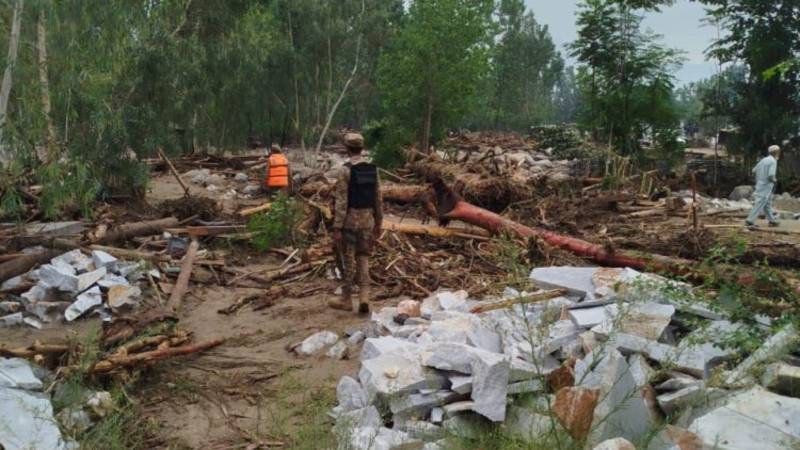
Pakistan’s climate change vulnerability profile highlights a harsh reality: both the immediate and long-term effects of these events are not solely dependent on geography or meteorological conditions. Instead, climate vulnerability unfolds within a sphere of political economy. A complex interplay of resource control, elite patronage, and fragmented institutions shapes the country’s climate vulnerability. Additionally, entrenched hierarchies, historical marginalisation, and weak governance significantly determine the scale of suffering and the speed and equity of recovery.
The convergence of water scarcity, conflict, and chronic underdevelopment defines the climate vulnerability of Balochistan. Naseerabad district’s greenbelt was severely affected by the 2022 floods, but bureaucratic delays, diversion of funds, and tribal animosities have hindered reconstruction and adaptation interventions. The prolonged drought in the arid uplands drives migration and heightens competition over rangeland and groundwater, where the traditional tribal governance system mediates access in ways that sideline marginalised groups. The province’s insurgency dynamics, overlaid with climate shocks, further constrain relief efforts, leaving many communities dependent on delayed and inadequate assistance.
Mountainous terrain, high ecological sensitivity, conflict, and an informal governance system of the Jirga characterise disaster response in Khyber Pakhtunkhwa. The northern highlands experience faster glacial melt and precipitation anomalies, leading to GLOFs and flash floods. The route to climate adaptation financing passes through political constituencies of the province, conveniently bypassing those who do not have the ‘right’ political alignment. Jirgas often mediate disputes in the aftermath of climate shocks, but reinforce pre-existing social inequities due to exclusionary practices against women and weaker clans. The drought-prone southern districts are witnessing accelerated migration towards urban centres. This intensifies competition over water, land, and employment, while non-transparent land allocation, coupled with the warabandi system, leaves many climate migrants exposed to exploitation. The persistence of terrorism further impedes sustained investment in climate resilience.
Pakistan’s climate security will be determined less by advancements in meteorological modelling than by the equity of its governance
Punjab presents an equally critical configuration of climate-related political economy. The province’s recurring winter smog is rooted in cross-sector governance failures. Vested interests in construction, energy, and transport undermine emissions control efforts. The riverine belts of the province experience monsoon flooding, yet infrastructural investments in embankments, drainage, and early warning systems tend to concentrate in constituencies with greater political and economic influence. Urban flooding and heatwaves are other faces of climate change which disproportionately affect underdeveloped neighbourhoods, smallholders lacking access to irrigation, labourers, and cart vendors. This underscores the skewed distribution of climate adaptation infrastructure towards commercial agriculture and politically connected elites.
Lastly, the intersection of climate pressures with entrenched land tenure arrangements and contested water governance is visible in Sindh. The historical floods in the lower Indus Basin have now become much more than mere hydrological events, frequently influenced by powerful waderas and political intermediaries. Flood resilience in the province reflects an arena of political negotiation over embankment breaches, canal operations, and relief allocation. Moreover, feudal ownership of extensive agricultural lands restricts adaptation measures such as crop diversification or flood-resilient housing from reaching sharecroppers or tenant farmers. Additionally, Karachi and other urban areas present strong pull factors to rural climate migrants. They increasingly settle in informal and underdeveloped communities where access to basic services is mediated through political patronage networks.
Instead of empirical assessments of climate risk, it is political incentives which shape adaptation, resilience, and mitigation strategies throughout Pakistan. Disaster management agencies operate with constrained autonomy, relying on volatile political priorities and donor-driven projects that rarely align with long-term resilience needs. Formal and informal governance systems coexist, often undermining one another. Tight and highly centralised bureaucratic control over resource allocation further exacerbates post-disaster deprivation. This produces a climate governance framework in which vulnerability is determined as much by the distribution of authority and resources as by environmental exposure. Channelling adaptation finance through elite-dominated systems risks perpetuating inequities, while mitigation suffers from selective enforcement that shields politically connected polluters and penalises weaker actors.
Breaking this cycle demands a transition from reactive crisis management to proactive, conflict-sensitive climate governance. It requires resource allocation based on transparent vulnerability criteria, the integration of local knowledge into adaptation planning, and the inclusion of women, youth, and marginalised communities in decision-making. It also calls for the strengthening of provincial and district institutions and local governments to enable coordination with community-level structures, coupled with an honest reckoning with the political determinants of climate protection.
Pakistan’s climate security will be determined less by advancements in meteorological modelling than by the equity of its governance. Addressing elite capture, patronage politics, and institutional fragmentation is essential if climate policy is to be transformative rather than superficial. In an era of accelerating climate change, survival will hinge not solely on scientific capacity but on recognising climate risk as an urgent question of distributive justice.