

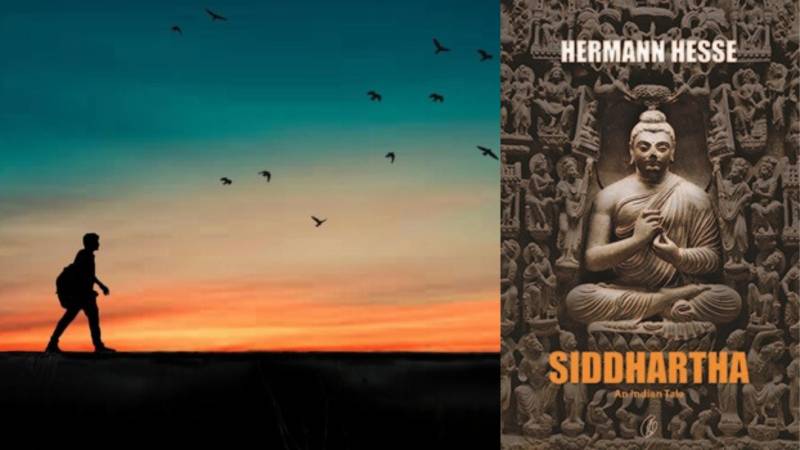
I’ve read Hermann Hesse’s Siddhartha three times. Once when I was just out of school, full of questions and vaguely certain that the world owed me some kind of truth. The second time, I was in my twenties, ticking all the right boxes in life and still feeling strangely hollow. The third time, more recently, I didn’t go looking for the book. It found me again. And, as usual, it didn’t yield any grand revelations. But it gave me something better: space to breathe and a quiet reminder that the answers I’m chasing might not be out there at all.
What strikes me about Siddhartha is how deeply personal the journey is. It’s not a spiritual manual. There’s no checklist to follow. Siddhartha walks away from everything people told him was sacred: religion, teachers, even love. Not because he’s arrogant, but because none of it feels real to him. He wants to experience life for himself. He wants to know, not just believe.
There’s something in Siddhartha that continues to mirror the times we live in. Surrounded by advice, flooded with content, constantly told how to be better, calmer, happier – yet somehow we never find true satisfaction. Siddhartha’s decision to leave even the Buddha’s teachings because “no one is granted deliverance through a teaching” felt almost shocking the first time I read it. But with time, I understood that he wasn’t rejecting wisdom. He was rejecting borrowed wisdom. He realises that teachings, no matter how perfect, cannot substitute for personal experience.
By the end of the book, Siddhartha has lost people he loved. He’s seen his dreams collapse. But he’s also found something he never had at the beginning: peace
Later, he falls into wealth and pleasure with Kamala and Kamaswami, until success numbs him. He becomes a man of the world: well-fed, respected, even admired – but inwardly empty. “Slowly the soul sickness filled him,” Hesse writes. Isn’t it true that many of us have experienced the same sickness in our daily routines, always in pursuit of “meaning” beneath outward success?
There’s a moment later in the book that stays with me. Siddhartha, now older and having lived a life of both extreme self-denial and extreme pleasure, says: “I have had to experience despair, I have had to sink to the greatest mental depths, to thoughts of suicide, to experience grace.”
It’s brutally honest. And it’s so real. Because growth isn’t always a climb. It’s often a spiral. We fall, we lose ourselves, we break down. And sometimes, only then do we start to really see.
One of the most powerful moments in the book is when Siddhartha, now living by a river, reflects on how he no longer feels the need to judge others.
“It is not for me to judge another life,” he says. “I must judge for myself, I must choose, I must refuse.”
That line has echoed in my mind more times than I can count, especially when I catch myself measuring my path against someone else’s. It’s a reminder that understanding doesn’t come from standing above people. It comes from walking one’s road without resentment or comparison.
What makes Siddhartha so different from other spiritual stories is that it never pushes one towards perfection. It shows a man who fails repeatedly. Who becomes vain, selfish, and even cruel at one point. But that failure is not wasted. He learns through it – not instantly or dramatically, but slowly. Like water shaping stone.
And speaking of water, the river is probably the book’s most important character. It doesn’t teach Siddhartha with words. It just exists. Always moving, always present, holding all opposites together: joy and sorrow, birth and death, past and future. The river teaches him what no person could. And it reminds me of something that we forget too often: that silence, too, has a voice. That's not everything that has to be solved. Some things just have to be seen.
By the end of the book, Siddhartha has lost people he loved. He’s seen his dreams collapse. But he’s also found something he never had at the beginning: peace. Not the kind of peace we brag about or post online, but the quiet kind that settles in the chest when one stops running.
When people ask why I reread Siddhartha, I never quite know how to answer. It’s not a thrilling story. It doesn’t offer life hacks. But it does something else. It reminds me that I don’t have to have it all figured out. That maybe I’m not supposed to. That maybe the point is to live, to listen, to fall and rise again. Not in pursuit of some grand enlightenment, but simply to be whole.
And in a world that’s constantly rushing towards the next thing, that feels like more than enough.