


The title is a direct quote from the Government of Pakistan’s Economic Survey 2024-25. Sadly, Pakistan has been stuck at the crossroads of history ever since independence.
A video interview with veteran journalist Jehangir Khattak about Pakistan’s economy prompted me to refresh my knowledge of the subject. Here’s what I found.
According to the government’s economic outlook, the economy, as measured by GDP, grew during the last fiscal year, 2024-25, by 2.68%. This is half of the average annual growth rate of 5.31% since 1961.
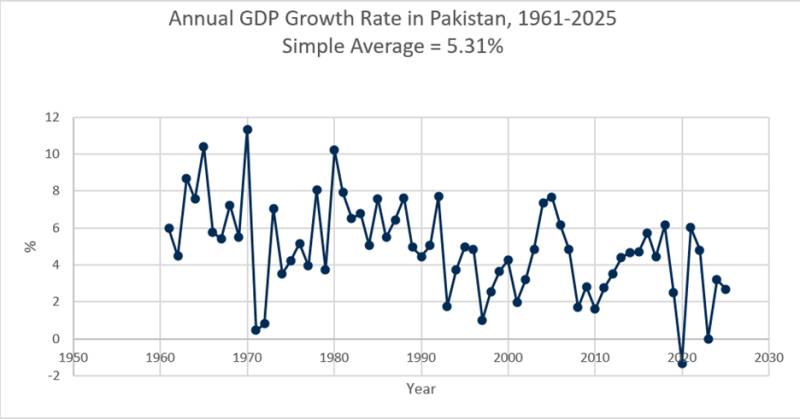
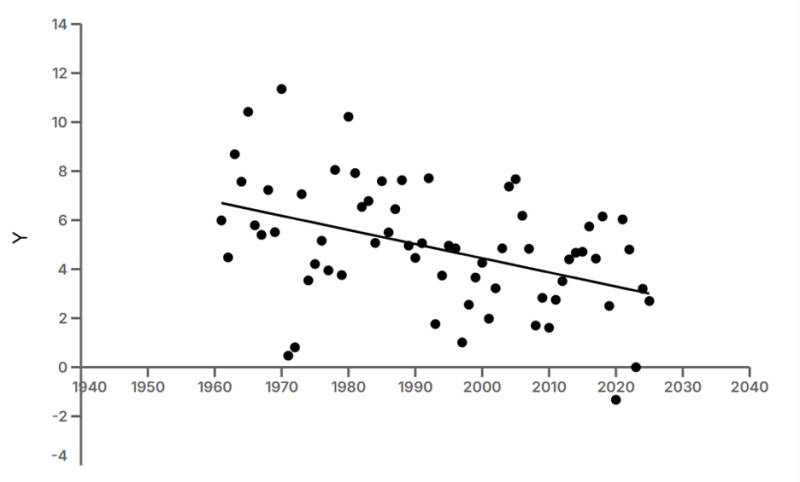
Growth during this 64-year period has been erratic. Furthermore, it shows a declining trend, which is confirmed by a simple regression analysis.
The government is predicting that GDP will grow by 4.2% during the next fiscal year but the IMF has already revised it downwards to 3.6%.
Population grew by 1.5% last year, while the populations of Bangladesh and India grew by 1.2% and 0.9% respectively. For developing countries, high population growth rates are a net negative. Yet Goldman Sachs predicted Pakistan would become the world’s sixth largest economy by 2075.
I critiqued it and said the only way that would come to pass is if Pakistan “acquires the characteristics of the Asian Tigers. To do that, it would have to raise its investment rate, boost exports, reduce foreign debt, create a budget surplus, and lower defence spending. It would have to liberalise the economy with significant incentives for private enterprise and a modicum of red tape, have a booming tech sector and domestic harmony, and become part of a free trade zone in South Asia.”
Pakistan has been plagued with trade and fiscal deficits for years. During the last fiscal year, imports were $59.1 billion and exports $32.1 billion. Remittances from abroad, most of which come from Saudi Arabia and UAE, amounted to $38.3 billion, saved the day.
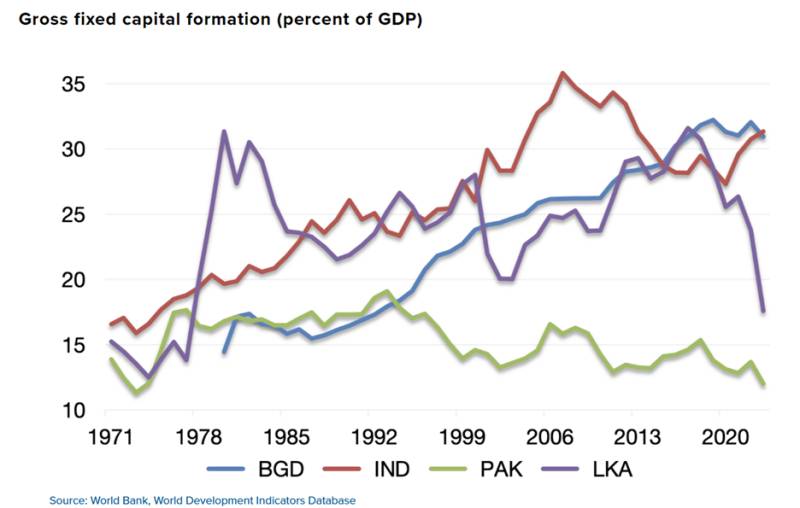
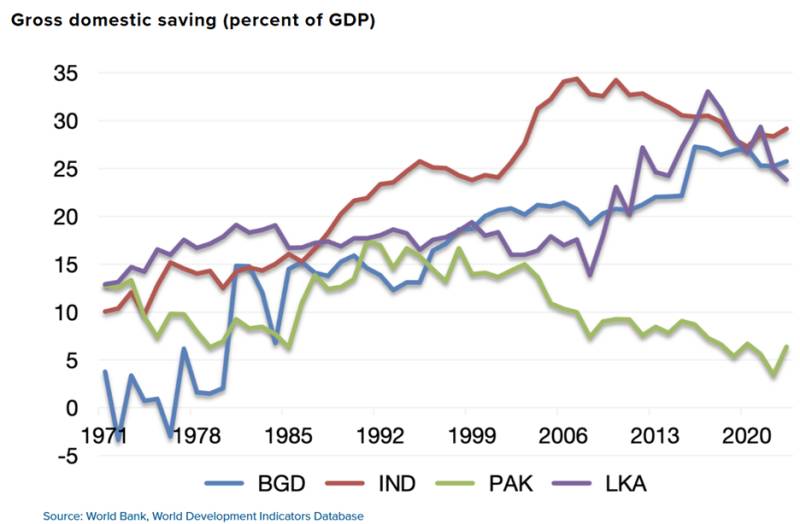
Investment’s share of GDP for Pakistan was 13%, compared to around 30% for both Bangladesh and India. Savings share of GDP for Pakistan was even lower, at 6%. For Bangladesh and India, it was around 30%. For China, the percentages are around 40%.
The tax base is very narrow. Nearly eight decades after independence, agricultural incomes continue to be exempt from taxes
Writing on “Rescuing Pakistan’s Economy” for the Atlantic Council, Aamir Husain compares Pakistan’s rates of investment and savings over time with that of India, Bangladesh and Sri Lanka. The comparison is stark on both metrics, especially after the 1990s.
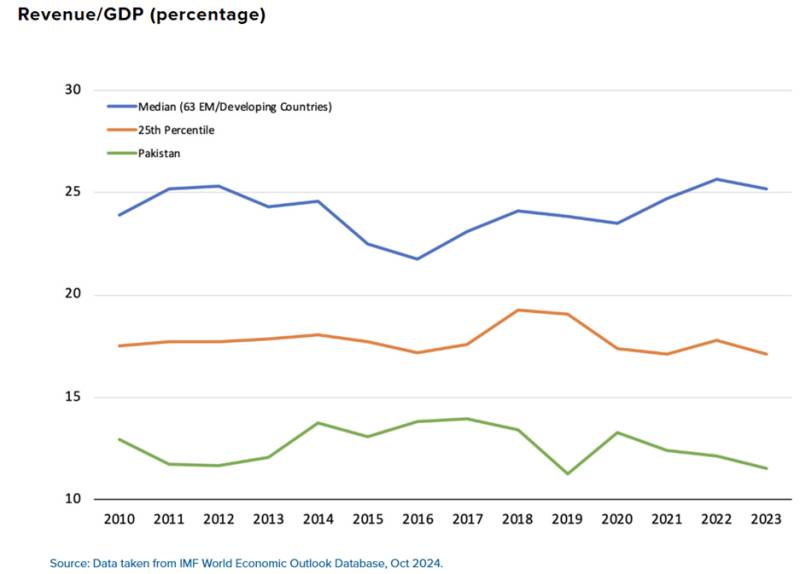
Pakistan’s tax rate is around 10%, way less than the median for 63 developing economies. The tax base is very narrow. Nearly eight decades after independence, agricultural incomes continue to be exempt from taxes.
It’s difficult to imagine Pakistan turning into an “Asian Tiger.” However, a few years ago a prominent economist penned a book which envisions that Pakistan will become an Asian Tiger by 2050.
The country would be transformed by a “home-grown and crowd-sourced phenomenon” which brought together “professional groups across the country into an umbrella organisation, research for Pakistan. This provided a platform through which networks carried out their research and advanced their intellectual and knowledge base. The result was a country characterised by decentralisation, urbanisation, a high degree of literacy, no budget deficits and a surplus in the balance of payments.”
Furthermore:
“There were checks and balances on the federal government and on the authority of the prime minister. No military dictator ruled the roost. Indeed, the army had no visible presence in the affairs of the country, domestic or international. And the scourge of fundamentalism was erased.”
In other words, the country would reinvent itself. There is no indication that such a scenario, much less the Goldman Sachs Scenario, is in the works. The country is dominated by vested interests.
According to the World Bank, 45% of the Pakistani population lives below the poverty line. To remedy the situation, it will provide $40 billion in loans to Pakistan. While that sounds great, how will Pakistan repay that staggering amount?
Pakistan has accumulated an external debt of nearly $90 billion. Debt servicing, which stands at $29 billion, consumes nearly half of the government’s budget.
Adding further to the indebtedness, the IMF will provide a loan of $7 billion, repayable in 37 months. This is the 25th loan from IMF.
Compounding the situation, Pakistan has nearly doubled its spending on defence in just the past five years. In 2020-21, $4.53 billion was allocated to defence. In the current budget, the number has risen to $9 billion.
Military expenditures divert scarce resources that could be used to reduce poverty, enhance literacy, improve health and raise the labour force participation rate. The “Guns v Butter Tradeoff” has not disappeared, as claimed by a former national security advisor.
Pakistan has 170 nuclear weapons versus India’s 180. Despite the nuclearisation of the Subcontinent, there has been no nuclear dividend. Even if the two nations, consumed forever by sibling rivalry, did not have nuclear weapons, Pakistan could reduce the size of its armed forces by a third and still maintain an adequate defence posture against India. As John Mearsheimer and others have argued, the invading country needs to have a 3:1 advantage in conventional forces to win. With nuclear weapons, it should surely be able to cut defence spending.
But any push in that direction always runs into political headwinds. The time has come for Pakistan to normalise relations with India and convert the Line of Control in Kashmir into an international border. Only then will it be able to rationalise defence spending.
Pakistan should also stop funding guerilla fighters to mount special operations in neighbouring countries. Such expenditures unleash forces that the government cannot control. Ongoing violence in the two provinces bordering Afghanistan and Iran proves that point.
Once that happens, the future envisaged in the Economic Survey might come to pass. “Through disciplined implementation of policy and strategic guidance anchored in a long-term vision, URAAN Pakistan, which emphasises export-led and investment driven growth, has the potential to cultivate a resilient, inclusive, and prosperous economic future.”