

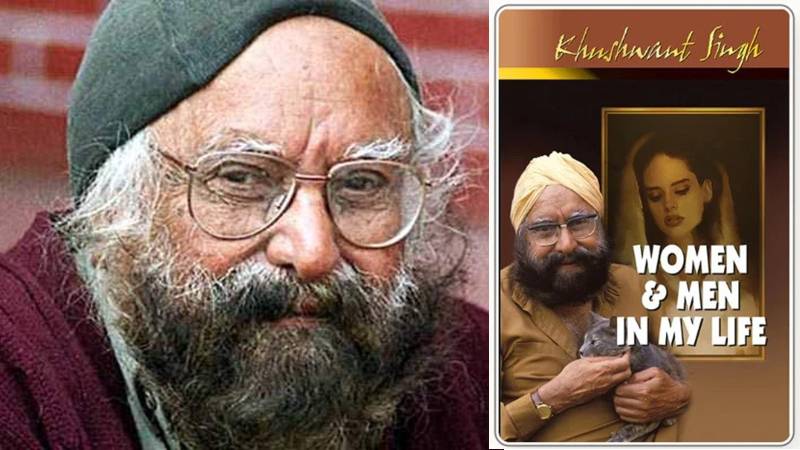
There are a few books that are read twice, and even fewer that are really relished on a second reading. Khushwant Singh’s works belong to the prestigious latter category, and I assure you, their meanings grow richer with every reading. Born in 1915 in what is now known as Hadali, Pakistan, Singh had a diverse career spanning law, the foreign service, journalism, and, of course, writing. He authored more than a hundred books, many of which brought him international acclaim, including his searing and haunting novel Train to Pakistan, set against the backdrop of the Partition of the Subcontinent.
Singh had a remarkable way with words and would soon win over the affection of those whom he met. On such people, he wrote a complete book titled Women & Men in My Life to show how deeply he cherished the presence of certain individuals in his life, and to settle scores with others. Once you are through it, you find yourself a completely different person. As a reader, you thank your stars for having bought this book; as an aspiring writer, you are in awe of Singh’s writing style. Candidly honest, sharply witty, rich in idiomatic expressions, and sophisticatedly and unapologetically frank in its treatment of politics and sex, There is never a dull moment in Khushwant Singh’s portrayals of human beings.
The book is divided into two sections: part one is about women, part two about men. There are twelve women with whom Singh had relations in different capacities during his life. Some relationships were uncharacteristically ephemeral, while others stayed with him until his last breath. It is the latter whom Singh remembers very fondly and, in a way, acknowledges that they had a significant say in his personal and private matters of life. One of these women is Sadia Dehlvi. Singh writes, “There was nothing I could think of saying to her except blurting out, ‘Why are you so beautiful?’” They enjoyed an ideal liaison, quite rare even in those times. Living in Delhi, when Sadia eventually decided to tie the knot with a Pakistani man, Singh recalls that he was among those who “signed the nikahnamah as a witness to her consent to marry Reza.” He thought that Sadia’s marriage and her decision to move to Pakistan would lead to a cooling of their affection and that she would simply walk out of his life. Sadia proved this assumption wrong, and they invariably stayed in contact. Keeping in view the matchless bond that they shared, Singh also dedicated his book Not a Nice Man to Know to Sadia, whose dedication reads: "To Sadia Dehlvi, who gave me more affection and notoriety than I deserved."
Candidly honest, sharply witty and unapologetically frank in its treatment of politics and sex, there is never a dull moment in Khushwant Singh’s portrayals of human beings
The other unassuming woman who briefly remained a part of Singh’s life and influenced him positively was Ghayoorunnissa Hafeez. Initially, she was a classmate of Singh’s sister, and he came to know her when she was invited to their home to spend a weekend with them. Her reticent yet pluralistic attitude changed his thoughts towards Islam and her community. He writes, “Why I regard my brief and near-platonic relationship with Ghayoor as an important landmark in my life is that she changed my attitude towards Muslims.”
One more woman who deserves to be mentioned here is Nirmala Mathan, mainly for her sharp instincts and dedication to her passions. Once Singh and Mathan were sitting in a restaurant when a violinist came towards their table. Singh could not think of more than a handful of old tunes, but she surprised him. She began singing along to the violinist’s tunes, and soon the empty restaurant was filled with a crowd. On another occasion, when Singh was leaving Bombay to return to Delhi, Mathan gave him a large photograph of herself. During her visit to Delhi, Singh invited her over for lunch. That morning, he placed her photograph in his study to pretend it had been there ever since he received it. He writes, “See, Nirmala, where I keep you?” I said. She saw through the ruse. “You are a liar,” she said. “You put it there this morning. You can’t fool me so easily.”
Similarly, there are fifteen sketches of men. Oddly enough, Singh’s descriptions of the men he stayed close to are equally impressive, spellbinding, and sharp-witted. But I must assert that he is a tad less sparing in his treatment of men. His sketch of Inder Sain Johar is particularly scathing and lacks restraint. At the same time, he holds Balwant Gargi in high esteem for his expertise in Punjabi prose writing. Singh praises Gargi and writes, “He handled the Punjabi language better than most writers of prose and spiced his narrative with wit, sarcasm and acid humour.” He also believed that Gargi was an uncommon litterateur and raconteur and, during the days of bonhomie, encouraged him to write in English to reach a wider audience at home and abroad.
The only human being whom Singh accorded the highest level of reverence and for whom he did not use a single defamatory adjective was his lifelong friend Manzur Qadir. As was his wont, I expected that Singh would have certainly written something ignominious or mortifying about him. But Qadir’s personality and traits commanded respect even from Khushwant Singh, which is quite surprising, and their camaraderie continued long after the Partition of the subcontinent. Singh writes, “Manzur died some fifteen years ago in London. Whenever I visit Lahore, one of my top assignments is to visit his grave, strew rose petals on it, recite the Fatiha, and shed some tears.”
All other sketches are eminently interesting. I wonder how easily he could see both the best and the worst in the people he met and write so captivatingly about them. Had life been a bit kinder and allowed Khushwant Singh a few more years, he would have produced more chefs-d’œuvre.