

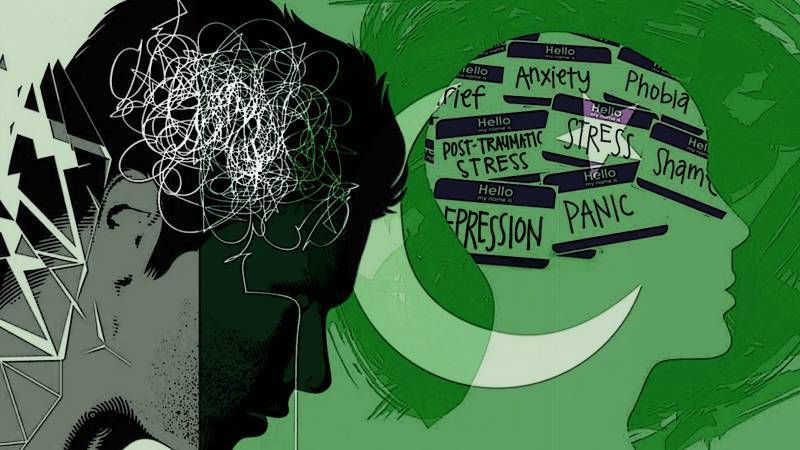
Pakistan’s mental health landscape is quietly crumbling under the weight of stigma, underinvestment, and societal neglect. Here, taking insulin for diabetes or medication for blood pressure is routine, yet seeking help for depression or anxiety is still seen as a weakness—not a necessity. Public understanding usually subscribes to parochial and outdated constructions. As a result, millions continue to suffer in silence, with little awareness and even less access to meaningful support.
This burden is not unique to Pakistan. Global insights from the Mental State of the World Report 2024 serve as a wake-up call. Analysing over a million responses across 82 countries, the report paints a troubling picture: while older adults (55+) maintain a relatively stable level of mental functioning, with an average MHQ (Mental Health Quotient—a metric reflecting a person’s ability to manage life stresses and function productively) score near 100, young adults aged 18 to 34 have been disproportionately affected. Their global average MHQ is just 38, and a staggering 41% experience functionally debilitating distress. The pandemic may have faded, but its psychological aftershocks continue to reverberate.
Pakistan is no exception—in fact, it may be uniquely vulnerable. In a country where 64% of the population lives in rural areas, access to mental health professionals is a rarity. One in four Pakistani adults will face a mental health issue at some point in their lives—a number comparable to the entire populations of countries like Saudi Arabia, Ukraine, Malaysia, or Yemen.
Yet mental health understanding remains dismally low. The Milkar Baseline Survey of over 1,350 people reveals that only 24% could correctly define mental health. Meanwhile, 25% equated it with financial stability, and 41% did not know which professionals are authorised to prescribe medication.
When asked about causes of mental health issues, 37% pointed to behavioural habits, 36% to environmental stressors like poverty, 21% to early life experiences, while just 11% acknowledged biological or genetic causes. A striking 17% didn’t know at all. This reflects a persistent neglect of scientific explanations and a tendency to reduce mental health to individual choices or circumstances.
Signs and symptoms are equally misunderstood. 59% identified emotional symptoms like sadness or anxiety, but fewer were aware of physical indicators like sleep disruption or changes in appetite and energy. Only 14% recognised the role of relationships or social support networks in shaping mental health—indicating a major blind spot in understanding its social dimensions.
Unlike physical health systems, which have at least some institutional recognition, mental health infrastructure in Pakistan remains chronically underfunded and politically neglected
Access remains deeply unequal. Just 3% had sought professional help in the past six months, relying instead on informal strategies. Only 26% were aware of helplines, 40% knew of psychiatrists, and 47% cited hospital-based services—figures that highlight informational and infrastructural barriers, especially for rural and low-literacy populations.
Pakistan has one of the lowest psychiatrist-to-population ratios globally: one psychiatrist for every 270,000 people. By contrast, the American Psychiatric Association recommends at least one per 10,000.
Stigma continues to dominate the social landscape. 70% associate mental illness with weakness or danger, and 42% believe individuals with mental health issues cannot lead functional lives. Among those with lived experience, 63% reported feeling judged, while 59% said they were told they were “overreacting.” These attitudes—shaped by gender, education, and culture—reinforce silence and isolation.
Women, in particular, face gender-specific barriers: restricted mobility, cultural expectations, and greater stigma make it even harder for them to seek help. Many turn to spiritual practices or rely on close-knit social networks rather than formal care.
Despite these challenges, some encouraging signs are emerging. 92% of respondents believe society should adopt a more tolerant attitude toward people with mental health issues. 59% believe in the effectiveness of therapy and self-care. Behavioural responses, while largely informal, also show promise: 37% turn to spiritual practices like prayer and meditation, 32% focus on physical wellbeing through sleep, diet, and exercise, and 30% rely on social connections.
Acceptance is growing too: 70% say they would live with a family member with a mental health issue, 63% are open to relationships with such individuals, and 57% would work alongside them. These positive attitudes cut across gender but correlate strongly with higher education levels.
The mental health crisis is also generational. Young people, in particular, are bearing the brunt. Global trends and local realities show that symptoms like obsessive thoughts, detachment from reality, and impaired social interaction have risen dramatically among this cohort. The same youth who will shape Pakistan’s future are navigating a labyrinth of mental fatigue without maps or guides.
The root causes are not hard to spot: an overwhelming digital culture, increased social disconnection, economic uncertainty, academic pressure, environmental stressors, biological roots, and the aftershocks of a pandemic that disrupted lives and routines. Unlike physical health systems, which have at least some institutional recognition, mental health infrastructure in Pakistan remains chronically underfunded and politically neglected.
Pakistan now needs a multi-pronged, systemic strategy to turn intention into infrastructure and care.
First, mental health must be integrated into primary care. Training general practitioners and community health workers to screen, counsel, and refer patients would reduce the load on specialists and make care accessible even in remote areas.
Second, education is key. School-based mental health programmes must become part of the national curriculum—not as an add-on but as a core subject. Studies show that early intervention through emotional intelligence training, resilience-building, and safe spaces for expression can significantly improve long-term outcomes.
Third, Pakistan must invest in its mental health workforce. This means expanding training programmes for psychologists, therapists, and counsellors—and incentivising them to work in underserved regions. Telepsychiatry, if expanded thoughtfully, could bridge gaps in access where physical infrastructure is lacking. This also necessitates fiscal interventions—with a substantial, earmarked budget—especially given the scale of the crisis and Pakistan’s chronically low health expenditure.
Fourth, digital platforms must be regulated and used wisely. While overuse of social media and smartphones is linked to deteriorating mental wellbeing, these tools can also be leveraged to deliver therapy, psychoeducation, and community support—especially to youth.
Fifth, we need a massive reorientation of research funding. Mental health is not just a service delivery issue—it’s a science and policy challenge. More data is needed to understand how economic, environmental, and social factors uniquely shape mental wellbeing in Pakistan. And more importantly, this data must guide policy.
Additionally, psychologists themselves are not regulated in the same way as medical doctors or dentists. A proper accreditation framework is urgently needed to ensure that certified practitioners meet globally recognised standards of training, ethics, and care. This would not only build trust but also protect vulnerable patients from unqualified or exploitative providers.
Finally, we need to talk. Openly. Frequently. Relentlessly. Language matters. Representation matters. Role models—including artists, athletes, educators, and politicians—must step up to normalise vulnerability and encourage help-seeking.
Pakistan is facing a silent emergency. And silence is its greatest ally. We can break it—not with pity, but with policy; not with tokenism, but with transformation.