

There are events in history that refuse conclusion. They resist chronology, elude closure, and remain not as episodes but atmospheres. Karbala is one such event, not merely a battle of 680 CE but a grammar of grief, a poetics of refusal, a vocabulary through which oppressed humanity names injustice. It is where history becomes symbol and symbol becomes ritual, carried across centuries in lamentation, poetry, procession, and memory. One does not read Karbala; one enters it. A small caravan stands against an empire; a thirsty child faces the armies of abundance; a man refuses allegiance to power that has forfeited moral legitimacy. Victory loses its meaning. The defeated becomes the measure of the right.
Husain in Karbala is not merely a historical figure. He is a category, the embodiment of ethical refusal against tyranny. Yazid is not only a ruler but the allegory of sovereignty severed from justice. Every generation revisits this polarity and decides where it stands. The moral dramatisation at Karbala persists because martyrdom is the paradox of conscience. The martyr dies, but remains; the tyrant survives, yet is haunted by shame. Husain’s death is an annihilation that transforms into an ethical triumph, vulnerability becoming authority. In this sense, Karbala is less a religious event than a metaphysical meditation on power. Once a historical wound outgrows its archive, it becomes myth, not as falsehood, but as intensified truth. Myth here means memory thickened into meaning.
In Persian marsiya, in Urdu elegy, in Bangla puthi, in Muharram processions where the body beats time like a drum, Karbala has travelled across languages, sects, and geographies. A mother learns grief through Zaynab before she learns theology; a poet invokes Husain to speak against dictatorship; a young man in Kashmir reads Karbala to understand loss. Wherever injustice is remembered, Karbala resumes. It is a tent pitched inside the conscience.
A Play at the Crossroads of History and Memory
Premchand arrived at Karbala in 1924, in a subcontinent that stood trembling between possibility and fracture. Nationalism swelled, but so did communal mistrust. Hindi and Urdu became markers of separation rather than shared heritage. In this climate, Premchand, Hindu by birth and humanist by imagination, took up the story of Husain not as archive but as future. His Karbala sought to translate Islamic memory into the fabric of Indian ethics. Rather than a Muslim past, he wrote Karbala as a shared inheritance. What he staged was not history alone; it was the dream of India before the dream was broken.
Translation is the hinge of this entire encounter. Superficially, translation is linguistic transport. More deeply, it is trespass, a re-embodiment of grief into another tongue. Karbala demands such trespass. Each retelling bleeds anew; each translation risks either dilution or ignition. When Karbala entered Hindi and then Urdu through Premchand, it entered the idea of India. Its passage was political. It declared that Husain is not sectarian property, but ethical patrimony.
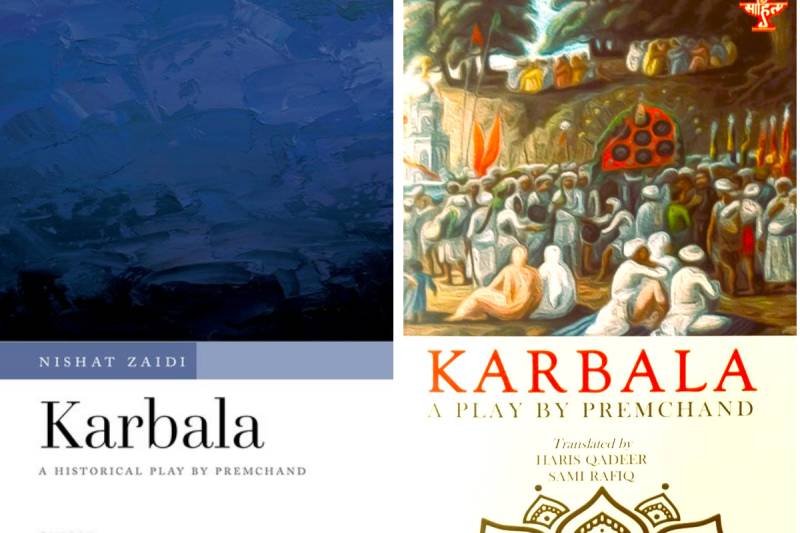
Nearly a century later, two English translations return this play to public conversation: Nishat Zaidi’s edition from Oxford University Press (2024) and the Sahitya Akademi translation by Haris Qadeer and Sami Rafiq (2025). Their arrival coincides with a moment in which history, religion, and citizenship are once again under contest. The India of our present is not the India Premchand hoped to heal, and that gap gives his play its revived urgency.
Premchand’s play is less a dramatisation of a medieval tragedy than an intervention in modern politics
To read Karbala in English today is to ask uncomfortable questions. What does it mean to invoke a story of resistance in a time when dissent is often equated with disloyalty? How do we remember Husain when remembering itself becomes suspect? When democratic structures embrace majoritarian logic, when speech is policed, when history is rewritten into singular memory, Karbala returns as counter-history. And thus, we must ask: why does Premchand’s Karbala still matter to India today?
Karbala, Premchand, and the Indian Imagination
Premchand’s play is less a dramatisation of a medieval tragedy than an intervention in modern politics. Set against a backdrop of Khilafat, communal riots, and colonial anxiety, Karbala uses an Islamic epic to imagine a plural nation. Husain’s refusal of Yazid becomes the metaphor for resistance under the empire. Each martyr, Ali Akbar, Abbas, Qasim, infant Ali Asghar, is ritualised like a stanza in an elegy. Women, especially Zaynab, do not merely grieve; they witness, turning memory into a weapon. The poetry within the play, the refrains of lament, the cadence of dirge, create an affective architecture through which the audience lives the tragedy rather than observes it.
Premchand was too shrewd a dramatist to rely on history alone. He knew history rarely moves conscience unless refracted through story. His boldest gesture is the inclusion of Hindu warriors standing by Husain. This is not decorative secularism; it is an ethical proposition that justice is not the property of one community, that grief can be shared, that sacrifice crosses faith. This vision sacralises secularism by embodying it. The desert becomes a mirror in which colonial India sees itself, and in which contemporary India might yet see what it has forgotten.
Time behaves in Karbala like grief, looping and resisting closure. The play does not move from exposition to resolution; it unfolds as heartbreak, each scene another ripple in sorrow. The stage simulates ritual. The audience is drawn not to analysis but to participation. One does not watch Karbala neutrally; the play forces alignment, as history did. Silence becomes complicity. To stage the play is to ask the audience to choose whether it stands with Husain or with power. In this theatrical demand lies Premchand’s moral radicalism.
A century on, the play feels prophetic. The plural India it dreamed is now embattled by majoritarian rhetoric that seeks cultural unison over multiplicity. In such a climate, Premchand’s Karbala performs two preservations simultaneously. It preserves Karbala for India, refusing to relegate it to sectarian memory, and it preserves India for Karbala, insisting that shared suffering is the ground for a shared future. To revisit Karbala today is less homage than intervention.
Reading the Translations: Two English Voices for One Fire
When Karbala enters English, its task shifts. English, colonial in history and bureaucratic in the present, must learn lamentation. It must unlearn neutrality. The translator must not only render dialogue but carry the tremor of sacrifice. Zaidi and Qadeer accomplish this through distinct sensibilities.
Nishat Zaidi’s translation (Premchand. Karbala: A Historical Play. Oxford University Press, India, 2024) is scholarly and careful, architectured with introductions, annotations, glossaries, and contextual scaffolding. She opens the text patiently to readers unfamiliar with Islamicate traditions. Her language is precise, luminous in places, occasionally formal, as if safeguarding the dignity of grief from sentimental excess. Zaidi gives us Karbala as text, for classrooms, researchers, and readers willing to sit with history. Her restraint brings clarity, though sometimes the emotional temperature cools. Yet perhaps dignity requires coolness. She offers bones and context.
Haris Qadeer and Sami Rafiq (Premchand. Karbala, A Play. Sahitya Akademi, India, 2025) bring another register altogether, a performance heartbeat. Their translation reads like a script ready for the stage. The sentences move fast, voices feel immediate, lament breathes through cadence. Where Zaidi explains, Qadeer enacts. Where Zaidi frames, Qadeer immerses. Their preface reveals urgency, the need to return Karbala to a present fractured by religious suspicion. This edition, unlike Zaidi’s, is less annotated and more affect-driven. It trusts the audience to feel their way to understanding.
Nationalism without plurality tends towards tyranny, and that power without justice resembles Yazid’s throne
Placed side by side, the two translations do not compete; they converse. One offers archive, the other breath. Together, they restore the fullness of the play, the cognitive and the visceral. Between them, Husain stands as both history and eternity. Their prefaces demonstrate the ethical tension of translation. To carry Karbala across language is to lift a bier. Too lightly, and it becomes a spectacle; too reverently, and it becomes inaccessible. Translation is not linguistic transfer but moral stewardship. The translator becomes a witness.
It is in this labour that English itself trembles. A language long used to govern must now learn to grieve. Karbala humbles it. The translations force English to feel thirst. They pull the reader into that desert where water is withheld, children die, women endure, and men refuse tyranny. The reader cannot remain a spectator; the text demands alignment. To read Karbala is to answer a question, even if silently: where do you stand when power demands obedience?
Why This Return Matters Now
To return to Karbala today is to enter India’s political present through an ethical past. The centenary of the play coincides with an era when historical revisionism, identity politics, and majoritarian narratives attempt to narrow the nation’s imagination. In classrooms where medieval history is retold without Muslim presence, in public life where mosques become claims and meat becomes provocation, in media where dissent is suspect, Karbala becomes counter-memory, a memory that resists erasure.
The play restores a shared past where Hindus mourned Imam Husain, where lament was communal, where religion did not barricade grief. It reminds us that nationalism without plurality tends towards tyranny, and that power without justice resembles Yazid’s throne. Karbala teaches that minority courage can be a moral majority. Husain’s caravan was small, yet unassailable. This matters in an India where citizens must sometimes prove belonging.
Premchand understood this deeply. His Karbala is not propaganda but an invitation to ethical citizenship, to interfaith empathy, to moral imagination. Reading it today is not an aesthetic pleasure but a civic responsibility. Democracies decay not when tanks roll in, but when memory erodes. Tyranny now wears constitutional clothes. It smiles before it silences. In such times, literature remembers better than textbooks.
Karbala reminds us that mourning is resistance. To grieve publicly is to refuse silence. In the desert, Husain dies thirsty yet unbowed. In our cities, dissenters may not bleed, but they choke under surveillance, incarceration, and digital mobbing. Karbala gives language to this suffocation. When Hindus stand with Husain in Premchand’s play, they enact a fraternity forgotten in the present. It is not romantic nostalgia; it is political possibility.
The centenary of the play is not a celebration; it is a warning. If majoritarian nationalism claims permanence, Karbala whispers that permanence belongs to those who refuse erasure. If power thinks itself eternal, Karbala laughs through history, for every Yazid passes, but Husain remains. The future of India may yet depend on which memory we choose to nourish.
To revisit Karbala now is to choose a nation of shared grief over one of homogenous pride. It is important to remember that empathy can be constitutional, not sentimental. The play does not ask that all become mourners; it asks only that we recognise mourning as a language of community. It asks that we recall a century when literature healed what politics broke, and that we imagine that possibility again.
Returning to Karbala is therefore not commemoration but necessity. Husain and Premchand stand again on the Indian stage, not garlanded but speaking. Their voice is neither archaic nor devotional alone; it is a demand. To read Karbala in English now is to stand briefly in that desert and ask ourselves a question that cannot be asked casually. If called to Karbala, would we walk with Husain or watch from comfort? The answer reveals not faith but conscience.
In this moment of national reckoning, translation offers vocabulary, Husain offers a moral horizon, and Premchand offers a stage. May readers and citizens be worthy of the invitation.