

“There is no escape—we pay for the violence of our ancestors” — Frank Herbert
No matter how much effort is made by humanists to eliminate violence from the face of this earth, there seems to be no end. Whether in wars internationally or in the confines of homes, violence can rage at all levels. When nothing seems to work their way, humans resort to verbal and/or physical abuse. Such behaviour not only gives vent to their inner anger, it also intimidates the victim into forced submission, which, however, can be highly deceptive for the perpetrator. A human being can be physically subdued, but no one can control thought processes and emotions that are concealed within and which are capable of erupting unimaginably.
Earlier, while members of the female sex were the principal targets of violence, today one witnesses gender-based cruelty where harm is inflicted on people based on their gender, sexual orientation or gender identity. So even males and transgender people can face victimisation by their families, social groups and society in general.
Violence is defined by the World Health Organisation (WHO) as “the intentional use of physical force or power, threatened or actual, against oneself, another person, or against a group or community, that either results in or has a high likelihood of resulting in injury, death, psychological harm, maldevelopment, or deprivation.” This definition associates intentionality with the committing of the act itself, irrespective of the outcome it produces.
Today, intolerance has grown to an extent that some people cannot see a perspective that is different from their own. Consequently, these conflicting views and interests have given rise to sectarian clashes, honour killings, hateful attitudes towards members of a community that identify with various gender identities, and a biased approach in terms of political outlooks or dogma. The mighty, who consider themselves suitable to exert power in society, have a natural tendency to dominate the weak. As long as this influence is benevolent, peace prevails, but this can turn chaotic once rebellious voices start getting heard and clandestine movements open out in demands undesirable to the powerful. When nothing works to sort out issues, violence takes precedence.
Relishing in the idea of getting away with crime encourages the perpetuation of violence, especially on the part of victims’ close associates who ruthlessly and shamelessly inflict cruelty on their near and dear ones
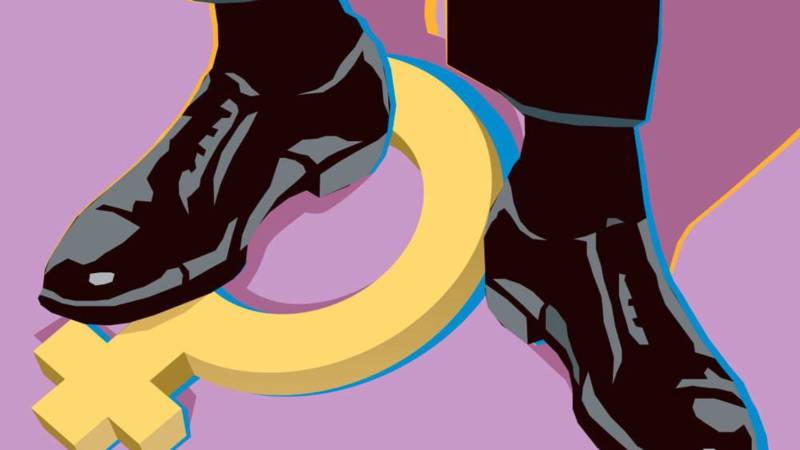
Sociologists have related violence to the prevalent patriarchal system where men make the rules and dominate in businesses and government. At the same time, women are supposed to support men, bear children and take care of household duties. Maintenance of this balance is essential, for which violence and physical abuse become imperative at times. According to Gloria Steinem: “The patriarchy requires violence or subliminal threat of violence to maintain itself… The most dangerous situation for a woman (read any gender) is not an unknown man (or woman) in the street, or even the enemy in wartime, but a husband or lover in the isolation of their own home.”
Potential victims are more fearful of their kin rather than strangers, with whom they may interact with confidence, but find it difficult to confide in their close relatives in case they cause them distress or they are subjected to judgment. A patient hearing can obliterate the chances of abuse, but rarely do elders listen to the weak in their families. The same applies to governments and the restless, questioning citizens they are meant to serve. Instead of negotiating, treating them with force means perpetuation of resistance that sometimes transcends generations, giving continuity to violence spanning over decades.
In ancient times, public attention was diverted by constructing large arenas like the famous Roman Colosseum, where violence was staged not so much as a source of entertainment but for desensitising the people. Thus, the torment of the gladiator when wrestling a hungry lion was quelled, overtaken by the urge to see him victorious over a beast. Nothing could be so inhuman as these disgusting acts of ‘valour’, egged on by the elite to prevent the possibilities of uprisings.
Pakistani society still largely runs on the traditional tribal and feudal systems under the control of which the majority of the population is forced to live. This entails that the weaker segments are prone to violence if they are found deviating from the conventional norms laid down by the controllers. Two recent instances of couples being killed for exercising their choice of living together in a holy union, and the brutal murders of a teenage TikTokker and a transgender person, have once again highlighted the backwardness of thought that has seeped into the twenty-first century. Technological advancements may not have been able to put a dent in the patriarchal mindset, but they have succeeded in setting the stage for intellectual debates on this important social aspect.
The most lamentable outcome of these issues is the failure on the part of successive governments to prevent violence. This indicates the helplessness of law enforcers who find themselves unable to crack down on perpetrators, collect incontrovertible evidence and get them punished to set some solid examples for others. Relishing in the idea of getting away with crime encourages the perpetuation of violence, especially on the part of victims’ close associates who ruthlessly and shamelessly inflict cruelty on their near and dear ones.