

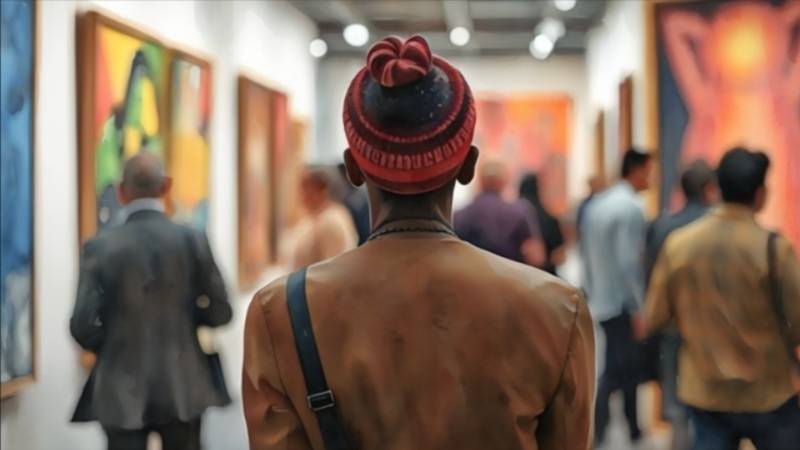
The deeper one ventures into the ecosystem of global contemporary art, the more evident it becomes that labelling artists by regional identity is less about celebrating multiplicity and more about streamlining the guest list. What looks like inclusion is often just clever compartmentalisation; curatorial laziness wrapped in the silk of multiculturalism; postcolonial residue sprinkled with market glitter. The system thrives on difference, not in the philosophical sense of diversity, but in the neatly packaged, press-release-ready sense of Otherness. We’re not collecting voices; we’re curating accents.
Exhibitions, biennials, funding panels, even grant forms are less interested in the expansiveness of an artist’s ideas than in the currency of their coordinates. One wonders sometimes if artists are selected based on their work or because they can be pinned, like butterflies, to a geopolitical map. It is a deeply problematic model: masquerading as care, but operating as containment.
To be a “South Asian artist” in the eyes of the Global North is to be invited to carry the weight of 5,000 years - preferably in palatable visual motifs. There is an unspoken dress code: memory, trauma, and a hint of resistance. Coherence is key. Symbolism is encouraged. You are not brought into the fold as a mind among minds, but as a beautifully bruised emissary of a region. As though the only function of your brush or lens or sensor is to teach the West about its blind spots. As if art’s highest calling is to narrate - never to confuse. This is not inclusion. This is anthropology disguised as aesthetic engagement.
In such structures, identity labels like “South Asian” or “African” quietly evolve from descriptors to soft taxonomies; terms that pretend to be open-ended but actually come with a syllabus. They imply that an artist’s primary value lies not in conceptual daring, emotional nuance, or formal innovation, but in how deftly they can translate their birthplace into contemporary art discourse. The result? An artistic economy of cultural labour, where origin is not a context but a currency.
And in this pressure to represent, to explain, to signify, one begins to detect a tragic irony: the more artists are asked to “speak their truth,” the less space they have to invent it. Art becomes thesis. Ambiguity, mystery, abstraction. These are fine, as long as they loop back to identity. Otherwise, they’re just… confusing. And heaven forbid we confuse anyone.
This climate has birthed a kind of self-orientalism, especially among younger diasporic artists. Not quite inauthentic, but unusually aware of the exchange rate of their experience. To be seen, they must be legible. To be legible, they must perform (act out). The result is a now-familiar genre I call the diaspora aesthetic – part heartache, part homework.
The most ethical curatorial position is not to classify, but to stay curious. The most urgent question is no longer “Where is this artist from?” but “What is this artist for?”
At too many biennials and art fairs, and even at local exhibitions, one encounters variations on a theme: sepia-toned family photographs layered with calligraphic longing; migration narratives embroidered on textiles; videos shot in airports, train stations, or the liminal space between two Skype calls. These works are often sincere. But increasingly, they begin to resemble each other. There is a quiet homogenisation at play. A formal feedback loop of grief, nostalgia, and soft melancholia. What’s missing is not content. It’s permission – permission to play, to abstract, to be universal, to make art that is about light or breath or slowness or nothing in particular at all.
Now, let me be clear: I’m not dismissing work that draws on ancestry or lived memory. In fact, some of the most devastatingly intelligent art I’ve encountered draws from precisely those wells. Consider Huang Yong Ping pulping Chinese and Western art histories into sludge, Sajjad Ahmed’s mundane looking pictures points commerce, Atul Dodiya layering devotional iconography over shuttered violence, Rashid Rana’s micro-mosaics undoing the comfort of an image or Goya – just painting the absolute hell out of despair. These artists do not explain history or present; they trouble its architecture. Their work does not illustrate identity. It disorients it. The difference? Their work emerges from inquiry and curiosity and not from expectation.
Yet for many artists from the Global South, expectation is the starting point. They are presumed to be narrative, political, autobiographical, not because their work demands it, but because the gaze insists upon it. This is more than a misreading. It is epistemic inequality: some artists are afforded the luxury of opacity, play, formal chaos, others must offer translation. They are asked to situate, to signal, to behave.
And so, we must reframe the curatorial question. Not: How does this reflect your culture? But rather: What does this open up? That one shift alone could unshackle an entire generation of artists from the obligation to explain themselves. And instead allow their work to speak in other dialects: conceptual, formal, emotional, philosophical.
This dance between global platforms and local realities creates a cruel choreography. At home, artists are told to be “contemporary” (code for Western). Abroad, they’re invited only if they can be “authentic” (code for not too Western). The result? Many artists begin to amputate parts of themselves, either to belong at home or to be palatable abroad. A tragic cultural yoga.
What we get, then, is not a richer art world but a narrower one. Cultures get frozen in time - preserved like pickles for biennale consumption. Whole regions are presented as coherent wholes: “Africa,” “South Asia,” “the Arab world” - as if these were thematic rooms in a museum, not centuries of contradiction and cosmopolitanism. We call it global, but really, it’s curated difference on a world tour.
And this curated difference has a flavour: curated catharsis. An institutional craving for trauma-as-content. Marginality becomes aestheticised. Suffering becomes saleable. We may no longer ask artists to perform culture through embroidery or miniature. But we now ask them to perform resilience, exile, displacement. The colonial gaze, it turns out, has a great stylist.
What we need is not just diversity of faces, but a diversity of questions. A new curatorial ethic. One that begins not with the map, but with the mind. That asks not “Where are you from?” but “What are you thinking?” That reads artists not as carriers of culture, but as constructors of experience. The best art does not teach us about a place. It destabilises our sense of place altogether.
We must reimagine our institutions accordingly. Many biennials and festivals proudly showcase “voices from the Global South,” but quietly ask those voices to sing in key. The themes are familiar: decolonisation, migration, memory, resilience. All urgent, yes! But when they become prerequisites, they exclude precisely the wildness, the abstraction, the formal disobedience that art is meant to protect. What if, instead of trauma, our exhibitions were about tactility? Instead of survival, about softness? Instead of resistance, about irreverence?
To rewire the narrative, we must begin at home. Support platforms that do not fetishise region. Fund work that is untimely, experimental, and speculative. Build institutions that trust the artist’s intelligence more than their identity. And, above all, teach students that being a South Asian artist doesn’t mean explaining South Asia. It means questioning it. Reluctantly, if necessary. Playfully, if possible.
Our pedagogy must shift. We must tell our young artists that they are not stewards of some eternal culture, but inventors of new grammars. That identity, like medium, is unstable. That their job is not to be understood, but to make us think harder. Their work is not testimony. It is a proposition.
This is what real decolonisation demands - not just a reshuffling of names, but a reinvention of thought. Not more regional slots on the roster, but fewer assumptions at the table. It’s not about how many artists we include, but how many kinds of thinking we allow. To decolonise is not to regionalise further, but to free the work from the tight grip of geography altogether.
Of course, none of this means we forget colonisation. To decolonise is not to erase. But the deepest form of decolonisation is the expansion of freedom, not the rehearsal of victimhood. That freedom must include the right to abstraction. The right to silence. The right to make art that means absolutely nothing until it suddenly means everything.
And so, as an observer, I say this: the most radical act we can commit today is to stop asking artists who they are and start listening to what they’re doing. The most ethical curatorial position is not to classify, but to stay curious. The most urgent question is no longer “Where is this artist from?” but “What is this artist for?”
Until we change our expectations, we won’t change the system. Until we unlearn our appetite for difference, we’ll keep staging the same exhibitions with different names. Until we let artists be free, we’ll never know what they’re truly capable of. And if identity becomes a currency, they may never afford to question it.
The coloniser’s gaze survives - just upgraded for Instagram. Reflected back by the artist, now polished and artfair-ready.
And if we don’t interrupt that reflection, we’ve failed - not just as creatives, critics or curators, but as humans still pretending we’re paying attention.
Let us begin again. Not with the map. But with the idea.
Author's Footnote: The term “artist” here refers to all creative practitioners. Taxonomise at your own risk.