

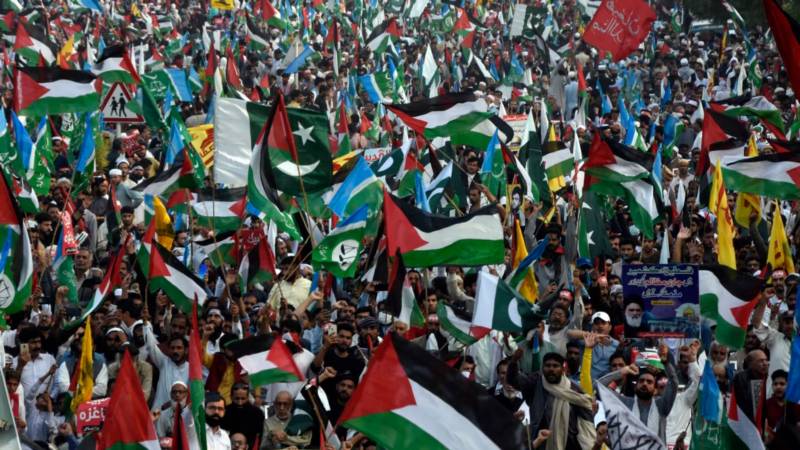
Gaza lies shattered. Homes, schools, hospitals, and streets are reduced to rubble, and more than three-quarters of its people have been displaced. Nearly half are children, growing up without classrooms or healthcare. The question now is who will take the lead in rebuilding. For Pakistan, this is not only a humanitarian issue but an opportunity to define itself on the world stage.
Pakistan’s commitment to Palestine runs deep. From Zulfikar Ali Bhutto’s fiery speeches to Imran Khan’s declaration that recognition of Israel is impossible without justice for Palestinians, the message has been consistent: Palestine matters to Pakistan. For ordinary Pakistanis, this solidarity is not distant politics—it is part of identity. The streets of Karachi, Lahore, and Islamabad have echoed with this conviction for decades.
Yet Gaza cannot be rebuilt with words alone. The United Nations has estimated housing reconstruction alone at more than $15 billion, while the overall recovery needs covering infrastructure, schools, hospitals, and the economy are expected to exceed $50 billion over the coming decade. What has been lost is not only buildings but the possibility of normal life. Schools must reopen, hospitals must function, and homes must be rebuilt. This requires skills, manpower, and vision. Pakistan can offer all three.
Its construction industry has experience mobilising under pressure, from large housing projects to rebuilding after earthquakes and floods. Its doctors and nurses, respected worldwide, could staff field hospitals and train Palestinian teams. Its universities could provide scholarships for young Gazans, giving them skills they would carry home. Diplomatically, Pakistan has the credibility to rally Muslim states behind a serious reconstruction plan, transforming sentiment into coordinated action.
This effort would also serve Pakistan’s interests. Leadership in Gaza’s recovery would enhance its standing across the Muslim world, create economic opportunities for its firms, and deepen ties with Gulf states that will finance much of the work. Domestically, it would strengthen Pakistan’s sense of being a principled nation that not only speaks but acts.
As a Jewish writer, the devastation in Gaza raises serious moral questions for me. It is impossible to watch events unfold without confronting the human cost. That is why Pakistan’s insistence that the issue matters strikes me as important. In a world where too many nations reduce politics to calculation, Pakistan continues to treat Gaza as a matter of conscience.
Pakistan has the chance to move from being a voice for Gaza to being a hand that rebuilds it
Part of what makes Pakistan distinct is its own history of diversity and tolerance. This may surprise those outside the country, but Pakistan has long been home to multiple communities. In Karachi, Parsis built schools and hospitals that still serve the city. In Lahore, Sikh shrines and Hindu temples are reminders of a layered heritage. Even today, religious minorities contribute to public life—Christian nurses in hospitals, Hindu traders in Sindh, Sikh pilgrims welcomed at Kartarpur. This multicultural texture, though often under strain, gives Pakistan a particular moral authority to speak about coexistence and rebuilding.
That authority could now be put into practice. Imagine Pakistani engineers alongside Palestinian workers, laying the foundations of new neighbourhoods. Picture doctors from Rawalpindi and Karachi tending to wounded children in Rafah. Think of Gazan students studying in Islamabad or Lahore, then returning with knowledge to revive their own institutions. These are not far-off dreams. As one Pakistani builder recently remarked, “Our firms are ready to work in Gaza if the world opens the door. We have the people, the expertise, and the will.” And as Dr Khalid Rehman, a respected educationist, has said: “Education is the seed of dignity. If Pakistan opens its doors to Gaza’s youth, it will be planting hope for generations.”
In the halls of diplomacy, Pakistan’s voice already echoes. As Ambassador Asim Iftikhar Ahmad put it in June 2025, “The situation in Gaza is a stain on our collective conscience”, calling the crisis not just humanitarian but a test of moral clarity.
The obstacles will be real restrictions on aid, shifting politics, and donor fatigue. But history often turns on the courage of nations willing to act when others hesitate. Pakistan has the chance to move from being a voice for Gaza to being a hand that rebuilds it.
The Pakistani Foreign Office declared in 2023: “The world cannot remain indifferent while Gaza lies in ruins. Pakistan stands with the people of Palestine, today and always.” Those words matter, but action matters more. Gaza’s future will be written not in statements but in stones laid, hospitals reopened, and children back in school.
For Pakistan, this could be a defining moment, a chance to lead not only with passion but with construction, not only with protest but with healing. And for me, as a Jewish writer, it is impossible to ignore how much depends on what nations like Pakistan choose to do now.