

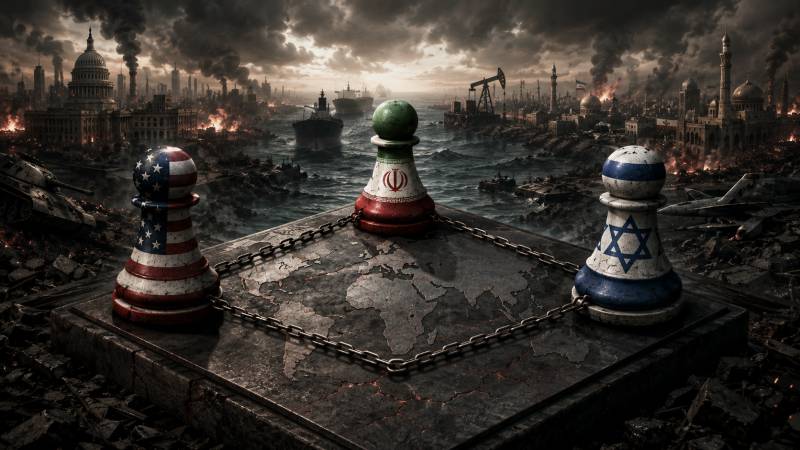
The dark clouds of a renewed conflict between the United States and Iran, complicated by the strategic imperatives of Israel, do not merely portend a regional skirmish. We are witnessing the assembly of a global catastrophe, a "baseless war" that threatens to engulf the modern economy and reshape the world in the image of destruction.
While the drums of war beat loudest in the halls of power in Washington, Tehran, and Jerusalem, the reverberations are felt most acutely by the common man, whose livelihood is being sacrificed at the altar of geopolitical ego and military-industrial profit.
At the heart of this escalating crisis lies what can only be described as a "Triangle of Self-Esteem Mongers." The United States, Iran, and Israel have entered into a symbiotic yet destructive dance, fuelled by nationalistic pride and the quest for regional hegemony. To the leadership of these three nations, the conflict is a high-stakes game of prestige; to the rest of the world, it is a descent into a living hell.
The irony of this triad is that the nations themselves—or rather, their political and military elites—rarely suffer the immediate brunt of the blockades or the economic fallout. They operate within a protected sphere of strategic reserves and high-level financial manoeuvres, while the global citizenry is left to navigate the wreckage of a fractured supply chain and a soaring cost of living.
The economic mechanisms of this war are particularly cynical. One might expect that a nation at the centre of a global conflict would see its currency falter, yet the U.S. dollar continues to benefit from a "flight to safety." As global markets panic, investors instinctively retreat to the Greenback, artificially bolstering American purchasing power even as American policies destabilise the planet.
This creates a perverse incentive for the continuation of tension: a world in fear is a world that buys dollars. This phenomenon masks the true cost of the war, providing a veneer of stability to the U.S. domestic economy while emerging markets collapse under the weight of devalued local currencies and soaring debt.
Furthermore, the financial underpinnings of this "triangle" reveal a circular economy of death. Even as the rhetoric against Tehran reaches a fever pitch, back-channel manoeuvres involve the United States offering "ceased assets" back to Iran—funds that were frozen in international accounts—using them as a carrot-and-stick approach to manage the level of escalation. This suggests that the conflict is not about a lack of resources, but the controlled release of them to keep the fires burning at a manageable intensity.
If this wave of warfare is not checked by a collective global outcry, the resulting economic and social collapse will not be a temporary setback, but a permanent scarring of our civilisation
Simultaneously, Israel’s role in this infrastructure is undeniable and deeply integrated into the American military-industrial complex. In a cycle of conflict-funding, Israeli strategic interests flow directly into the coffers of U.S. defence "tycoons"—the manufacturers of tanks, stealth jets, and sophisticated missile systems.
In this ecosystem, war is not a tragedy to be avoided, but a business model to be optimised. While the common man faces "the hardest conditions of life", the architects of these weapons find their net worth soaring, funded by a partnership that prioritises the "dreams of destruction" over the reality of human survival.
The consequences for the global economy are nothing short of catastrophic. The closure of maritime routes, particularly the Strait of Hormuz, has sent energy prices into a vertical climb. For the industrialised nations of Europe and the burgeoning economies of Asia, this is an existential threat. Inflation is no longer a manageable statistic; it has become a predatory force, stripping the working class of their savings and making necessities like
bread and fuel luxuries. The farmer in South Asia who can no longer afford fertiliser and the factory worker in Eastern Europe whose plant has shuttered are the true casualties of a war they did not choose.
Furthermore, the war serves as a convenient veil for territorial and strategic expansion. Under the guise of neutralising an existential threat, the regional map is being forcibly redrawn. The systematic degradation of sovereign infrastructures allows for a political expansion that would be unthinkable in peacetime. This pursuit of a "greater security" for one nation inherently creates a state of total insecurity for the rest of the globe.
As the conflict deepens, the moral vacuum of this war becomes more apparent. It is a war based on "self-esteem"—the refusal of leaders to lose face and the cold calculation that the lives of the "common man" are acceptable collateral.
The world is being dragged into a whirlpool where the primary exports are misery and volatility. If this wave of warfare is not checked by a collective global outcry, the resulting economic and social collapse will not be a temporary setback, but a permanent scarring of our civilisation.
In conclusion, the U.S.-Iran-Israel triangle represents a failure of modern diplomacy and a triumph of predatory geopolitics. By prioritising the profits of defence tycoons and the ego of national identity over the stability of the global market and the sanctity of human life, these powers are setting a fire that they may not be able to extinguish.
The world does not need more missiles funded by tycoons or currencies bolstered by chaos; it needs a return to a reality where the welfare of the many outweighs the prestige of the few. Until then, the common man remains a hostage to the pride of giants.