

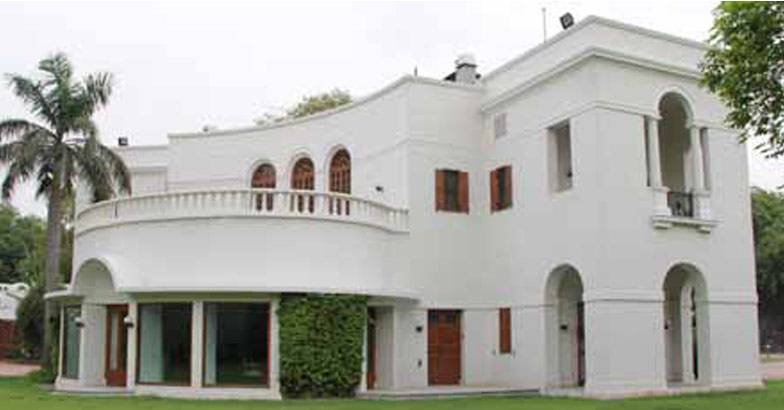
At a time when properties linked to the family of Pakistan’s first Prime Minister, Liaquat Ali Khan, in Muzaffarnagar, have been declared "enemy property" by the Indian government, another piece of his legacy continues to stand tall in the heart of Delhi.
The elegant two-story residence, once known as Gul-e-Rana and now called Pakistan House, serves as the residence of Pakistan’s High Commissioner. It also hosted the first Pakistani Embassy in Delhi, soon after the Partition.
Recently, when opened to the media and Delhi's who is who, one notices that the house has remained frozen in time, preserving its regal essence. Its sprawling living rooms, grand dining space, stately library and intricate galleries lead to shaded verandas and lush green lawns.
The ground floor and the exterior, at least, have been maintained just as Liaquat Ali Khan left them when he departed for Pakistan. The spotless white exterior and restrained architectural details add to its timeless charm.
A stone’s throw from India Gate in the heart of India’s capital, 8B Tilak Road—formerly Harding Road—is still known as Gul-e-Rana among officers posted at the Pakistan High Commission in India.
Named after Khan’s wife, the bungalow is a living testament to the years leading up to the partition of the subcontinent. It has silently contributed to shaping the history of the region.
It was in this house that Khan lived when he presented the first budget as Finance Minister in Jawaharlal Nehru’s interim government in 1946. The house also served as a refugee camp and safe haven for Muslims awaiting passage to Pakistan in 1947. Later, it functioned as the Embassy of Pakistan before becoming the official residence of the Pakistani High Commissioner in the 1960s. The Embassy, later rechristened as the High Commission, was shifted to a new building constructed in the diplomatic enclave of Chankayapuri.
It remains one of only two places in New Delhi where Pakistan’s flag unfurls, the other being the Pakistan High Commission.
When Khan was allotted the finance portfolio in the interim government, he chose not to move into an official residence but continued to operate from his own house. Assisted by his colleague Mohammad Ali Bogra—who would later become Pakistan’s third Prime Minister—he worked from this very residence.
As partition unfolded, the house became a refuge for a stream of displaced Muslims whose homes had been looted. Sajjad Hyder, one of the first 13 Indians selected by Prime Minister Nehru to form the Indian Foreign Service, wrote in his book Foreign Policy of Pakistan: Reflections of an Ambassador that more than 10,000 people took shelter in the house.
Once a private home, it had transformed into a refugee camp guarded by volunteers. Its lawn became a waiting area, the terrace housed women and children, and young men stood guard around its periphery.
“The state of our security was such that incoming refugees were being hacked to death in front of our gates, and we feared that the mission would be attacked at any time,” Hyder recalled.
“In no time, the lawns and the roof of the house were occupied. The women and children were given accommodation on the first floor, while the men stayed outside. At least 20 babies were born on the rooftop of this building.”
The house that Khan had purchased just years earlier to establish a base in Delhi had become a sanctuary amid chaos.
Historians speculate that while Jinnah had time to sell his house, Khan could not find a buyer in such short notice—or perhaps his family still held hope of returning
Pre-Partition Base
“After the Pakistan Resolution was adopted in 1940, Khan and Muhammad Ali Jinnah felt the need for a base in Delhi,” says journalist and author Vivek Shukla. “That’s when Khan bought 8 Harding Lane, and Jinnah acquired 10 Aurangzeb Road.”
Jinnah already had his mansion in Mumbai, and Khan had properties in Muzaffarnagar. But by 1940, living in Delhi had become indispensable for both.
Historians note that Khan’s wife, Gul-e-Rana, who came from a Christian family before marrying him, was instrumental in opening the house’s doors to refugees. An English teacher at Indraprastha College, Delhi University, she was known for advocating women’s education and leading protests against liquor shops in Chandni Chowk and Kashmiri Gate.
Before leaving for Pakistan in August 1947, Rana had applied for a two-month leave from her college, hopeful that she would return. She wrote to the school principal, Dr Veena Das, promising to be back by the end of September. “It was three decades later that the school’s chairman, Lala Narayan Das, revealed this,” says Shukla.
Liaquat Ali Khan and Gul-e-Rana never returned to live in the house. Recently, for the first time in years, the bungalow opened its doors to select Delhi citizens. On a sunny spring afternoon, guests were treated to rows of flowers lining the lush green lawn, and the sounds of Pakistan’s Coke Studio, and the aroma of Chapli kebabs and biryani. To the Indians present, the gathering was a reminder of shared cultural commonalities—language, food, and music—spanning borders.
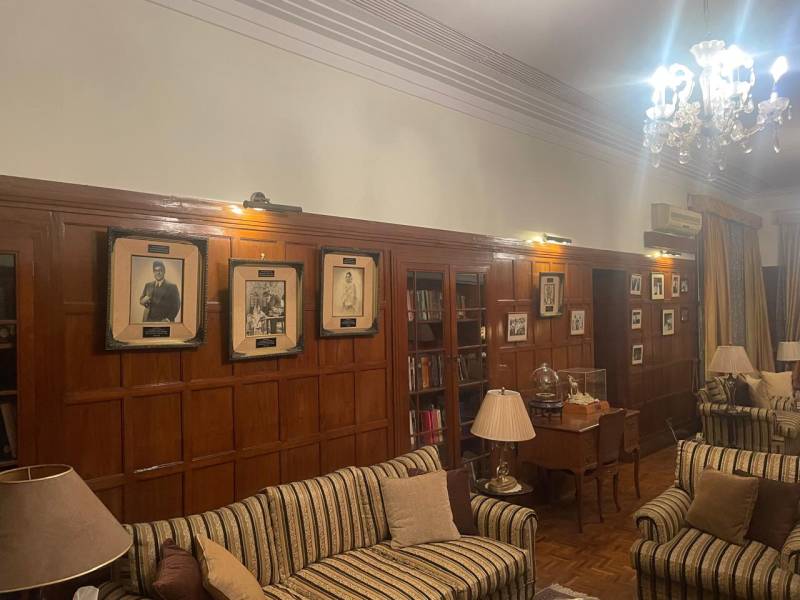
The walls of Gul-e-Rana still hold pictures of happier times, featuring Khan and his wife. His library, which once doubled as the High Commissioner’s office, still houses several books and pieces of furniture left behind by the family.
While Jinnah’s house in Mumbai’s Malabar Hill remains in a state of disrepair and dispute, Khan’s Delhi residence has been preserved. Before leaving for Pakistan in 1947, Jinnah sold his house on Aurangzeb Road to Indian businessman Ramkrishna Dalmia for 2.5 lakh Indian rupees.
The Dalmia family later sold it to the Netherlands Embassy, which now uses it as the ambassador’s official residence. Yet, more than seven decades later, the property is still known as “Jinnah’s house” in Delhi.
Historians speculate that while Jinnah had time to sell his house, Khan could not find a buyer in such short notice—or perhaps his family still held hope of returning.
Pakistan House remains a poignant reminder of history etched into its walls and pillars—a silent witness to the seismic shifts of 1947 and a link to a legacy that continues to shape the subcontinent’s past and present.