

Islamabad has always been fertile ground for speculation. In its closed circles, power corridors that stretch from the Prime Minister’s House to GHQ, and from the Presidency to key ministries, information flows like an underground river: vast, unchecked, and often invisible to the public. The media, which is supposed to be the conduit between the state and the citizen, only ever seems to access the tip of this informational iceberg, and even that only when someone decides it should be seen.
Amid this controlled chaos, a new wave of murmurs is spreading: talk of the 27th Constitutional Amendment. It’s not front-page news yet, but in Islamabad's elite circles, it’s the only thing anyone seems to be talking about. Theories abound, each more ambitious than the last. The political pendulum, already unsteady, seems poised to swing in a direction that could either reinforce the current balance of power or overturn it entirely.
Let me be clear: I don’t subscribe to conspiracy theories. But when seasoned politicians, senior bureaucrats, credible journalists and those in the know begin treating a "theory" as a viable possibility, it demands our attention. Not all conspiracy theories are hollow; some are warnings wrapped in whispers.
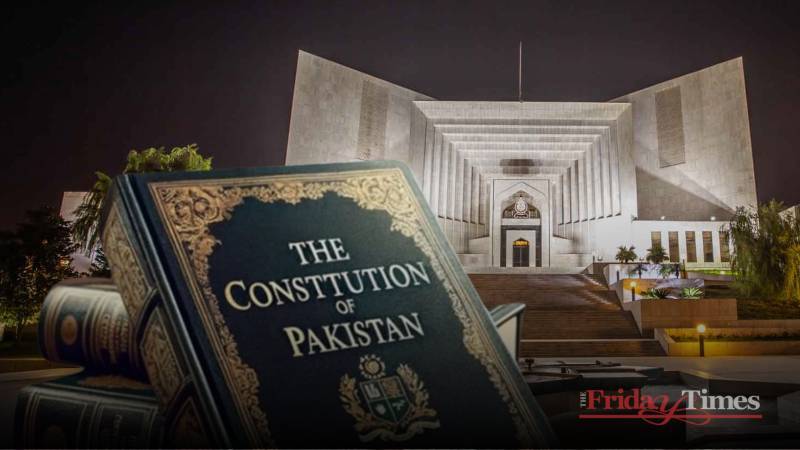
Though still a whisper and a footnote in confidential memos, the 27th Amendment could become Pakistan’s most consequential political restructuring since the 18th Amendment
The most talked-about scenario? A reinvention of the presidency. Why would anyone desire the presidency in its current toothless form? That’s precisely the point; they don’t. What’s being suggested is not just a reshuffling of roles but a recalibration of the constitutional architecture, giving the presidency enhanced powers under the guise of the 27th amendment. This wouldn’t be a ceremonial head of state anymore; it would be a pivot point of governance, possibly the central figure in a remodelled hybrid system.
To those who dismiss this as pure fantasy, consider Defence Minister Khawaja Asif’s recent remarks, where he openly described Pakistan’s current arrangement as a "hybrid system." The term isn’t new, but its public acknowledgement by a key member of the ruling party is. Hybrid systems in our context have always had a negative undertone, civilian façades with military engines, but Asif’s candour suggests something else. Perhaps a formalisation of the hybrid, an evolution of it. Perhaps a system being prepared for public consumption through slow leaks and soft nudges.
Of course, the real question is: Has any system worked for Pakistan? Pure democracy, martial law, judicial activism, technocratic caretakers—we’ve tried them all. Each came with promises; each left behind disappointments. Perhaps that is why some believe a structured, well-defined hybrid model might be the "solution" to Pakistan’s governance crisis. Perhaps this is the experiment we’re preparing for next.
But here lies the danger, and the opportunity.
Can such a system bring consistency and policy continuity, two qualities Pakistan has historically lacked? Could it insulate governance from political vendettas and media theatrics? More importantly, will it work for the people, not just the power elite?
Pakistan is a uniquely difficult country to govern. Loopholes in the system are often treated as features, not bugs—tools to topple, to obstruct, to delay. If this new system, born out of a constitutional amendment, is meant to plug those holes, it must be judged not by its structure, but by its impact on the lives of ordinary Pakistanis.
In the end, we’re left with more questions than answers.
Though still a whisper and a footnote in confidential memos, the 27th Amendment could become Pakistan’s most consequential political restructuring since the 18th Amendment.
Until then, we watch, we listen, and we wait.