

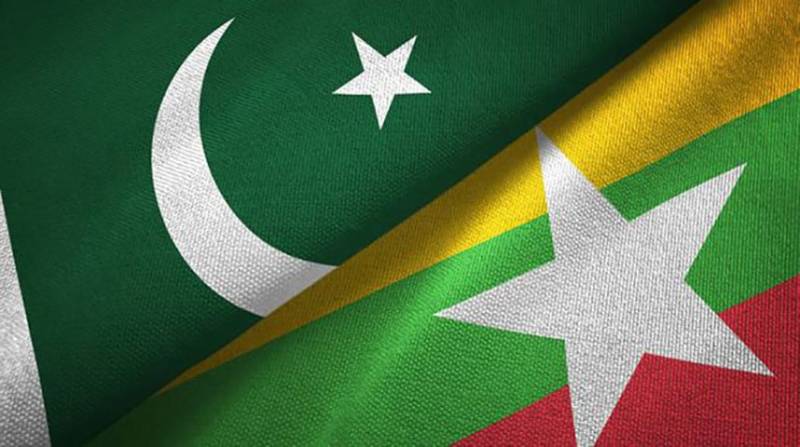
Union Minister for Foreign Affairs of Myanmar, Mr Than Swe’s visit to Pakistan (26–29 January 2026) has led to the signing of an MoU on ‘Political Consultations between the Foreign Offices of Pakistan and Myanmar.’ This is a significant development as it has institutionalised regular engagement and opened doors for dialogue on bilateral, regional and global issues.
Meanwhile, the agreement to ensure consular support for each other’s nationals is yet another positive development. The agreement will protect people from falling victim to scamming gangs. Many workers are trafficked into taking work by gangs operating scam centres in Myanmar’s border areas.
According to United Nations estimates, around 120,000 people are working in online scam centres in Myanmar. To put an end to the illegal facilities along the border areas, Myanmar is already working with China and Thailand.
Union Minister for Foreign Affairs of Myanmar, Than Swe, meeting with Prime Minister Shehbaz Sharif, focused on enhancing cooperation between Pakistan and Myanmar on regional and global platforms. Regionally, the Association of Southeast Asian Nations (ASEAN) is an important organisation, an economic body with a GDP of US$3.9 trillion, making it the fifth largest in the world.
Pakistan holds a Sectoral Dialogue Partnership (SDP) with ASEAN, and to become a Full Dialogue Partner (FDP), support from ASEAN member countries is essential. Myanmar, being an ASEAN country, is significant for Pakistan. During the recent high-level exchange, Mr Than Swe invited Pakistani investors and business leaders to explore opportunities in Myanmar. He said, “We are at the centre of one of the world’s largest markets, and we would like Pakistani investors to come, see and study the opportunities for cooperation.”
Deputy Prime Minister and Minister for Foreign Affairs, Senator Ishaq Dar, during his meeting with Mr Than Swe, mentioned Pakistan’s rich Buddhist heritage and the potential of religious tourism
Mr Than Swe also called for enhanced people-to-people interaction and the establishment of sister-city initiatives between Pakistan and Myanmar. During President Asif Zardari’s visit to Myanmar in 2012, cooperation in the oil and gas sector, along with prospects of a Preferential Tariff Arrangement (PTA) and Free Trade Agreement (FTA), were discussed. However, not much progress was made afterwards.
At present, Pakistan–Myanmar bilateral trade is US$70 million, which is far below its latent potential. To impart dynamism to Pakistan–Myanmar trade, a lead role from the business communities of the two countries is essential. Moreover, Pakistan’s geographical location could prove to be a strategic asset for the East Asian economies to establish connectivity within the region. In the context of Myanmar, the country’s hydrocarbon reserves could be of immense importance to the South Asian economies. Here, too, Pakistan and Myanmar can cooperate.
Deputy Prime Minister and Minister for Foreign Affairs, Senator Ishaq Dar, during his meeting with Mr Than Swe, mentioned Pakistan’s rich Buddhist heritage and the potential of religious tourism. The Buddhist archaeological sites in Pakistan are a source of attraction for the people of East Asia.
The Pakistani city of Taxila has been part of the ancient Gandhara civilisation. In Burmese, Taxila is known as “Taketo”; the city had been a centre of Buddhist learning in ancient times. The Buddhist sites in Taxila include Dharmarajika Stupa, Bhir Mound, Sirkap, Jandial Temple and Julian Monastery.
Pakistan’s Swat Valley, surrounded by the Hindu Kush Mountains, is also home to Buddhist heritage. The remains of a sleeping Buddha statue are in Bamala and Najigram. A Buddhist apsidal temple has been discovered in the Bazira area of Barikot, Swat. Despite being home to Buddhist archaeological sites, tourism remains limited in Pakistan. The prime reason is a lack of proper infrastructure.
The upcoming economic corridors, connecting East Asia, South Asia and Central Asia, are likely to open up economic cooperation. With economic connectivity, prospects for religio-cultural exchange might also prosper.