

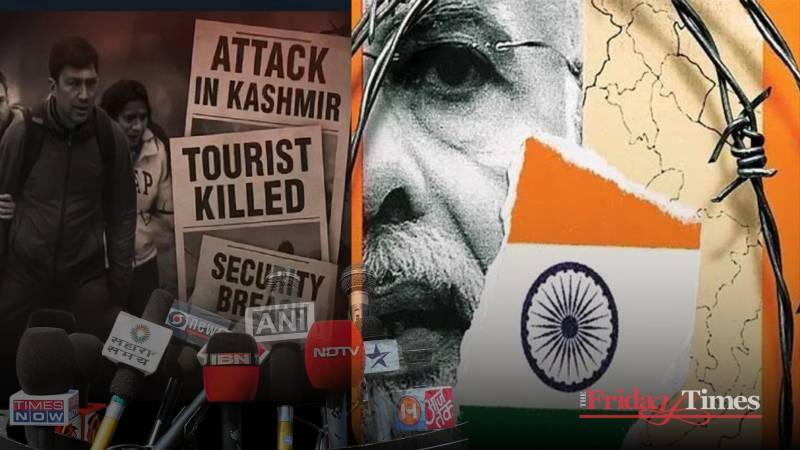
The other night, I found my seven-year-old son leaping from sofa to sofa, clutching a plastic jet in one hand and shouting, “Strike! Strike! Target destroyed!” When I asked what he was playing, he replied with wide-eyed enthusiasm, “Like on TV! India is winning the war again!”
He had no idea what war really meant—no clue of blood, loss, or diplomacy. But he had clearly absorbed the nightly theatre of Indian news channels, where toy planes have grown into TRP missiles.
Across living rooms in the country, a generation is being weaned not on facts, but on feverish war montages. The line between national security and national spectacle has not just blurred—it’s been bombed into oblivion.
As diplomats and military establishments of India and Pakistan are still weighing their options after the Pahalgam terrorist attack, a full-fledged war has already begun inside Indian TV studios, where media houses have fanned the flames of war hysteria and brought conflict into every living room across the country.
Even before Indian Prime Minister Narendra Modi called a meeting of the Cabinet Committee on Security to evaluate punitive measures against Pakistan, before India downgraded diplomatic ties and suspended visas for Pakistani nationals—the war had already begun inside TV studios.
Armies may take time to strategise and weigh options for retaliation, but tanks and guns were already rolling on screen. Inside TV studios, that is.
On every news channel, anchors—some even dressed in combat fatigues—appeared armed with toy fighter guns. Fighter jets flew overhead on green screens, with bombs exploding on animated backdrops. It looked no less than graphics from a video game.
Since the terrorist attack in the Pahalgam valley in Kashmir that killed 28 tourists, there has been little actual reporting from Indian newsrooms. Prime-time is filled with fiery slogans, jingoistic graphics, shouting matches, dramatic music, and war-themed montages, all passed off as news.
Indian news channels seem less concerned with informing or sensitising the public, and more invested in inflaming their sentiments.
Even before the armed forces could finalise their inventory for a possible strike along the eastern border, TV channels had already gone full throttle, detailing India’s military strength and presenting hypothetical battle plans. Facts or classified status of the information were never a concern.
Instead of reflecting on events or promoting democratic discourse, this rush to create media narratives only gives Pakistan a reason to argue that it is being scapegoated
Rather than pursuing balanced reporting or demanding accountability, most of India’s media have once again chosen to amplify war rhetoric—stoking public anger, creating fear, and sensationalising an already sensitive situation.
While Pakistan may appear the obvious target, pseudo-nationalist sentiment has turned Indian Muslims and young Kashmiri boys into scapegoats—both in the valley and across the country.
In fact, perhaps the Indian government should consider sending the chiefs of the three armed forces on vacation. They could appoint the likes of Arnab Goswami, Editor-in-Chief of Republic TV, to launch missiles from his Mumbai studio, and Navika Kumar to lead the battalion.
After all, why shed the blood of soldiers on the border when hyper-nationalist journalists have volunteered to take on the war?
Every Indian news channel is filled with provocative headlines. Republic TV aired titles like “Avenge Pahalgam Attack” and even called for a “Final Solution” for Pakistan and Indian Muslims.
According to a detailed post by Indian media watchdog Newslaundry, many newspapers and TV channels have been complicit in this frenzy.
Times Now ran segments proclaiming, “Will gun down every terrorist.” Zee Media explained diplomatic strikes on Pakistan in great detail, boasting about India’s arsenal and the ease with which Pakistan could be wiped from the map. Whether the information was classified or verified never became part of the conversation.
Aaj Tak, part of the India Today group, had anchors yelling dramatic headlines like “Ghati me aatank par akhri war kab?” (When will the final blow on terror in the valley happen?). Its reports included on-ground footage of reporters peeping inside hollow tree trunks—as if conducting reconnaissance for war.
After the Indian government's decision to suspend the Indus Water Treaty, news channels screamed that Pakistan would now “die of thirst.” There was no time to verify treaty facts or realise that stopping river flows might flood northern India. But the idea that “India will stop the river and Pakistan will die” was good enough for TRPs. Facts could wait.
And if the TV wasn’t enough, newspaper headlines echoed similar war cries—demanding revenge, surgical strikes, and military retaliation.
This is not the first time Indian newsrooms have shown such immaturity in covering an India-Pakistan crisis.
After the 2016 attack on the Pathankot Air Force base and the 2019 Pulwama suicide bombing that killed 40 Central Reserve Police Force personnel, newsrooms quickly blamed Pakistan and demanded vengeance.
In 2016, following the Uri attack and India’s subsequent surgical strikes, a striking example of media theatrics unfolded in Srinagar. Rohit Gandhi, then the newly appointed editor of WION and otherwise known as a well-meaning journalist, staged a dramatic broadcast from Dalgate—deep in the heart of the city, far from any active military zone. To simulate a war-like atmosphere, Gandhi, flanked by a retired army officer, set up a mock "Line of Control" complete with barbed wire. The segment was presented as if it were being reported directly from the actual LoC, misleading viewers and manufacturing a spectacle that blurred the lines between journalism and jingoism.
Several journalists in Kashmir later revealed this fabricated story to Delhi media circles.
In any India-Pakistan crisis, Kashmiris become the softest targets. Zee News hosted a debate titled “Why do Kashmiris always side with terrorists?”—ignoring that no other region has suffered from terrorism like Kashmir has.
This hostility from newsrooms quickly spills onto social media. Platforms like Facebook, X (formerly Twitter), and YouTube have become battlegrounds. Real issues—such as the causes of the attacks, intelligence failures, and accountability—are lost in nationalist fervour. Inflammatory slogans, doctored videos, and AI-generated images create hysteria.
Ironically, these are the same news organisations that don't raise questions when red carpets are rolled out for the Home Minister at funerals. They ignore the protests by retired soldiers outside Parliament demanding One Rank One Pension, or the government’s unkept promises to troops still fighting for basic rights.
Indian media houses can no longer be considered neutral. They are deeply entangled with ideological or financial interests aligned with the ruling establishment. Their narratives serve to bolster nationalist sentiment, often diverting public attention from governance failures, and earning rewards in return.
Instead of reflecting on events or promoting democratic discourse, this rush to create media narratives only gives Pakistan a reason to argue that it is being scapegoated. Had the Indian media waited for an official government statement before blaming Pakistan, its accusations might have held more credibility.