

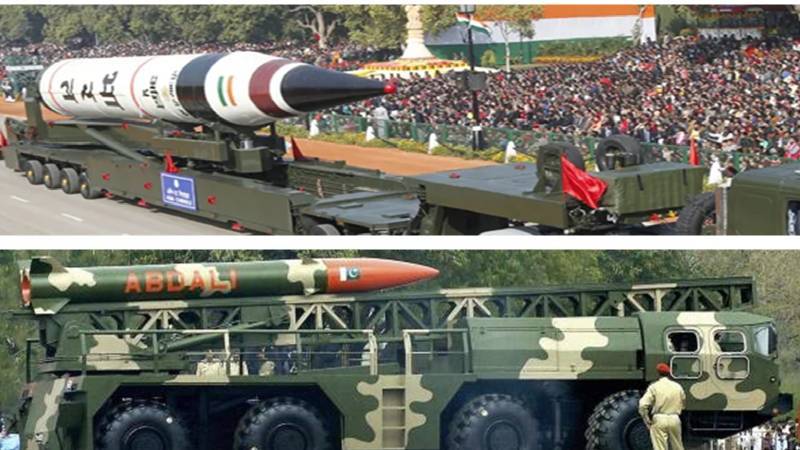
Pakistan is at war with itself. India is at war with itself. The last thing they need and require is to fight each other. There are two ongoing insurgencies in Pakistan--one is in the country's Northwest and the other is in the country's Southern province of Baluchistan. India, on the other hand, has remarkably overcome and minimised separatist violence in its trouble spots like Kashmir and in the North East. But the religiously divisive policies of its Hindu extremist ruling party, BJP, and its sister organisations have opened fresh wounds of communal tensions in Indian society. The social and political environment is far from normal. Pakistani and Indian states are well-versed in manufacturing political consensus in their respective societies. These post-colonial states are also experts in diverting focus away from their internal conflicts and strife and instead focusing their state efforts on channeling their resources and attention towards an external enemy.
Pakistan is a classic case: For the past four years, the country's political arena has become the stage for mainstream political parties’ campaigns against the military's involvement in the country's political system. Both the present ruling party, PMLN, and the former ruling party, PTI, have at different points in time, during the past four to five years, engaged in anti-military diatribes. The military's manipulation of the country's political system has provoked these anti-military political campaigns. These political campaigns and the military's response to them have dominated our political discourse during the past four to five years. However, the manufactured political consensus against possible Indian aggression started to push the anti-military campaign into the background. This, however, doesn’t mean that Pakistan's troubles have vanished as there are growing signs that the insurgencies continue to make their marks on national life. The military’s media wing continued to report military raids against religiously inspired insurgents in the North West and secular-minded separatists in the Southern province of Baluchistan. How will the insurgents react if the Pakistani military gets engaged in a military conflict on its international border in the East? War is not fireworks on a wedding day, neither is one day or a 20-20 cricket match.
One gets the impression from our military and political leaders’ recent assertions that India will strike and Pakistan’s response would be up a notch. And that’s it. No, sir no, this is not how it works. War means the destruction of cities and farmlands, war means the destruction of industrial capacity, and war means the destruction of expensive military assets. Your tit-for-tat portrayal of war is based on an utterly misconstrued conception. War is not an event, it is a process that makes societies endlessly barren and desolate the cities, farmlands, and industrial zones. Food shortages and the absence of fuel supplies become a norm. How do cities function in such a situation? In the military history of the world, no military strategist has ever been able to answer this question. I am sure Pakistani military planners don’t have an answer to this question either. We don’t know how our societies--the urban and rural societies which appear quite normal in normal circumstances, would react to these shortages. But one thing is for the insurgents to have the field day.
The divisive policies of the BJP and its obsession to consolidate Hindu vote banks have led to the creation of deep communal divisions in Indian society
India during the past 15 years has remarkably succeeded in minimising violence in its trouble spots where separatist and ideologically based insurgencies had been going on--for instance, separatist movement in Kashmir and fatalities insurgencies in North East have shown a much-reduced level of violence. In Kashmir, the gun-toting militant has been replaced by a stone-carrying political activist. Naxalties-led violence has also been reduced in the North East. But India is now faced with another kind of social strife, which is pitting one community against another. The divisive policies of the BJP and its obsession to consolidate Hindu vote banks have led to the creation of deep communal divisions in Indian society. But as I said, just like the Pakistani state, the Indian state is well-versed in manufacturing political consensus. Just look at how Indian Muslim leaders and religious scholars in Indian society are spitting venom against Pakistan more aggressively and belligerently than Hindu extremists.
This manufactured inter-communal consensus cannot hide the deep alienation the Muslim population of India is facing at the hands of Hindu extremist groups. Christopher Jefferlot, a French author and expert on Indian politics, has recently documented how the lynching of Muslim butchers at the hands of Hindu extremists has become a common and rampant practice in Northern India. How the oppressed Muslim community is feeling in the face of Hindu extremist's onslaughts could be judged from the fact that during the last 15 years, a large number of Muslim militant and extremist groups have emerged in Indian society. A large number of Indian Muslims have joined ISIS in Syria, Iraq, and Afghanistan. Indian security officials have themselves expressed concerns about this development. Kashmir is still a powder keg with youth joining ISIS and other extremist groups more readily than giving vent to their anger by joining the more manageable Kashmir separatist groups. The Indians are responding to this situation no differently from Pakistan's security apparatus--India diverted the focus away from its homegrown militancy and terror groups by blaming Pakistan.
There is every likelihood that the Hindu extremist government’s divisive policies and inhuman treatment of Muslims in India at the hands of Hindu extremists would push Muslim communities more into a deep embrace of India’s homegrown militant and terror groups or into the fold of international terror organisations like ISIS in Afghanistan. The Indian state is well versed not only in diverting attention away from worsening security situation at home but blaming others for a situation, which is a product of its own policies. I am not at all inventing the theory that the Pahalgam attack was the handiwork of some homegrown Indian group. This is not my contention. What happened in Pahalgam is a matter for expert investigators to investigate and to bring out the truth before the whole world. I am trying to contend that now India doesn’t need foreign terror groups to play havoc with its internal security situation. It is self-sufficient in terror groups and Muslim militants trained in Afghanistan, Iraq, and Syria. And when Prime Minister Modi’s government sponsors Hindu extremist groups in anti-Muslim lynching and other inhumanities, it is fueling the fire. That is why I say Indians are at war with themselves. And fighting Pakistan would only aggravate its problems.
Pakistan and India have not fought a full-scale war since 1971. In 1971 Indian military attacked East Pakistan. It was a general attack in which land forces and air forces both took part. However, civilian populations were generally spared by both Pakistani and Indian military. Kargil conflict in 1999 was restricted to one location on the Line of Control (LOC). The political class in both the countries generally speaking no military experts. That is why their rhetoric about military strikes or war is always very naive. India will carry out punishing strikes, voices from India would say. In their calculation, they simply ignore that Pakistan would respond and it has a well-equipped and well-motivated military to strike back more forcefully. But then Pakistanis repeat the same mistake. They say their response to Indian strikes would be up a notch. Their rhetoric doesn't take into account that Indians have an equally more than equally equipped and more or equally motivated military, whose response might overwhelm Pakistan.
Indian security planners should realise that the Pakistani military is the mechanism through which the Pakistani state controls Pakistani society. Any attempt to downgrade this capability could result in the emergence of unfathomable threats to regional stability
Both the sides and their rhetoric simply ignore the economic and financial side of this business of strikes and counter-strikes. A few months back when Israelis and Iranians were carrying out strikes and counter-strikes against each other, Washington US magazine Foreign Affairs published an estimate of what the strikes and counter-strikes cost Iranians and Israelis. Iranian missile and drone strikes cost Iran only $80 million, while the cost of defending Israeli territories was more than $3 billion. Here we will have to see the difference: Israelis were using Missile defense systems to prevent Iranian missiles from impacting Israeli soil. Neither India nor Pakistan would be using this technology in their defense against incoming missiles. However both Pakistani and Indian have been flirting with Swarm drone technology and Indians may be close to fielding a counter mini-missile defense against incoming swarm drones. The main lesson drawn from the Israeli and Iranian equation is that attacks are now much cheaper than defense.
Pakistanis have a mythic image of the military and its military men primarily because of a particular interpretation of Islamic history that ignores the cultural and intellectual achievement of early Muslim societies and over-emphasises its militant character. After the political advent of Hindu extremist organisations, Indian societies have already started to harbour a mythic image of their military. This mythic image results from the recycling of Hindu militant heroes like Shivaji, the Martha warrior king of the 17th century who fought against Mughal Emperor Aurangzeb, and others like him in the post-Mughal history of India. In these processes of mythologising the military on both sides of the border, no realistic voice has ever pointed out that modern military machines are not designed to defend and protect populations in urban and rural areas. The modern military machines are designed to destroy the enemy. It is not for defending the cities or farmlands, especially when the weapons of choice are either supersonic, state-of-the-art fighter or bomber aircraft, or the pilotless drones or missile systems. Israel and America are super-rich countries that can develop and employ missile defense systems to defend their cities. Pakistan and India can’t. Or at least they don’t have this capacity at the moment. Indians are working hard on it but haven’t succeeded so far. Pakistanis have not yet started working on it.
If we deeply study Indian and Pakistani societies we will come to realise the artificiality of the whole business of military machines in both the societies of these two South Asian rivals. The modern technologies, west-invented cultural ethos, and patterns of military training and professionalism are alien to the culture of social and economic backwardness in the societies on which they preside. The slick uniforms and arrogance of their cultural behaviour do not at all match the hunger of downtrodden multitudes that barely survive in the societies of Pakistan and India. Modern military is bequeathed to Indian and Pakistani societies by our colonial masters. Pakistan, however, even failed to utilise and control the institution of the military for national development and stability. This became more than apparent thrice in our history when the military used force to oust elected governments and assumed control of the governments. Indians more smartly managed this colonial legacy and utilised it for national development and stability. But at the social level, the culture of Indian military professionalism and their ethos are no less alien for ordinary Indians than they are for ordinary Pakistanis.
Through dispassionate analysis, we can safely arrive at the conclusion that both Pakistan and Indian states and societies are facing more grave dangers to their stability and continued survival from within than the external threats both of them appeared to be harping at. A dispassionate analysis will also prove that instability or lawlessness in either country will not be in the interest of the other. Both India and Pakistan stand to gain nothing from instability in each other’s country. Destroying or attempting to downgrade each other’s capacity to control their respective societies will lead to horrendous consequences for the other side. A stable Indian society that is in stable control of its state machinery is something that should be perceived by Pakistani security planners as a source of regional stability.
Similarly, Indian security planners should realise that the Pakistani military is the mechanism through which the Pakistani state controls Pakistani society. Any attempt to downgrade this capability could result in the emergence of unfathomable threats to regional stability. We need to develop innovative ways of dealing with the security threats that are emerging at the regional level. One of the threats to peace is the emergence of mass casualty attacks in different parts of our region like the Pahalgam and Jaffar Express attacks. Despite categorical allegations from both sides, the reality is we don’t know who is the mastermind of these attacks. To tackle this problem out of the box thinking is required.