

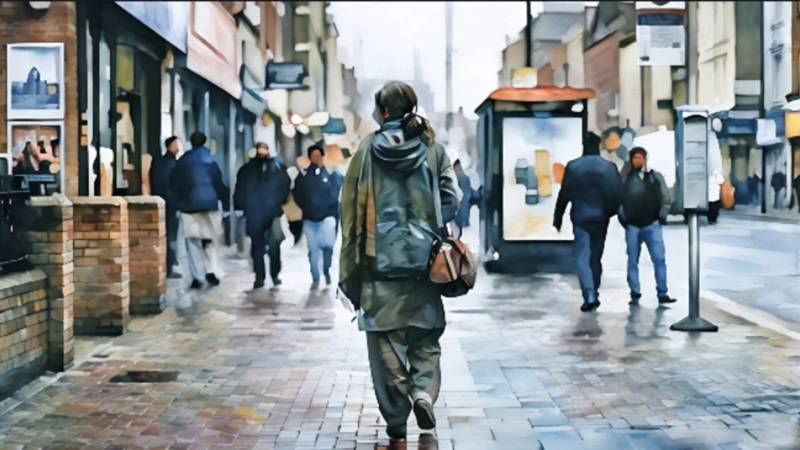
On Friday, 14 February 2026, police in the southern Punjab town of Sadiqabad reunited an elderly woman with her family after she had gone missing. The incident did not dominate national headlines. There were no televised briefings or viral social media campaigns. It was a routine recovery: quiet, procedural, and quickly forgotten.
Yet in Pakistan, such outcomes are not routine. For every missing woman who is found, many others disappear into circumstances later categorised as abduction, migration, domestic dispute, or voluntary departure. What often goes unexamined is how many of these cases intersect with poverty, gender inequality, and organised trafficking networks.
Under the United Nations Protocol to Prevent, Suppress and Punish Trafficking in Persons, commonly known as the Palermo Protocol, trafficking is defined as the recruitment, transportation, transfer, harbouring, or receipt of persons, by means of coercion, deception, abuse of vulnerability, or force, for exploitation. Exploitation includes sexual exploitation, forced labour, servitude, slavery-like practices, or organ removal. Crucially, trafficking does not require crossing an international border; it can occur entirely within a country.
This distinction matters. Migrant smuggling typically involves consensual facilitation of irregular border crossing for payment, ending upon arrival. Trafficking, by contrast, is defined not by movement but by coercion and exploitation. Not every missing person is trafficked, and not every exploitative labour condition meets the legal threshold of trafficking. But where deception, abuse of vulnerability, and sustained exploitation converge, particularly involving women and children, the line between informal migration and trafficking often collapses in practice.
Pakistan’s geography compounds these risks. With a population exceeding 240 million, the country sits at a strategic crossroads linking South Asia, Central Asia, and the Middle East. Its porous western borders and extensive Arabian Sea coastline position it simultaneously as a source, transit, and destination country for trafficking. The 2025 Trafficking in Persons Report, issued by the U.S. Department of State, notes that authorities identified 37,303 trafficking victims in the most recent reporting year, up from 29,113 the previous year in Pakistan. Of the 26,613 identified sex trafficking victims, more than 21,000 were women. Even among the 9,917 forced labour victims, women accounted for nearly half.
Many trafficking cases do not begin as trafficking investigations but as missing persons complaints: by the time exploitation is confirmed, evidence has often dissipated
For international observers, trafficking in Pakistan is often understood primarily through cross-border migration routes, and with good reason. Pakistan is deeply embedded in regional and transnational trafficking networks. Routes run westward through Balochistan into Iran, onward to Turkey, and eventually toward Europe’s Mediterranean crossings. Others move south by sea toward the Gulf states. Women are trafficked through both irregular smuggling corridors and formal visa channels, including work and pilgrimage visas that are later exploited. But these cross-border routes do not begin at the border; they begin in villages.
Internally, women and girls are frequently moved from impoverished rural districts into urban centres such as Lahore, Karachi, and Islamabad, entering informal domestic labour markets, commercial sexual exploitation, or precarious service sectors. These internal movements act as feeder systems for transnational trafficking. The domestic and international dimensions are sequential stages within the same ecosystem.
Recruitment typically starts in economically marginalised communities. Brokers, sometimes neighbours, sometimes distant relatives, sometimes organised intermediaries, frame migration as opportunity: a domestic work contract in Dubai, a hospitality position in Doha, a marriage proposal abroad, or passage to Europe promising economic mobility. The initial movement may appear voluntary. The coercion becomes visible only later.
The drivers of trafficking in Pakistan are structural, not episodic. Poverty rates remain high in rural districts. Rapid urbanisation, over one-third of the population now living in cities, increases demand for cheap labour while weakening traditional oversight. Vulnerability is embedded not only in migration corridors but also within Pakistan’s urban households.
In 2016, the case of 10-year-old Tayyaba in Islamabad forced national attention onto child domestic servitude. Employed in the home of a district and sessions judge, she suffered sustained physical abuse, including burns and beatings. Medical examinations documented severe injuries, and proceedings before the Islamabad High Court resulted in convictions under child protection laws. The case provoked public outrage.
Yet despite visibility, structural reform of the domestic labour sector has remained limited. Domestic work in Pakistan remains largely informal and weakly regulated. Tens of thousands of children, most girls, are engaged in domestic service nationwide, though exact numbers are difficult to verify. The significance of the Tayyaba case lies not only in the abuse itself but in what it revealed: exploitation operates within respectable urban households, not merely clandestine criminal networks.
Regional instability, particularly in neighbouring Afghanistan, intensifies irregular migration flows and complicates border governance. Criminal justice responses remain uneven. Thousands of trafficking-related cases are registered annually, yet conviction rates remain disproportionately low. Law enforcement agencies, including the Federal Investigation Agency, face investigative capacity constraints, jurisdictional overlaps, and evidentiary challenges.
As one senior FIA official, speaking on condition of anonymity, noted:
“Many trafficking cases do not begin as trafficking investigations. They begin as missing persons complaints. By the time exploitation is confirmed, evidence has often dissipated, and victims are under pressure from families or communities not to pursue prosecution.”
This delay is critical. In trafficking cases, the first 24 to 48 hours are often decisive not only for victim recovery but for evidence preservation.
Compounding the problem is the absence of comprehensive, gender-disaggregated public data on missing women. Cases are frequently categorised as “runaway,” “abduction,” or domestic dispute without systematic cross-referencing against trafficking indicators. Social stigma further discourages prompt reporting. In conservative communities, suspicion may fall on the woman’s behaviour rather than on possible criminal exploitation.
Technology has introduced new vulnerabilities. Increased smartphone penetration has enabled traffickers to recruit victims through fraudulent job advertisements, sham marriage proposals, and social media grooming. Online deception lowers recruitment costs while expanding reach into previously insulated communities.
Against this backdrop, human trafficking is often treated solely as a human rights concern, when in reality it also poses a serious national security threat.
Trafficking networks frequently overlap with routes used for narcotics, forged documentation, and irregular migration. Shared infrastructure, corrupt facilitators, transport corridors, and financial channels strengthens organized criminal ecosystems. Weak prosecution rates create permissive environments where exploitation becomes low-risk, high-reward criminal activity.
Failure to treat missing women cases as potential trafficking investigations weakens institutional credibility. When disappearances are normalised as private family matters rather than investigated as potential organised crime indicators, criminal networks operate with relative impunity.
The February 14 reunion in Sadiqabad should be read not merely as a human-interest story but as a demonstration of what institutional responsiveness can look like when complaints are acted upon swiftly. But such recoveries remain exceptions rather than guarantees.
Until trafficking is recognised not only as a humanitarian crisis but as an institutional vulnerability that strengthens organised criminal networks and undermines state credibility, disappearances will continue to blur into administrative categories rather than criminal investigations.
The quiet recovery on February 14 ended with relief. For many others, the journey ends somewhere between a rural recruiter’s promise, an urban household’s closed doors, or a foreign labour corridor: unseen, undocumented, and unresolved.