

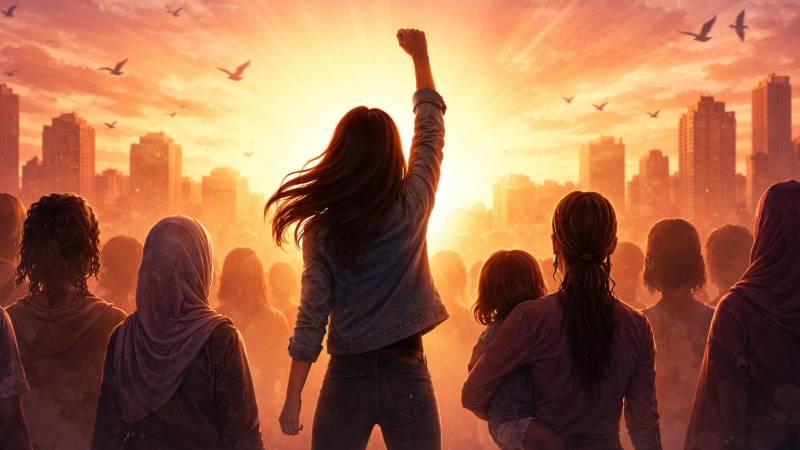
It is International Women's Day again. And again, somewhere in the world, a woman is explaining that what happened to her was not her fault. Again, she is pointing to her clothes, her choices, her geography, her religion, and saying: None of this invited what was done to me. Again, the world is only half listening.
Two images sit with me this week.
The first: a meme, elegant in its quiet devastation, a short skirt, a burqah, and a diaper in the corner that could not even speak. Three garments from three utterly different worlds, united by the same unbearable truth: that no item of clothing, no cultural code, no length of hem or depth of cover has ever protected a woman from violence. Not here. Not anywhere.
The second image is of a seven-year-old girl named Ira Moni, photographed in a hospital bed in Chattogram, Bangladesh, with a feeding tube at her throat, her eyes carrying something no child's eyes should ever carry. She did not survive. She was seven years old. She was not wearing anything "controversial". She was simply a child who existed in a world that had not yet decided her life mattered enough to protect.
This is where I begin. Not with statistics, though I will come to those, but with the particular exhaustion of still having to argue, in 2026, that the dress a woman wears does not cause her rape. That the word "feminist" is not a threat to civilisation. That International Women's Day is not a disturbance to the social order but a reckoning with it.
I have spent more than three decades working on violence against women, girls and children (VAWGC) across sectors, across borders, across the full and often punishing spectrum from research and advocacy to policy and training. What I can tell you from this vantage point is that VAWGC is not a woman's problem.
It is a structural failure. It is a system built to exclude, diminish, and control women, and it operates through silence as much as through force. It operates through the benevolent sexism of the man who "just wants to protect her" and through the silent sexism of the institution that never quite promotes her. It begins before birth, in the preference for a son, and it follows a woman to her grave; sometimes it is what puts her there.
The silent sexism that never announces itself, the assumption, the interruption, the credit quietly transferred to the man standing next to you
Those three decades have given me something I did not ask for: a long, vivid archive of disappointment. I carry it as flashbacks. The podiums I shared with men who were known abusers, men who spoke beautifully about women's rights and then went home to enforce their own version of order.
The meetings where the elitist, patriarchal consensus was so thick you could feel it settling on your shoulders before anyone had even spoken. The women colleagues who had internalised misogyny so deeply that they policed other women on behalf of the very system that diminished them both.
The silent sexism that never announces itself, the assumption, the interruption, the credit quietly transferred to the man standing next to you. The benevolent sexism that arrives dressed as concern: let us protect you, let us speak for you, let us decide what you need.
And then the moments that are harder to say out loud. The times I faced something that deserved to be called out, reported, pursued through whatever path to justice existed, and I stood at the entrance of that path, looked at it clearly, and turned away. Not because I did not know my rights. I have spent my life documenting other women's rights.
But because I also know my auqaat, that untranslatable Urdu word that carries your place, your measure, your social weight on the scale. Because I know what it costs a woman to pursue justice: the burden of proof, the burden of honour, the burden of blame, the burden of every responsibility she carries for everyone else, none of which pauses while she fights for herself.
I know how many women make that calculation in silence and decide the price is too high. I have made it myself. This is not a confession of weakness. It is evidence of exactly how deep the rot goes that even those of us who have spent careers fighting this system are not outside it.
The scale of VAW is not abstract. Approximately one in three women worldwide experiences physical or sexual violence in her lifetime. The international community has developed more than twelve comprehensive frameworks to address its conventions, declarations, action plans, and protocols.
GDP tells you the size of what a country has built. It does not tell you who was sacrificed in the building
In Pakistan, where I have worked most closely, VAWGC is widespread and cemented in systemic gender inequality and patriarchal norms. We have made some legal and policy gains, some of them genuinely hard-won. But our approach remains largely reactive: survivor support after the fact, legal aid if a case reaches a court, health services if a woman survives long enough to access them.
Prevention, the kind that changes norms, reforms systems, and addresses root causes before violence occurs, remains dangerously underdeveloped. We are still, mostly, collecting the wreckage.
The numbers that mark our collective failure are not kind.
The World Economic Forum's Global Gender Gap Report 2024 estimates that at the current pace, it will take 134 years, five generations to close the global gender gap. A senior WEF official said plainly: we cannot wait until 2158.
The UN warned, and Secretary-General António Guterres has repeated before the Commission on the Status of Women, that full legal equality for women — the kind that actually exists in law, not merely in aspiration — could take close to 300 years at our current rate of change. Three hundred years. Our granddaughter's great-great-granddaughter might finally be born into legal equality. Or she might not.
What does this tell us? It tells us we are not in a slow emergency. We are in a generational catastrophe; we have normalised to the point of comfort. The frameworks exist.
The evidence exists. The political vocabulary exists. And still, in 2026, we are explaining to social media comment sections why a seven-year-old's murder is not a talking point but a human tragedy that demands structural reckoning.
On this Women's Day, I want to say something that goes beyond the usual call for more laws and better implementation, though God knows we need both. I want to call for a reimagining of what we measure when we measure progress.
We have organised national success around GDP for long enough: the size of an economy, the rate of its growth, the volume of what it produces. But what does it mean for a country to be "successful" when one in three of its women lives with violence?
What does it mean to have a growing economy when girls are pulled from school to be married, when women vanish from the workforce after childbirth and never return, when entire categories of human intelligence are suppressed before they can contribute anything at all?
The measure of a country's leadership should include whether those who govern have a genuine, not performative, understanding of VAWGC.
Whether they can build real, violence-responsive mechanisms across every system: health, education, justice, economy, and community. Whether they treat the safety of women and children not as a welfare issue but as a core governance responsibility. GDP tells you the size of what a country has built. It does not tell you who was sacrificed in the building.
I do not want another Women's Day of hashtags and high-minded statements from people who will return to business as usual by Monday. I want leaders who understand that Ira Moni's death, and the thousands like hers, are not anomalies. They are the endpoint of a continuum that begins with a joke about a short skirt and a burqah and a diaper and travels through every classroom that never teaches boys about consent, every courtroom that asks what she was wearing, every newsroom that buries the story on page twelve, every parliament that never quite gets around to passing the protection bill.
The meme I described at the opening of this piece is shared by people who believe they are making a point about diversity — that violence crosses cultural and religious lines. It does. But the deeper point it makes, perhaps without intending to, is that we have so thoroughly failed women that the only thing left is dark humour about the universality of that failure. A short skirt. A burqah. A diaper. No protection anywhere. That is not irony. That is an indictment.
I wish for a world on this Women's Day and every ordinary day that follows, where the success of nations is measured not in what they produce but in the safety and dignity of those most vulnerable within them, where VAWGC is understood not as a women's sector issue but as a leadership and governance crisis, where prevention is not an afterthought but the architecture, where little girls grow up to become old women unharmed, unhurried, and fully, legally, substantively equal.
We have the knowledge. We have the frameworks. What we have not yet found in enough quantity and enough places is the political will that treats women's lives as genuinely non-negotiable.
That is what I am asking for. Still. In 2026.