

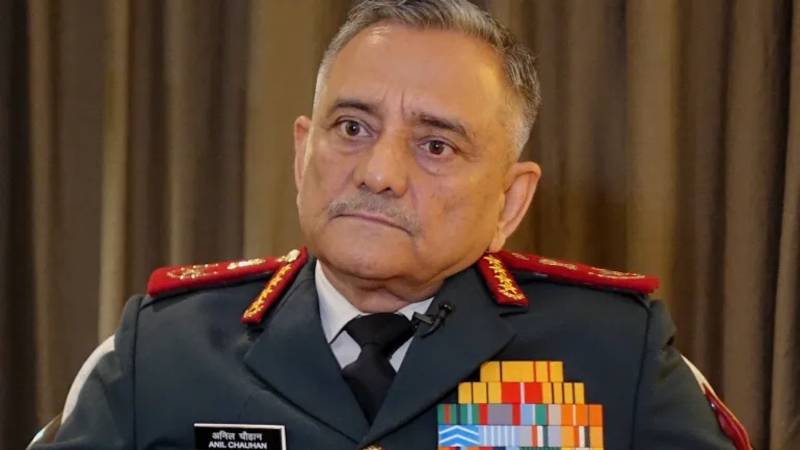
On May 31, on the sidelines of the Shangri-La Dialogue 2025 in Singapore, India’s Chief of Defence Staff Gen Anil Chauhan admitted – the first time by an Indian government official on record – that the Indian Air Force had lost some fighter jets to the Pakistan Air Force. However, he went on to say some odd things, not least among them that it wasn’t important how many jets India had a lot but how they had been lost, and if lessons had been learned.
He said lessons had been learned by India, so much so that within 48 hours, the Indian Air Force was fully operational again and up and running and carried out attacks “deep inside Pakistan”.
First of all, it makes for odd logic for the head of a country’s military to say in the same breath that while fighter jets had been lost to the adversary, it wasn’t important because what was important was how they had been lost. For the head of a military to say this is mind-boggling, not least because losing 5-6 of your fighter jets, including 2-3 of the main flagship jets, the Rafales, in around 60-90 minutes would indicate that you lost badly and were on the back foot from the very beginning.
Furthermore, since both India and Pakistan have repeatedly said that their air force did not cross into each other’s airspace and battled from their sides of the Line of Control or international border, the Pakistan Air Force downing 5-6 Indian Air Force jets all inside India is no mean feat. It also indicates that if Pakistani jets can do this from within their airspace then how safe really are IAF jets when they are airborne?
General Chauhan needs to be reminded – and this is basic common sense – that numbers do matter of course when you enter into a battle or war with an adversary
The Indian Chief of Defence Staff claimed that two days after losing several IAF jets to the PAF, the IAF was back in the air, striking deep inside Pakistan.
The truth is that two days after losing several IAF jets to the PAF, the IAF was still very much grounded, and the entire fleet of the prized Rafales was well over 300 km away from the border, away from the range of the PL-15 missiles of the PAF fighter jets.
The truth also is that two days after losing several IAF jets to the PAF, the IAF was not used at all, and instead dozens, if not hundreds of drones were fired into Pakistan. Clearly, India didn't want to risk losing more fighter jets to the PAF.
As for striking deep inside another's territory consider where the IAF jets crashed: Bhatinda in Indian Punjab: 95-100 kilometers from the international border; Avantipura: 85 kilometers from the Line of Control; Pampore: 65-70 km from the Line of Control; Ramban: around 100 kilometers from the Line of Control; and Beas: 65 kilometers from the international border.
So if Pakistan could shoot down 6 Indian fighter jets without even crossing into Indian airspace ground the entire IAF and force the Government of India to keep it at least 300 kilometers from the border with Pakistan – till the conflict ended as the ceasefire was announced – imagine what it could have done had the aerial conflict happened again.
In fact, on June 3, former Pakistan Foreign Minister Bilawal Bhutto Zardari, who is leading a high-level delegation to the UN and the US to press Pakistan’s narrative, told a press conference in New York at the UN that during the aerial combat, Pakistan had locked 20 Indian fighter jets but downed only six, and the reason for that was that they had been directed to exercise maximum restraint and (presumably) attack only those aircraft that had fired missiles into Pakistan.
General Chauhan needs to be reminded – and this is basic common sense – that numbers do matter of course when you enter into a battle or war with an adversary. Of course, tactics are important, and if you suffer losses one’s tactics must be examined or re-examined and changes made for future conduct of war or battle. Furthermore, the bigger the magnitude of losses, the more extensive the weaknesses in one’s strategy and tactics.
Moving on to the current phase, where both countries have sent in delegations to various world capitals to press their narratives to overseas governments. Pakistan has an edge because of its military prowess in the aerial battle that was fought which severely crippled the Indian Air Force, so much so that it had to be grounded till the ceasefire was announced.
Pakistan has chosen its main delegation which has gone to the US and the UN well with the ablest and most articulate of speakers in Bilawal Bhutto Zardari, Sherry Rehman, and Hina Rabbani Khar (all former ministers and current Members of Parliament). They are doing an excellent job and a couple of points they should also reiterate before their overseas interlocutors: 1. That India’s stated ‘new normal’ of assuming that Pakistan would be behind any future terrorist attack is dangerous in itself and needs to be recalibrated and 2. Pakistan does not have anything to do with what happened at Pahalgam and has no interest in such incidents being repeated in the future.