

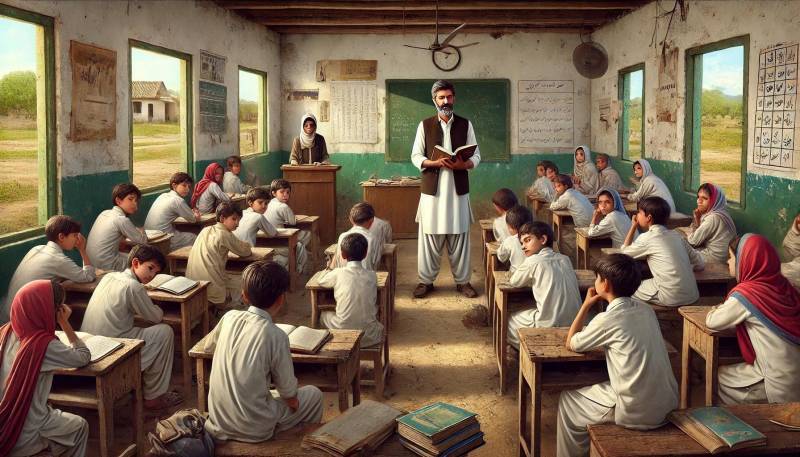
Muhammad Ali Jinnah, the founder of Pakistan, once stated: “Education is a matter of life and death for our nation.” Yet, decades after independence, Pakistan continues to take this matter for granted. Successive governments—and indeed the people—have deferred responsibility, placing blind faith in divine intervention rather than structural reform. The question arises: why did Jinnah accord such gravity to education, calling it a matter of existential importance?
The answer lies in his understanding of reality—the competition, the urgency, and the harshness of the world. Jinnah knew that a nation’s survival and prosperity hinge upon its intellectual strength.
Pakistan is ranked 125th out of 130 nations in terms of education—a damning reflection of its misplaced priorities. For the masses, what seems to matter more is not how they are governed, but who governs them—a cricketer, an industrialist, or a landlord. They never questioned, they never question, and hopelessly, they may never question. This absence of critical inquiry lies at the very core of the crisis.
From primary to secondary levels, Pakistani students study a fixed set of subjects: English, Urdu, Mathematics, Science, Islamiyat, and Pakistan Studies (or its variants such as Civics or Geography). These subjects ought to lay the foundation for scientific reasoning, ethical awareness, linguistic competence, and critical thinking—yet we rarely question why they are taught, or how they are taught.
Take Mathematics, for instance. It becomes increasingly complex in secondary education, yet students are seldom introduced to its foundational philosophy or real-world significance. Mathematics is not just numbers; it is the language of logic, the core of algorithms, and the engine of technological progress. From programming languages to Wall Street trading models, mathematics governs modern civilisation. Yet in Pakistan, it is reduced to rote formulas and meaningless theorems.
This failure to contextualise knowledge is precisely what prevents Pakistan from producing globally recognised scientists, engineers, or economists. We are trapped in a curriculum that neither fosters imagination nor nourishes inquiry.
Philosophy, the mother of all knowledge, offers cognitive tools to dissect reality. It fosters scepticism, enhances reasoning, and challenges perception
Science in Pakistani classrooms is a matter of memorisation, not exploration. The wonder of the scientific method—its reliance on curiosity, questioning, and critical analysis—is lost in a haze of exams and regurgitated facts. Long before science became part of modern schooling, it was philosophy that taught us the cause-and-effect principle, encouraging humans to ask why. The disciplines of science and philosophy were once inseparable.
Philosophy, the mother of all knowledge, offers cognitive tools to dissect reality. It fosters scepticism, enhances reasoning, and challenges perception. It does not always provide answers—but as Bertrand Russell wrote, it gives us more profound questions to ponder. It gifts us better questions. And yet, philosophy has all but vanished from our academic spaces.
This wasn’t always the case. Great scientists such as Einstein, Heisenberg, Schrödinger, and Oppenheimer studied philosophy. Their revolutionary scientific contributions were born out of philosophical reflection. Without that grounding, perhaps they would never have ventured so deeply into the unknown. Consider quantum physics—a field so counter-intuitive it challenges our very understanding of reality. Such a field could only emerge from a mind willing to entertain paradoxes and abstractions, sharpened by philosophy and fuelled by curiosity.
“What we observe is not nature itself, but nature exposed to our method of questioning.” —Werner Heisenberg. Meaning: knowledge is limited by our capacity to question. From this single quote, the value of inquiry becomes evident.
Carl Sagan once remarked in an interview, “You go talk to kindergartners or first-grade kids, you find a class full of science enthusiasts. They ask deep questions. They ask, ‘What is a dream? Why do we have toes? Why is the moon round? What is the birthday of the world? Why is grass green?’ These are profound, important questions. They just bubble right out of them. And then you go talk to 12th graders, and there’s none of that. They’ve become incurious. Something terrible has happened between kindergarten and 12th grade.” This situation aptly describes Pakistan’s education system. Something truly terrible has happened—and no one ever questions it.
Education is meant to be knowledge and awareness. “Knowledge for the sake of knowledge is a motto of fools,” said Allama Iqbal. Knowledge without practicality and action is empty. Since life is a constant course of actions and reactions (Newton’s third law of motion), Pakistan will remain in its state of perpetual inertia unless a new force is applied (Newton’s first law). That force, undoubtedly, is education.
Education with modern methods, with an enhanced curriculum and the incorporation of the Socratic method at every level, is the demand of our times. The supply, however, is dismal. If this demand remains unmet, the country will begin to feed on its own blood—defying the laws of economics, morality, fairness, and justice. To prevent this, strict and urgent reforms in education are not optional; they are essential.
There are some lies that, as Plato noted, are necessary to harmonise social order—he called them “noble lies.” A nation may require myths to stay united. But in Pakistan, the lies we have institutionalised—through redundant subjects like outdated Pakistan Studies, ritualised Islamiyat, and obsolete curricula—only serve to make us unthinking patriots, strictly bound to religion, and participants in herd mentality. And so, we shall keep mourning the fall of our nation, our dreams, and the despair of our futures.
As for the state’s justification for teaching these subjects in the way they are currently taught, our security forces already remain ever-prepared to detect and neutralise any perceived threat to national security—requiring neither academic explanation nor civil critique.
The final question: will this hopelessness sustain? Or is there any chance for Pakistan’s renewal?
The world is a complex system of algorithms, probabilities, statistical uncertainties, and randomness. No mind on earth can predict when a black swan will appear—when, amid chaos, someone will rise or fall on this grand theatre of history. There are no certainties. But here’s the twist: quants—the brilliant minds behind financial predictions—still rely on mathematical models and statistical logic to foresee what stock may rise, what opportunity may yield profit. They try. They keep trying.
And so must we.
What it takes is awareness, carefulness, and timely execution of well-devised plans. There is no magic in this world. If one still believes that magic is real—whether out of ignorance, herd psychology, or religious sentiment—they would do well to believe in the fortune-telling of their national demise.