

"The greatest deception men suffer is from their own opinions." – Leonardo da Vinci
Da Vinci was right. When journalists, entrusted with illuminating truth, allow themselves to be guided by convenience or ambition, they are not merely deceived but they become instruments of deception themselves. Society is left not just in injustice but in a shadowed twilight where reality itself becomes negotiable.
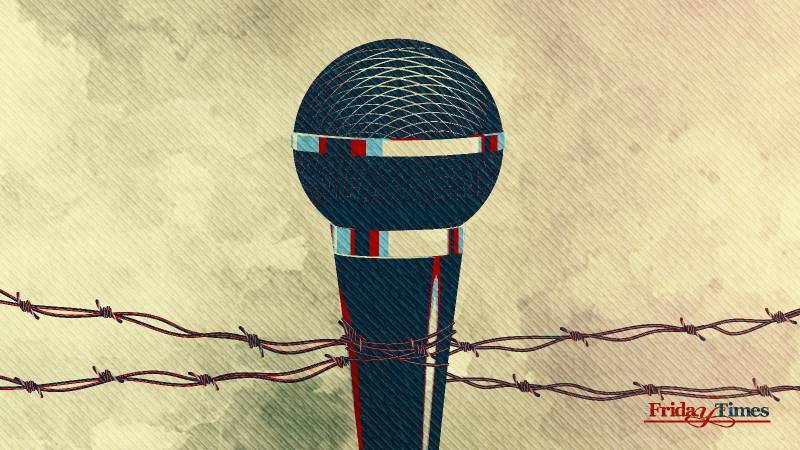
There is a weight, almost unbearable, in watching a society betray itself. In Pakistan today that weight presses down on the media with suffocating inevitability. The press is a sacred sentinel of truth; it carries the duty to question power, to illuminate the shadowed corners where laws bend like reeds in the wind, and to protect citizens from the whims of arbitrary authority. Yet now, in some quarters, it seems that duty has been quietly handed over to convenience.
A troubling segment of our media has transformed into couriers, not watchdogs, ferrying the messages of the powerful with the mechanical efficiency of food delivery boys. They deliver narratives into living rooms, unsorted and unquestioned, as though conscience were an optional extra. They barefacedly explain away the suspension of constitutional liberties, the erosion of fundamental rights, and punishments being meted out to the public in general and Pakistan Tehreek-e-Insaf (supporters, workers and leaders) in particular, without fair trial. Prime facie, in their world, journalism is no longer a calling but a conveyor belt.
Irony adds a bitter spice: many of these very journalists now occupy top positions in major news channels. They are frequently invited as panellists or hosts, where they propagate and defend the narratives of the powerful. In these gilded roles, they not only justify illegalities and injustices but also confer upon them a patina of legitimacy, shaping public perception to protect the forces that corrode democracy and the rule of law. One cannot help but marvel at the theatrical audacity of it all.
A journalist who predicts verdicts, rationalises oppression and delivers tyranny disguised as inevitability is not a journalist
The Supreme Court of Pakistan itself has repeatedly affirmed that justice must not only be done but must be seen to be done. And yet, the same journalists announce judicial outcomes as foregone conclusions. These purveyors of news forecast court judgments before a single gavel falls. Night after night, they narrate verdicts with eerie certainty, as if the chambers of justice had whispered their secrets into eager ears. Their certainty, far from comforting, casts a shadow over the judiciary itself. If verdicts are known beforehand and outcomes appear choreographed, then justice begins to resemble a performance staged behind velvet curtains rather than a solemn act of law. The notion of an independent judiciary falls like a house of cards. Montesquieu’s principle of separation of powers, enshrined in our constitutional parlance, becomes a quaint relic when the public suspects that courts serve as instruments of political theatre. The condition of the judiciary post–26th Constitutional Amendment further strengthens this belief.
Freedom of expression, like justice itself, is indivisible. Article 19 of our Constitution, reinforced by our superior judiciary in a catena of judgments, protects not only convenient speech but also the inconvenient, the offensive and the uncomfortable. Yet here we witness these media commentators willingly shrinking the boundaries of their own rights. They have reimagined and reinterpreted free speech into an ironic farce: it now means never questioning the powerful but instead acting as their postman, mouthpiece and apologist. To allow even a part of the press to look away selectively is to make it both witness and accomplice to suppression. As John Milton argued in Areopagitica, truth must be allowed to wrestle with falsehood. But in Pakistan today, that wrestling match has been prearranged, the outcome preordained, and truth politely left at the door.
Not all journalists have fallen prey to convenience. Many continue to report with integrity and courage, often at enormous personal risk. Their voices may be few, sometimes drowned in the clamour, yet they are proof that true journalism – the journalism of courage, truth, and accountability – still survives. Countless Pakistani journalists have paid the ultimate price for defiance: murders, abductions, prosecutions, torture, and relentless threats have been their lot. Yet they persist. They raise their voices against illegality, resist censorship, and keep alive the fragile flame of truth. By contrast, those who have sided with injustice and are parroting power’s narrative, rationalising unlawful acts and silencing conscience, are committing a grave disservice. They betray their profession and the people they were meant to serve. To side with oppression is not neutrality; it is complicity.
History offers unflinching lessons. In Nazi Germany, the press became a propaganda machine; in the Soviet Union, the newspapers turned into vessels of state orthodoxy. But history remembers the same not as journalism but as shameless facilitation of tyranny. A journalist who predicts verdicts, rationalises oppression and delivers tyranny disguised as inevitability is not a journalist. Journalists’ fidelity is to truth and justice. A journalist’s task is not to explain why the mighty act as they do but to scrutinise whether such acts can withstand the test of truth and legality. It needs to be noted that a press that allows parts of itself to become a courier of power – delivering messages into households like Uber Eats – ceases to be a pillar of democracy. Those who take up this role are collaborators in the erosion of justice. Their disservice is not measured in words alone but in the silencing of truth and the suffering of citizens left defenceless.