

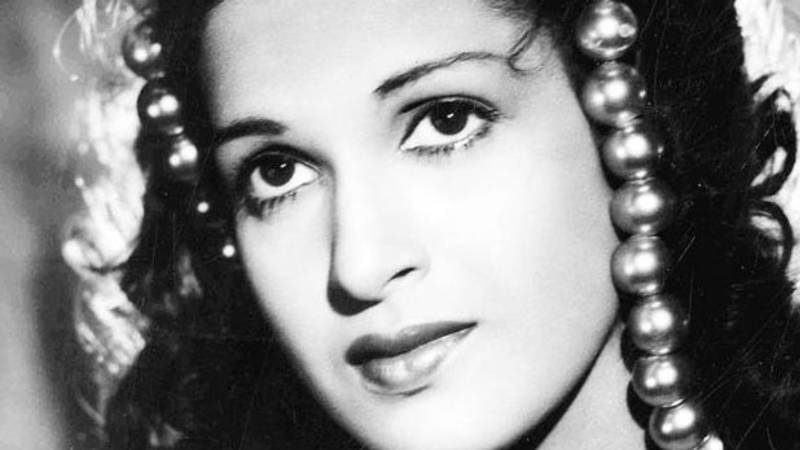
It was 1946 when Neecha Nagar was released. The film was a great success, winning an award at the Montreal Film Festival. A student of Kinnaird College, in her very first film, had touched the heights of fame. But the story was yet to take another turn. With her debut, Kamini Kaushal became a star, though being a star had never been her dream. It was a mere chance that drew her into films. Life often chooses our path. More offers followed. Around the same time, Dilip Kumar too had begun his career, with his first film Jwar Bhata released in 1944. In his personality was calm dignity; in his speech, a refined cadence. Though not his mother tongue, his Urdu flowed like that of a native speaker. Kamini, by contrast, was lively and mischievous, her charm bubbling over. At first sight, Dilip Kumar fell in love with her. The feeling was mutual. She, too, was drawn to his magnetic personality. Together they acted in films such as Nadiya Ke Paar (1948), Shaheed (1948), Shabnam (1949), and Arzoo (1950). The pair was much loved on screen, and in real life, they dreamed of a future together. But fate had other plans.
One ordinary day in Lahore, Kamini received devastating news. Her elder sister, Usha, had died in a road accident, leaving behind two tiny daughters, Kum Kum and Kavita, aged two and three. Kamini’s heart ached: what would these little ones do in the vast world without their mother? Before her stood the innocent faces of the children, and on the other side, her love for Dilip Kumar. It was no easy choice. After days of inner struggle, she resolved to marry her late sister’s husband, only so she could raise the children. No one in the family influenced her decision; it was hers alone. When Dilip Kumar heard, he was shattered. He had dreamed of a lifetime with Kamini. This wound never left him. In his autobiography Dilip Kumar: Substance and the Shadow, he would later confess that Kamini Kaushal was his first love.
By marrying for her nieces’ sake, Kamini not only gave up her love but also sacrificed another dream, her wish to do an M.A. in English. But she knew, sometimes in love, one must lose it all. Meanwhile, India was divided. Lahore, her beloved city, her childhood home, her cherished Kinnaird College, she had to bid them all farewell. The Partition had changed everything. Her next stop was Bombay, where her husband worked as Chief Engineer at the Port Trust. Often, marriage ended the careers of actresses, but Kamini’s first film had already made her a sought-after star. Filmmakers offered her roles, and her husband encouraged her. Thus, she returned to the cinema.
People are right, one may leave Lahore, but Lahore never leaves you
She went on to act with the greatest names of her time: Raj Kapoor (Jail Yatra, Aag), Ashok Kumar (Poonam, Night Club), Dev Anand (Ziddi, Sheer), and, of course, Dilip Kumar. Their pairing remained beloved on screen, though in life Kamini had drawn her boundaries. Marriage and children were her true centre now. One of her finest films was Biraj Bahu (1954), directed by Bimal Roy and based on a Bengali novel. Her performance won her the Filmfare Award for Best Actress.
Time flows, and change is the essence of life. Kamini was no longer the sprightly girl of Lahore. Life and responsibility had deepened her. From heroine, she became a character actress, yet her art never faltered. In 2019, she won the Screen Award for Best Supporting Actress for Kabir Singh.
In 2025, Kamini Kaushal is ninety-eight, still alert in mind. She lives in Bombay, her home filled with plants and flowers, a legacy of her father, the renowned botanist. She has known wealth, fame, and honour. Yet when alone, her heart drifts to Lahore, to her childhood home, to Kinnaird College. She returned once, in 1962, and stood again before the house that haunted her dreams. Now others lived there, but they welcomed her warmly. Much of the house was unchanged. Neighbours greeted her with affection. For a moment, it felt as if time had turned back. She visited Lahore twice more, once attending reunions at the colleges. To walk again through those halls, to meet her old classmates, was unforgettable. Decades have passed since she left Lahore, yet the city still beats in her heart.
In her dreams, she finds herself again in the old house, with its tall eucalyptus trees, its citrus hedge, its bright flowerbeds, the driveway, and the home beyond. Even now, sitting in her Bombay home, she closes her eyes, and in her imagination wanders once more through Lahore’s streets. A smile crosses her lips as she whispers to herself: People are right, one may leave Lahore, but Lahore never leaves you.