

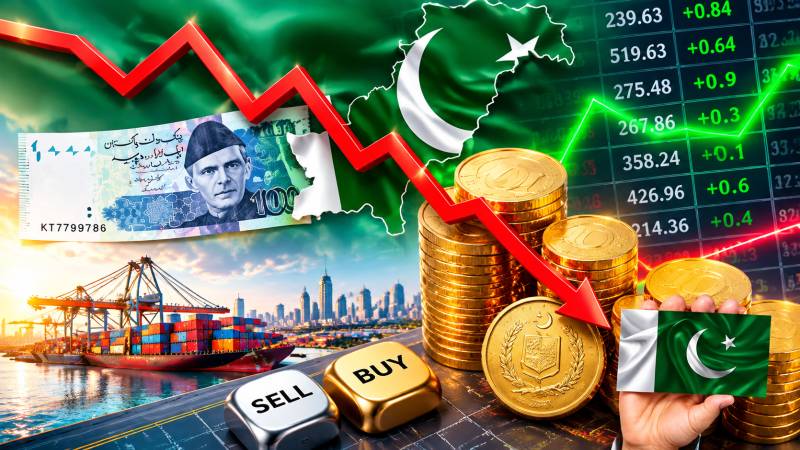
Economists argue that a currency must reflect a country's economic fundamentals. They are right. Artificially supporting an overvalued rupee subsidizes imports, penalizes exports and creates distortions that cannot be sustained. Yet Pakistan's repeated devaluations raise a fundamental question: why do our economic weaknesses persist, and why has devaluation failed to deliver sustained improvements in exports and economic performance?
I have long viewed Pakistan's economy as a car, with politicians in the driver's seat, an increasingly interconnected global economic and geopolitical system as the road, and four wheels representing its principal economic levers. The car's speed represents the strength and stability of the rupee.
The first wheel is macroeconomic stability: inflation, growth, interest rates, fiscal discipline, the tax-to-GDP ratio and government borrowing. Persistent deficits and excessive public borrowing crowd out private investment. Inflation erodes purchasing power, while high interest rates discourage expansion. A stable currency cannot be sustained by an unstable fiscal foundation.
The second wheel is foreign exchange demand and supply. Exports, remittances, investment, imports and import substitution, repatriation of profits and capital, domestic raw materials, tariffs and exchange controls all matter. Competitive exports and productive investment help finance foreign exchange requirements. Remittances provide valuable support but cannot replace export-led production and employment. Import restrictions may conserve dollars temporarily, but limiting machinery and industrial inputs can undermine future exports.
The third wheel is economic freedom and governance. Red tape, arbitrary regulation, ineffective courts, unreliable land records, deficient transport and communications, corruption, harassment, insecurity and opaque markets make business unnecessarily difficult. Economic freedom means predictable rules, enforceable contracts, competitive markets and institutions that facilitate enterprise. When formalization exposes businesses to harassment and bureaucratic discretion, the country loses investment, tax revenue and productive potential.
The fourth wheel is productivity and competitiveness. Education, technical and management skills, technology, energy costs, taxation, production efficiency and value addition determine whether businesses can compete internationally. A cheaper rupee cannot indefinitely compensate for unreliable electricity, costly financing or inefficient processes. Sustainable currency strength requires producing more value, not simply charging fewer dollars for existing output.
The condition of these four wheels determines how well the economy performs. Equally important is the driver. Political leaders who are inexperienced, compromised or short-sighted may lack the competence, independence or willingness to maintain the wheels and undertake the structural reforms necessary to keep the economy moving.
This analogy helps explain the limits of devaluation. A weaker currency makes exports cheaper for foreign buyers and imports more expensive for domestic consumers, encouraging exports and import substitution. In a productive economy with diversified industries, reliable energy and spare capacity, exporters can increase output. Pakistan, however, depends heavily on imported fuel, machinery and intermediate goods. Devaluation raises those costs almost immediately, eroding the competitive advantage a weaker currency was supposed to create.
A stable currency cannot be sustained by an unstable fiscal foundation. Persistent deficits, excessive public borrowing and inflation undermine the economic fundamentals required to support the rupee.
The consequences extend beyond exporters. Higher import costs feed into electricity, transport, food, medicines and household necessities. Inflation erodes wages and savings. Monetary authorities may raise interest rates to contain inflation expectations, constraining investment. Foreign-currency debt servicing becomes costlier in rupee terms. When productivity and exports fail to improve sufficiently, foreign exchange pressures return. Another devaluation follows, often before the previous adjustment has delivered its promised benefits.
Pakistan thus risks a recurring cycle: weak institutions and low productivity create external imbalances; devaluation raises inflation and production costs; investment and growth suffer; structural weaknesses persist; and the rupee comes under renewed pressure. Devaluation is not inherently wrong. But adjusting the exchange rate without repairing the economy repeatedly treats a symptom rather than the disease. There is also a human dimension. Devaluation is not technically a tax, but in an import-dependent economy it can impose a burden much like a regressive tax. Prices of essentials rise while poorer households' incomes often do not. Those least responsible for the economy's weaknesses can bear the greatest hardship.
An artificially strong rupee is no lasting solution either. It can encourage excessive imports, drain reserves and ultimately force a more painful correction. But accepting the need for devaluation does not mean ignoring who pays its price. Policy must address recurring currency weakness rather than repeatedly transferring adjustment costs to ordinary households.
Why do the wheels remain damaged? Structural reform requires political decisions whose costs are immediate and benefits may take years. Broadening taxation challenges influential interests. Restructuring state enterprises confronts entrenched beneficiaries. Reducing bureaucratic discretion threatens privileges. Empowering local governments requires transferring authority and resources. Political instability and geopolitical pressures can further narrow the space for reform. Governments too often prefer short-term relief to sustained institutional change.
Economists are right that exchange rates must reflect economic fundamentals; accountants, bankers and businesspeople must accept, as Dr Nadeemul Haque argues, what that mirror shows. We must understand that manipulating the rupee value through administrative measures cannot change the economic reality it reflects. The PKR may appear stronger on paper, but underlying weaknesses will manifest themselves elsewhere in declining export competitiveness, widening underlying current account imbalances, reduced investment, and distorted markets.
The strength of the rupee should therefore be an outcome of sound economic management, not an objective pursued through arbitrary controls. If Pakistan genuinely wants a stronger currency, it must focus squarely on accelerating structural reforms that improve productivity, competitiveness, economic freedom, fiscal discipline and governance. Turning the PKR's exchange rate into a political or emotional issue merely takes our eyes off the ball. This is a lesson for everyone—economists, accountants, bankers, businesspeople, politicians and the establishment alike. Repair the four wheels, put a competent driver behind the wheel, and the car will find its speed—even on a bumpy road.