

The Justice Munir Commission Report came in the wake of the Ahrar violence of 1952-53 in Lahore. Among many things, it reported of an education fund that was supposed to have been spent on the government’s adult education program, but was diverted towards four lesser known publications that were preaching and inciting violence as mouth organs for a contentious radical religious party. This was one of the factors that turned out to be responsible for amplifying hate towards Ahmadi communities.
Justice Munir’s enquiry further found the involvement of the Director of Public Relations while the Chief Minister had this in his knowledge but he chose to remain complacent at this gross, despicable act. A choice was already made on where to set the priorities. As a consequence of this and many other similar repeated stories, we are now faced with a self-created monster that no one can stop. The problem is that we have been systematically robbed of having any rational thought and conscience to make right the very wrongs made in the past. Unbeknownst, perhaps, of how this would that translate in the end, but it is safe to say, the state became an accomplice early on, just by not taking actions, or by politically appeasing hateful campaigns run by religious parties at the cost of education.
A similar story is unfolding with the National Commission for Human Rights inquiry report in November 2024 on blasphemy cases, and it mentioned the involvement of some officials of the FIA Cyber Crimes Wing working in connivance with common complainants in indicting young men and women for a capital punishment crime. The report recommended scrutiny over FIA officials using their authority to invoke PECA clauses against individuals, and also called for disciplinary actions against officials over illegal arrests or soliciting bribes.
The report came at a time when the Punjab Special Branch’s own earlier report revealed the same: where FIA officials were involved in money extortion and blackmailing through entrapment of the youth. Former Inspector General of Police (IGP) Syed Kaleem Imam also spoke in his TV interview of the substance highlighted in the reports concerning the FIA’s misconduct.
On the other hand, the radical religious parties and the lawyers involved in alleged crime are riling up public sentiment to discredit mounting evidence of the malicious intent of some officials and lawyers’ groups. Although many names have been mentioned, including two who are also appearing in independent journalistic accounts and reports, these individuals and the institutions that they are affiliated with continue to enjoy state patronage. That they face no consequence for the actions they are involved with, in playing with the lives of the vulnerable, puts a question mark on the state’s seriousness about protecting the vulnerable from exploitation and violence.
Lahore High Court judge Chaudhury Abdul Aziz recently resigned after he ordered not to take “adverse action” based on NCHR report, meaning no investigations were to take place to probe into the involvement of certain names alleged in the ‘blasphemy business’ group. It has recently come to knowledge that back in 2019, the FIA cybercrime wing itself had previously issued an office order to its employees cautioning them to refrain from nefarious activities of blackmailing and extorting money from youth over blasphemy accusations.

Indeed, the two reports furnished by state departments have become a litmus test for the government. It is yet to be seen if any accountability measures will be put in place, or whether the government will just give in to the pressure from threatening religious groups, and thus allow these reports to become discredited or irrelevant.
Lawyers’ forums and threats
An overview of how blasphemy laws have been dealt with at the legislative level, and the permissiveness granted at administrative and social level for cases stemming from these laws, indicates questionable intentions. Even due processes that should have taken place as per the law are hindered by the more aggressive extremist backlash that no one wants to touch. These are reported incidents of intimidation, violence and threats from the many right-wing lawyers’ forums and bodies that have sprung up more specifically since 2000, and continue to grow further, unregulated and unchecked.
A report by the National Commission for Human Rights (NCHR) recommended scrutiny over FIA officials using their authority to invoke PECA clauses against individuals, and also called for disciplinary actions against officials over illegal arrests or soliciting bribes
Today, there is an exponential penetration of extremist and hateful ideologies, thanks to unstopped propaganda, further compounded by the ambiguity of the legislation itself. Those who benefit the most out of this are the radical right parties, and their associated lawyers’ wings that are active in bars and courtrooms. The conduct of lawyers has been under the radar for some time. In 2012, Gabriela Knaul, as Special Rapporteur on the Independence of Judges and Lawyers, made crucial reservations about conduct of the lawyers, especially during a transition phase that saw transfer of power from Musharaf’s dictatorship to a civilian set-up. It mentioned inadequate accountability measures on malpractices and misconduct of lawyers, and also made serious observations on the independence and security of the members of the judiciary hearing the cases about blasphemy. The report also pointed towards the government’s passivity as one reason as to why the members of the judiciary were afraid of the “public sentiment” aroused in the cases that they were hearing.
Just two years after these observations, a notable human rights lawyer Advocate Rashid Rehman was shot dead by extremists in his office for defending the blasphemy accused. It must be noted that in a letter much earlier than the fateful day, he named two members from the legal community, including one lawyer Advocate Zulfiqar Sindhu and another, Ali Sajjad Chawan, among a total of four intimidators, but no action was ever taken to protect his life. Despite the CCTV camera footage and his hurling of death threats before the magistrate in a crowded courtroom, Sindhu was made Assistant Attorney General of Punjab in 2018.He is also backed by the Khatam-e-Nabuwat Lawyers Forum, a group that was founded by Ghulam Mustafa Chaudhury in 2000. They also are responsible for packing courtrooms as a measure to intimidate those hearing the proceedings.
Some other prominent bodies and lawyers’ wings of religious political parties are also the Legal Commission on Blasphemy. The lawyers’ forums of the Tehreek e Labbaik (TLP), and even the legal wings of the Jamat-e-Islami (JI) and of the Ahle Sunnat Wal Jamat (ASWJ) are among the active groups that are intimidating and threatening those who provide legal defence to people indicted in blasphemy charges.
While right-wing lawyers stress on the need to protect the 295 C in order to ensure rule of law and prevent mob violence, yet in the same breath, these groups of lawyers also defend vigilante murderers, despite the fact that their victims were already in police custody, undergoing trials as per the law. In fact, the application of the law has opened many avenues for the exploiters, and the trend has been going on long before the recently discussed pattern of exploitation. In this context, the current trend of a ‘Blasphemy Business Group’ is just another offshoot of a larger phenomenon.
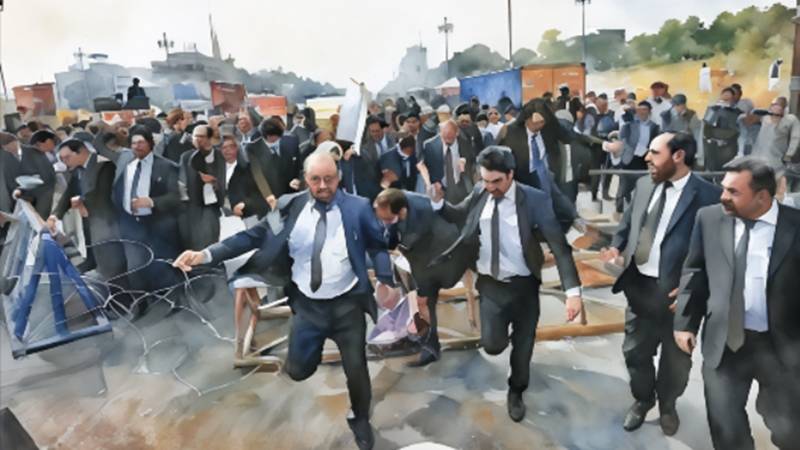
Among many examples to show how proceedings of state organs have been disrupted by these lawyers, a prominent instance was that of PEMRA taking on right-wing celebrity commentator Orya Maqbool Jan over his incitement and anti-Ahmadiyya hate speech on his primetime TV Show. He was issued a show-cause notice and summoned to the PEMRA office. Orya Maqbool Jan did respond to PEMRA, but by rallying right-wing lawyers on his social media a day before. So, the next day, they surrounded the office and hurled abuses and threats to disrupt the proceedings. The defenceless officers succumbed to this highly charged group and withdrew the notification in the absence of protection.
That lawyers’ influence in courtroom proceedings jeopardize everything is an affront to the spirit of a fair trial as enshrined in the constitution. Besides the Special Rapporteur's observations on the independence of the judiciary, the International Commission of Jurists (ICJ) in its 2015 report titled Blasphemy on Trial in Pakistan highlighted that the reasons for why more than 60% of the verdicts of lower or trial courts in blasphemy cases had to be overturned by the Supreme Court due to political motives or other personal vendettas. Another observation that it made was that members of the judiciary hearing blasphemy cases were known to have made public calls for hanging people who stood accused, and other incitements.
It must not be forgotten that in 2011, a former Chief Justice of Lahore High Court and also former judge were among those who called on lawyers in support of a vigilante, Mumtaz Qadri, during proceedings at the Supreme Court. The call had been rallied by Namoos-e-Risalat Forum, which is known to become active for religious sloganeering and disruption – a powerful intimidating method because of the sheer sentiments attached with it. With weak accountability in place, questions are bound to rise internally and also globally.
History of the laws and discussions on their misuse
A result of India’s first Law Commission in 1837, the groundwork for codified laws to address blasphemy were laid in the Subcontinent, with Hinduism and Islam being the major religious communities at the time. By the time these laws were formalized in 1860, they were considered pragmatic from the perspective of maintaining harmony and law and order.
Progressives in Great Britain mobilized against such laws at home due to their favouritism toward a single belief system, while simultaneously idealizing blasphemy laws under the Indian Penal Code for the Equity Doctrine they provided. In his essay on historical perspectives of blasphemy, David Nash, a professor of history who has written extensively on blasphemy in Europe, narrates the role these laws played in debates leading to their repeal in Britain—debates that, decades after the first introduction of a repeal bill, culminated in the Racial and Religious Hatred Act of 2006.
Even as discussions on repealing such laws were underway in Britain, debates on strengthening such laws in colonial India gained momentum in 1927 following a controversy sparked by the publication of a book that incited communal unrest. This controversy became the basis for introducing Clause 295-A. On one occasion, the Muhammad Ali Jinnah, who would go on to become the Quaid-e-Azam of the Muslims, proposed incorporating certain protections and freedoms, stating in the following words:
“Those who are engaged in historical works, those who are engaged in the ascertainment of truth and those who are engaged in bona fide and honest criticism of a religion shall be protected.”
The fear of misuse has been raised in recent years, with critics arguing that the law has stifled freedom of thought and expression, as well as the ability to investigate those who commit fraud using religious beliefs. The fundamental concern is that for any offense against religion to be criminalized, it must be accompanied by an exhaustive definition of that religion.
In present-day Pakistan, the question of what constitutes a Muslim sentiment that could be hurt remains vague. What exacerbates the issue is that one religious interpretation may be emotionally damaging to another, depending on the perspective of a particular religious order. We have seen how Ahmadi communities remain disenfranchised in matters of public and democratic participation, facing state prosecution merely for practicing their religious rituals. Such cases make it easier to further intimidate vulnerable communities.
Later amendments to the laws under the Pakistan Penal Code (PPC) were based on protecting the sentiments and sacredness of majoritarian beliefs rather than safeguarding the rights of any religious community. Let us revisit Justice Munir’s report, which revealed that there was not a single definition of a Muslim that could be unanimously accepted.
Later additions to the law in the 1980s, particularly Section 295-C, introduced capital punishment for blasphemy. The architect of this law, Ismail Qureshi, later admitted to a mistake in interpreting scholastic readings concerning the possibility of pardoning a blasphemer. Right-wing lawyers base their arguments on a contentious interpretation, asserting that the absence of pardon and the burden of proof falling on the accused are divine mandates rather than man-made — hence, they aggressively oppose any reform, equating such discussions with blasphemy itself.
However, a 2015 Supreme Court ruling declared that improvements to the law to prevent misuse would not undermine its essence. The ruling stated:
“Any call for reforming the blasphemy law (Section 295-C of the Pakistan Penal Code) ought not to be mistaken as a call for doing away with that law and it ought to be understood as a call for introducing adequate safeguards against malicious application or use of that law by motivated persons.”
Today, we are witnessing faith-based murders in their most horrific form. Countless innocent individuals have been falsely implicated in imagined crimes of faith. On one hand, there is vigilante mob violence; on the other, there is a sense of impunity and emboldening of exploiters due to inadequate legal safeguards. We must repeatedly examine the flaws in our legal system. Chanting slogans like "Sar Tann say Juda" and openly labelling others as apostates or blasphemers is conduct unbecoming of a lawyer.
This is precisely where the state fails—by not enforcing strict codes of conduct and accountability measures within the legal profession, nor reflecting on its own actions to rectify missteps that have led to the entrapment and murder of countless innocents due to extremist mindsets.
The families of over 400 youths implicated in alleged blasphemy cases demand a broader investigation, as the modus operandi of this mafia-like operation suggests possible involvement of the Federal Investigation Agency (FIA), extending beyond a single province. Recent exposés by the National Commission for Human Rights (NCHR) and the Special Branch provide reasonable grounds to suspect gross misconduct within these departments and among lawyers operating under provincial bar associations, which are supposed to enforce regulations and codes of conduct. The lack of action and absence of strong accountability measures reflect nothing but the state’s complacency in the face of a growing threat to public safety.