

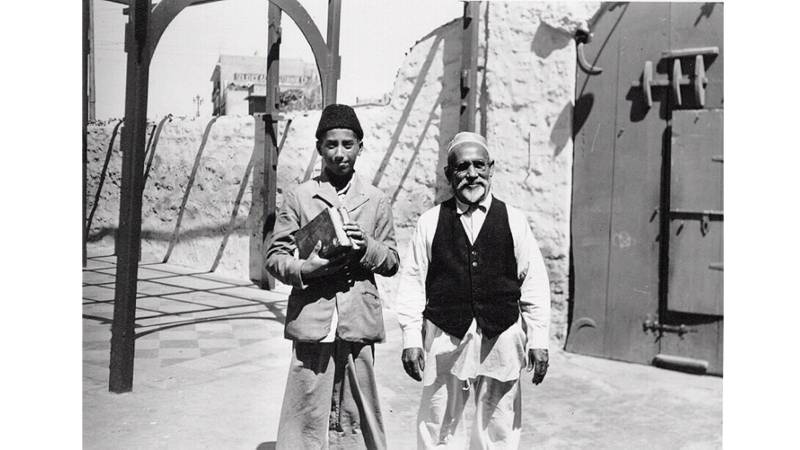
A Flourishing Community
History has a habit of hiding in plain sight. This applies to the Jewish diaspora of Pakistan, whose history has largely faded from the Pakistani memory. To many, it is entirely unknown that a vibrant Jewish community once existed underneath their very eyes, keeping a low profile while most of their fellow Pakistanis were advocating against the creation of the State of Israel in 1948. Despite Pakistan’s increasingly hostile political environment for the question surrounding Israel, this community was quite flourishing within the populous, energetic streets of Karachi. At the heart of the Jewish community was the Magain Shalom Synagogue constructed in 1893. Members of the community became part of Karachi’s commercial and professional life, leaving traces of their presence, such as Edward House, made by a Baghdadi Jew named Moses Somake born in Lahore, the Edward House being named after his son.
However, a pertinent question must be raised: what was the end of this prospering community once living in harmony with their Muslim neighbours and quietly weaving their legacy onto the city?
Three major reasons contributed to the Jewish population eventually getting totally displaced from the Pakistani society over a remarkably short period of time.
Departure
The first nail in the coffin was the major geopolitical shifts during the early formation of Israel, due to the 1948 Declaration of the State of Israel and the subsequent Arab-Israeli war. The sentiments of the masses against the Jewish community shifted to a very hostile nature, causing riots and protests all over the nation and eventually the burning of the Magain Shalom Synagogue. Although the synagogue survived the arson, this act contributed to the migration of the Jewish families mostly to Israel, while a handful of families remained.
Members of the community became part of Karachi’s commercial and professional life, leaving traces of their presence, such as Edward House, made by a Baghdadi Jew named Moses Somake
As the decades progressed, the remaining families found themselves in a dangerous pattern; every time a military conflict shook up the Middle East, the tensions were felt on Karachi’s streets as well. Major escalations during the 1956 Suez Crisis and the 1967 Six-Day War caused the streets to be filled with anti-Jewish protestors and led to further targeted harassment. The majority of the families then shifted to the United Kingdom, Israel, and Canada. The psychological toll of the harassment forced them to move towards a life of secrecy. After the 1960s, some members of the Jewish community could not live as Jews anymore. To avoid harassment, they quietly passed themselves off as Parsis or Christians just to protect their families.
The final blow dealt to the Jews was the state-sponsored Islamisation of Pakistan during the period of President Muhammad Zia Ul Haq in the 1970s and 1980s. The state's aggressive shift towards institutionalising religion left no room for the growth of an openly practising Jewish community to thrive. Rachel Joseph, a former schoolteacher widely known among historians as the last surviving custodian of the Bene Jew community, spent the last years of her life fighting against the erasure of her heritage. She called upon local journalists to voice her battles on the systemic erasure of her place of worship, stating:
"They assured us we would get a new flat with some room for our place of worship. It never happened."
Her brother, Ephraim Joseph Awaskar, who was designated to administer the Magain Shalom Synagogue, passed away in 1987. In 1988, the synagogue was officially demolished, later on being replaced with a commercial plaza.
Today the vibrant history of the lost Bene Jew community is trapped in the architectural ghosts of Karachi, a fading cemetery in Mewa Shah, and a handful of descendants living under assumed identities. For modern Pakistanis, acknowledging this forgotten chapter is not a political statement but rather a step towards reclaiming the rich and dense tapestry of our shared history.