

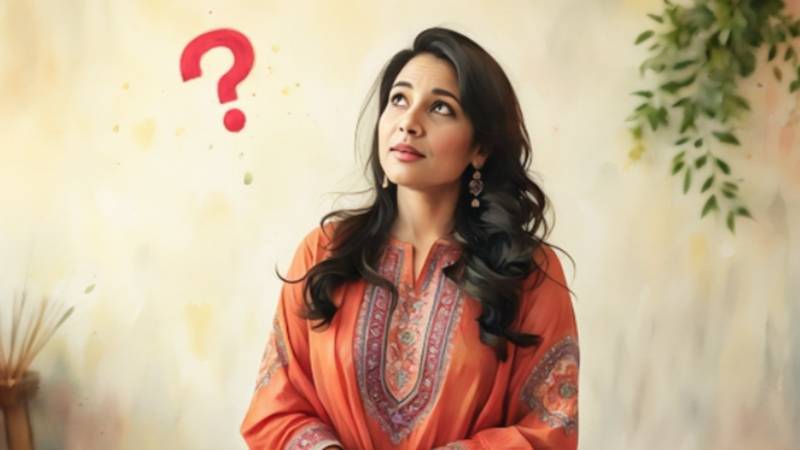
“We should banish “what ifs” from everywhere.”
A cousin's daughter, Aisha recently said this, while wiping away tears from her cheeks. Secretly, my cousin (Sanya) and I both agree with her.
If I said that some of our greatest battles are self-made because instead of letting sanity prevail, we ask “what if” – would you agree? What begins as a small task turns into something colossal – not because what sanity would otherwise dictate grows bigger, but because our fear of the unknown is what grows bigger.
Of course, these are easy words to say and agree with. But this conversation with Sanya and Aisha enlightened me to the epic-ness of the what-ifs in our life, along with how quickly they obscure our judgement.
Loose tooth troubles
I was hosting Sanya and Aisha for dinner, when I asked them to wash up and come to the table; it was Sanya's birthday and she and I were closeknit as cousins. In the backdrop of it all, we had tracks from Talha Nadeem's new album Kahaniyaan on repeat; our favourite, “Ley Chaley” had just started.
At the dining table, I noticed Aisha staring sadly at her plate. Suppressing a grin, I asked, “Do you not like the food?”. For reference, there was biryani.
She sighed, rather dramatically. “No, I love biryani.”
“I won’t be mad if you don’t like it. I made it because I thought you liked it, but preferences change.”
One, slow tear trickled down her cheek and I immediately realized the issue went beyond her taste buds. I tried again, “Aisha, what’s actually wrong?”
She began to sob, “I have a loose tooth and it hurts to eat!”
The woes of childhood.
I glanced at Sanya who was also fighting back a giggle. Trying to remain serious, I replied, “I’m so sorry. Do you want me to pull it out for you?”
She began sobbing harder.
“No, because it already hurts. But if I leave it – it will hurt more, and I won’t be able to eat anything until it falls out. And then I will be hungry. So, do I want my tooth to hurt or my stomach?” She groaned. “It’s so complicated.”
And with that she melted into an endless puddle of tears, her face entirely soaked with her sorrows.
The rabbit-hole of “What Ifs”
After several minutes of Aisha crying and contemplating her options, she finally decided that she wanted her tooth pulled.
I somehow and rather abruptly became the “tooth-puller”, and Sanya became the person whose hand was volunteered to squeeze if needed (she had the harder job, I think).
She sniffled and said, “all those things that I thought could happen made me more scared. 'What ifs' are dangerous! We should banish them from the earth!”
Off we went, in search of some cotton and plopped Aisha down on the living room couch for me to remove the tooth. But when I told her to open her mouth, the sobbing began again.
“What if it hurts more after it’s gone? What if it’s not ready to come out? Or what if it breaks in two? What if I squeeze Mama’s hand so hard that it gets bruised forever?”
Every “what if” triggered more and more tears that led to uncontrollable shaking with fears over one, little, wobbling tooth.
At first, Sanya and I talked it through gently, trying to soothe her fears. But with every passing second, a new “what if” turned up and set off yet another round of tears.
Finally: taking her hands in mine, I looked her in the eyes and said,
“Aisha, you need to stop it.”
She sniffed, wiped at a tear, and gave me a rather offended look. Another reference, I am not one to be easily deterred – if I have made up my mind on something and continued:
“Every “what if” that you come up with will put a new fear on your chest that you do not need to carry right now. And every time you voice those "what ifs", do you see how your body physically responds with fear and frustration? Right now, all you need to do is open your mouth. I’ll do the rest.”
Sometimes the answer is to just stop
As I was talking to Aisha, I couldn’t help noticing the irony of how often I’ve heard The Big Guy Upstairs saying the same thing to me:
“Every time you say “what if,” you put a new fear on your chest that you do not need to carry. Right now, all you need to do is trust me. I’ll do the rest.”
I recalled times where I had been just as tearful, fearful and silly as she was being in that moment. Just as human, really. And, in those instances, I also recalled often asking God why He wasn’t being more sympathetic or compassionate, why He wasn’t answering my questions.
In reality, though, answering those “what ifs” doesn’t banish them. "He" knew that with me, and I knew that with Aisha. Point is, sometimes what we really need, is the firm, gentle command to just stop it. We need that voice saying, “right now, all you need to do is trust me. That’s all. I’ll do the hard work…let me do it.”
We should banish “What Ifs” from the Earth
Aisha eventually did open her mouth and allowed me to remove the tooth. When it was over, I sat her down again and said, “I want you to know I wasn’t angry at you; I had to be firm because your problem was tiny, and your fears were huge. Now that it’s over I can tell you how proud I am of you for being brave and for trusting me even when you were scared.”
She sniffled and said, “all those things that I thought could happen made me more scared. “What ifs” are dangerous! We should banish them from the earth!”
I giggled when she said it, but my whole heart agreed with her. We should totally banish “what ifs” from the earth. And at the very least, we should banish “what ifs” from within ourselves.
Because, in all honestly, we have all been this version of Aisha – at some point in time. We've all been given a task and instead of executing, we let hesitations bind our hearts and minds in fears whose shadows tend to endlessly linger on. And on. And on. And in the process, forgetting about every time that nature does eventually take care of it all.
In an instant, with one indecision that leads to another, with one hesitation that starts small but grows bigger, a simple task somehow becomes a colossal mess of tears. And it takes just one question, one hint of doubt instead of immediate action – for this to happen.
I truly do believe that some of our greatest battles are self-made. Because instead of simply actioning…we ask, “what if”.
To banish “What Ifs” just trust and obey
Growing up, I had a lot of fears; in more ways than one and several decades later, I still do. We know that The Big Guy upstairs has our backs – provided our faith is strong and conviction (there) is in place.
Because, see: trust banishes “what ifs” and replaces them with “even if”. It doesn’t agonize over the probability of something happening, but rests in the reality that even if it does happen…nature will handle it, in its due course. It's like how the song playing in the background says:
Maan ki batain bol dene se khulengy rasty
Har subha manzil nae hogi nazar k samne
Ye Kahani zindegaani ki nahi aansaa magar
Aasmanoo mai kahien aik roshni hai muntazir
So, what are the “what ifs” in your life? I have been thinking a lot about mine and I know that the smaller ones that I don’t catch will grow into giants that will get the better of me.
Here I am, then; taking Aisha’s advice: banish the “what ifs” from my heart, mind and soul – where they don’t belong, anyway. And replace those doubts with a firm trust in the process, because:
Ye Junoon aage bhi yun lejaega jahan