


In an era when human connection is getting compromised and weaker by the day, there appear to be fewer avenues to reclaim the glory of those times when people waited weeks – and, in some cases – months to receive the response to a letter they had carefully penned and sent. The proliferation of social media applications has caused the new generation to detach itself from everyone, including their loved ones. In this whole scenario, coming across a book based entirely on epistles feels like a godsend.
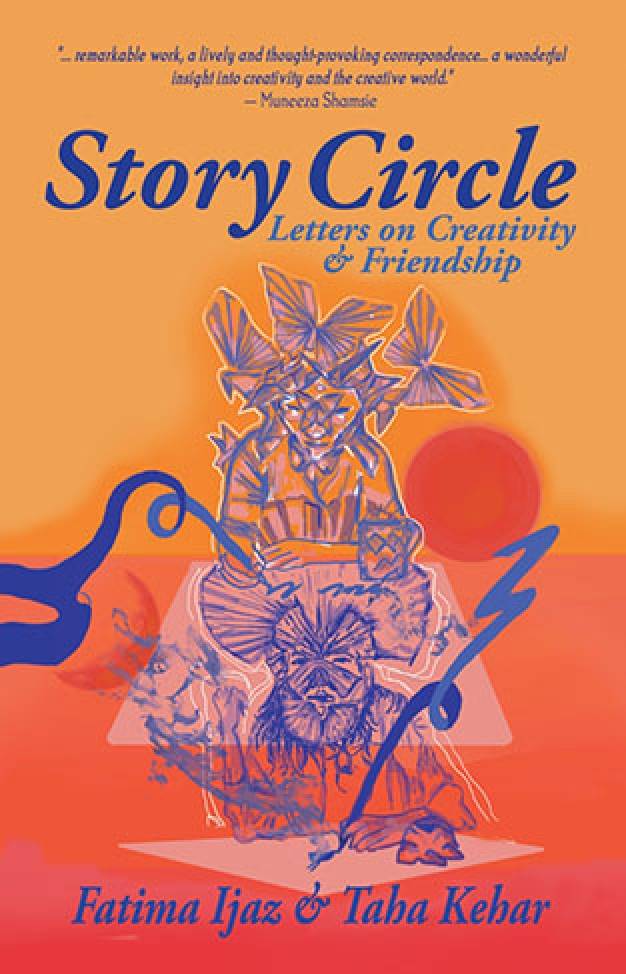
The book Story Circle: Letters on Creativity and Friendship is a compilation of 48 letters co-authored by Fatima Ijaz and Taha Kehar. Ijaz is a poet, essayist and editor primarily known for her poetry collection The Shade of Longing (2021) and her chapbook Last of the Letters (2024). Originally a Karachiite, she is currently based in Morrisville, Pennsylvania. Taha is a novelist, short story writer, academic and journalist working in Karachi. His works include Of Rift and Rivalry (2014), Typically Tanya (2018) and No Funeral for Nazia (2023).
At the time of writing these letters, shared as emails and printed in the email format, the authors were living far from each other, one in Pakistan and the other in the USA, separated by continents. From 16 August 2024 to 20 September 2024, the epistolary exchange spanned over six weeks. A few pages into the book, you enter the personal world of the authors and get to know the inner workings of their hearts and minds.
It takes immense grit to publish personal scars and secrets, yet these authors have successfully carved a unique piece of literature from their experiences
The opening letters contain discussions about the early meetings and musings of the authors, their first impressions of each other, and how they got along well and eventually decided to bring the idea of letter writing to life.
Kehar, in one of his letters, writes:
“I have other recollections from that Quetta trip as well. I remember your consternation when I pulled out a pocket-sized booklet from my bag on an airplane journey and began reading Surah Yaseen.”
Most of the letters are bound to leave the readers on a cliffhanger or in need of more discussion on topics of their interest. To make the process look ultimately natural, which it already is and which the readers cannot help noticing, authors ask for each other’s opinions on their personal matters, seek advice, and request recommendations for books, novels and stories. They lay bare their traumas, heartbreaks, fears, strengths, idiosyncratic writerly traits, possessive attitudes in relationships, social needs and what not. Equally relevant and natural is the fact that the human urge to hear back from the other as soon as possible also finds slight and beautiful expression in some of their letters.
Ijaz concludes one of her letters as follows:
“I'd love to hear about the spiritual experience, and eagerly await your next letter.”
This short quote from the book clearly hints that the authors have indulged themselves in all sorts of discussions, including spiritual ones. Kehar mentions many a time throughout his letters that, whenever faced with a challenge or calamity, he takes refuge in the words of the holy book.
They dilate upon creativity and agree that it is rudimentarily a delicate process. Sometimes, writers have to rack their minds for a whole day to recall a simple act of joy or remorse, and they still fail at it badly. Other times, their minds are overflowing with stories, just like the simmering tea that requires only a flicker of a flame to be boiled again.
In between these letters, they also add their published and unpublished poems, short stories, and articles to drive their points home. Ijaz’s short story “The Night” is particularly poignant and haunting. She begins her story with these captivating words: “I have yet to release myself from the hold of the night.” Conversely, most of Kehar’s letters are stories in themselves. In every letter, he sets off on a novel-writing-like journey and halfway through realises that he is writing a letter and hence it needs to be comparatively precise and short. At one point, he admits, “However, I must apologise for the length of my letters. The novelist in me is difficult to tame."
Ijaz’s passion and flair for Urdu and English poetry constantly shine through in her letters. Her words are adorned with Kaifi Azmi’s couplets, and she also shares lines from none other than Shakespeare. Kehar believes that the lyrics of a mellifluous song can be enough to give wings to a writer’s fantasies, and he even reproduces the most iconic lines of Salaam-e-Ishq Meri Jaan in one of his letters.
It is hard to fathom how much courage and grit are required to make their personal scars and secrets public in the form of a book. But both these authors have done it and deserve credit for carving a novel, unique, and engaging piece of literature out of their ordinary and extraordinary experiences. Most readers will finish the book and feel a twinge in their heart, a twinge that comes from wondering why they have not indulged themselves in a similar experience so far.