

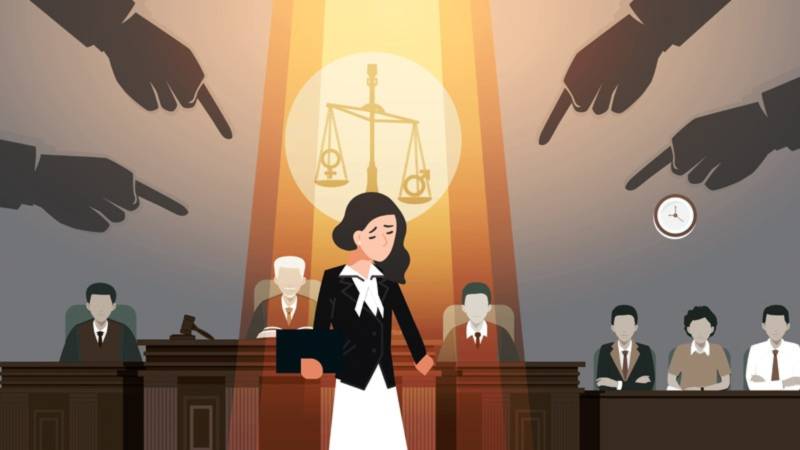
The courtroom has a strange kind of energy. It is part theatre, part battleground, and entirely unwelcoming to anyone who fails to fit the mould. When I walked into one for the first time as a 21-year-old litigator, I was not just stepping into my career; I was entering a world that seemed intent on questioning my very presence. Being the first woman in my family to practise law, and the first lawyer of any kind, felt radical. Coming from a conservative family that valued its traditions, the unspoken expectation was for me to choose a profession that was quieter, less public. Court-Kacheri? That was for men who thrived on debate and confrontation, not for women who had to calculate the risk of drinking water before a long hearing because, chances were, the courthouse would not have a functional restroom for them.
It might sound petty to complain about restrooms, but it’s not just about comfort—it’s about access, a basic right engraved in Article 25 of the Constitution. When women can’t even find basic facilities in courts, what does that say about their place in the system? Infrastructure isn’t neutral; it’s a reflection of priorities. And in Pakistan’s courts, the message is clear: women weren’t considered when these spaces were built.
But the lack of infrastructure is just the tip of the iceberg. Access to justice, in its truest sense, remains a distant dream for many. In my early days, I spent hours navigating the labyrinth of paperwork, delays, and general chaos that defines our court system. For women lawyers, this chaos comes with an extra layer of hostility. I once had a senior lawyer smugly inform me that I wasn’t cut out for the “gritty realities” of litigation. His reasoning? “You ladies need too many accommodations.” The irony wasn’t lost on me. It’s not that women “need” accommodations, it’s that we’re denied the basics. Think about it: how many male lawyers have to strategise their hydration levels before a hearing because they might not have a restroom? How many male judges dismiss arguments not because of their merits but because the lawyer presenting them happens to be a woman?
Opposing counsel often treated me like a novice, no matter how well-prepared I was. I remember one senior lawyer, a seasoned heavyweight in his field, who began a hearing by patronisingly asking, “Beta, shall I explain the case to you?” Without missing a beat, I replied, “Please do, sir, but only if you also explain why your submission contradicts the precedent you just cited.” The smirk vanished.
The thing about being a woman in law: you’re constantly making two arguments. One for the matter at hand and one for your right to be taken seriously
The hostility isn’t always overt. Sometimes it’s in the way your arguments are brushed aside until repeated by a male colleague. Sometimes it’s a smirk, a sigh, or a throwaway comment that reveals everything about how the system sees you. I recall at one time, during the hearing of a contentious company petition that I had filed on behalf of a client, the opposing counsel leaned over to calm his visibly anxious client (the defendant) and said, "Tension na lein Madam tou handle ho jaayegi." That wasn’t a strategy; it was condescension dressed up as confidence. For them, I wasn’t a legal threat; I was a manageable inconvenience. It wasn’t just insulting; it was a reminder that for many in the profession, gender is shorthand for irrelevance.
A judge’s derogatory remark or inappropriate demeanour isn’t an isolated incident; it’s part of a long lineage of normalised behaviour that rarely gets called out, let alone held accountable. Consider this: not a single woman sits on the current Bar Council, not one. And when the only sitting female judge dares to exercise judicial independence and take cognisance of a female lawyer’s pleas, the backlash is swift and institutional—as seen in her abrupt transfer after issuing an order that upset entrenched interests. These are not coincidences. They are symptoms of a system that polices women not just for what they say, but for daring to speak at all.
In this fraternity, even the mildest form of dissent or political disruption can provoke disproportionately harsh consequences, but only if you’re a woman. Where male lawyers might be reprimanded and move on, female lawyers risk career stagnation, reputational attacks, or institutional sidelining. The room for error is razor-thin, the consequences outsized. That’s the thing about being a woman in law: you’re constantly making two arguments. One for the matter at hand and one for your right to be taken seriously. And sometimes, even when you’re not arguing anything at all, you’re still seen as disruptive, just by virtue of existing in a space that was never meant for you.
And yet, despite these barriers, women persist. Because the courtroom isn’t just a place where laws are argued, it’s where power dynamics are laid bare. For women, stepping into a courtroom is an act of defiance against a system that has long excluded us. It’s a quiet but radical assertion of belonging. It’s no coincidence that the legal profession mirrors the broader inequities of society. Yes, the trend is beginning to change in more modern jurisdictions and bigger cities, but the reality in the lower courts of the smaller towns remains the same. Courts are microcosms of power, and power doesn’t like to share space. This is why, despite the growing number of women entering the profession, the structural issues persist. It’s not enough to just let women in the door; the entire framework needs to change.
For women in law, the journey isn’t just about mastering statutes and precedents. It’s about surviving in a system that wasn’t designed for us and, in doing so, making it a little easier for the next generation to follow. The courtroom wasn’t built for women, but we’re here anyway. We’re rewriting the rules, not through grand gestures but through the quiet, persistent act of staying. And if there’s one thing I’ve learned, it’s this: change doesn’t happen overnight. It happens in moments; small victories, quiet defiance, and the simple, radical act of showing up, again and again.