

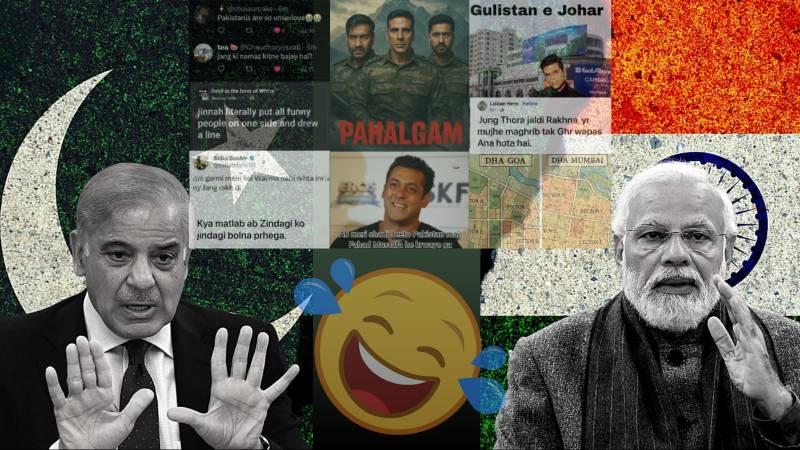
In the smoke and echo of recent escalations along the Indo-Pak border, it wasn’t the thunder of fighter jets or the churn of newsrooms that caught my attention—but something altogether stranger, and perhaps more telling: a meme of a Pakistani man offering an “aloo wala paratha” to a mock-serious Indian anchor shouting for war. It had all the timing of a stand-up set at a Lahori wedding, and the bite of a Punjabi uncle who’s seen too much and is afraid of nothing—not even Arnab Goswami.
This wasn’t an isolated instance. In the days following the Kashmir attack and the expected volley of outrage from across the Radcliffe Line, Pakistani social media didn’t go dark with fear or blaze with retaliation—it lit up with jokes. A thousand voices, keyboards, and sketch apps produced an avalanche of satire. While Indian media clamoured with drumbeats of patriotism, demanding revenge, the Pakistani response was… comic timing. Brutal, irreverent, and oddly serene.
One might be tempted to dismiss this as immaturity. But the laughter is not a sign of naïveté—it is the weary chuckle of a people who have lived too long in the shadow of existential dread. For a nation that has survived bomb blasts in bazaars, coups in silence, floods that swallowed towns, and a thousand pinpricks of economic despair—war is not the monster under the bed. It is an old ghost, already named and mocked.
When memes become a nation’s soft power, when satire trumps sloganeering, perhaps it is not a sign of decline—but of a unique resilience
This defence—sarcasm—is not new. The great cities of Lahore and Karachi, for all their grime and noise, hum with the knowing wit of café tables and tea shops. Jokes here are currency, traded faster than any rupee. It is how trauma is metabolised. Where Indian prime-time television thunders in hyperbole, the average Pakistani scrolls through memes where Rafale jets are replaced with toy planes and war cries dubbed with Bollywood songs.
This phenomenon, of course, does something strange. It shifts the emotional temperature. Indian citizens, enraged and egged on by a media caught in a performance of nationalism, find their anger bounced back at them—not with matching venom, but with mockery. And nothing disarms rage like ridicule. Slowly, you begin to see it online: anger replaced with confusion, then laughter, then, in rare moments, reflection.
It is easy to imagine this digital theatre as trivial, even dangerous—but that would be to misunderstand the region. South Asia, ever ancient, ever absurd, does not operate like the West’s neat dichotomies of war and peace. It operates in irony, in poetry, in the long memory of empires lost and futures dreamed.
When memes become a nation’s soft power, when satire trumps sloganeering, perhaps it is not a sign of decline—but of a unique resilience. In Pakistan, humour is not escape. It is resistance.
And so, while armies line up and editors shout into microphones, a quiet miracle unfolds in the margins of Instagram and Twitter feeds: two ancient neighbours, trapped in the rituals of rivalry, are forced—for a fleeting moment—to laugh together.
And what is laughter, if not the first breath of understanding