

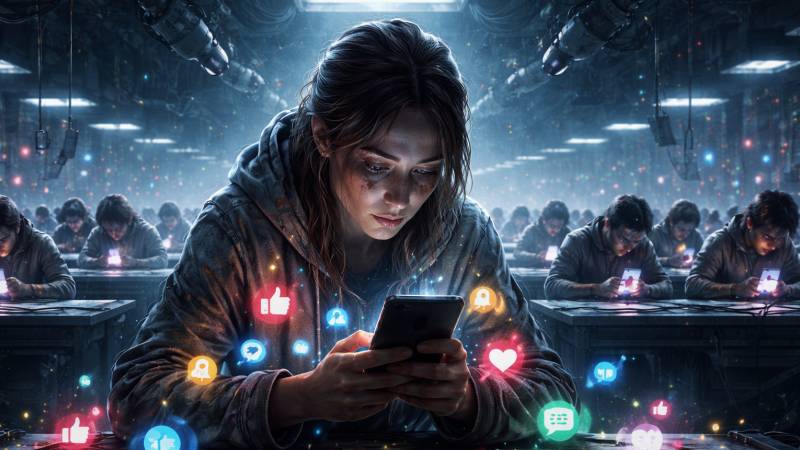
The faces have changed, the tools have changed, and the language has changed, but the logic of power has not. Across centuries, every society has produced a lower class, not by accident but by design. Inequality persists, even as the methods by which it is maintained have changed. Once, the lower class was defined by calloused hands, factory floors, and long hours of work under visible supervision. Today, it is determined by endless scrolling, glowing screens, and invisible algorithms. The lower class has not vanished: it has learned how to scroll.
In the industrial age, the lower class was readily identifiable. Factory workers, miners, and domestic labourers owned no land, no machines, or no capital. Karl Marx described them as the proletariat: individuals who were forced to sell their labour because survival left them no alternative. Their defining traits were long working hours, strict discipline, low agency and autonomy, constant replaceability, and physical surveillance. You could see exploitation in smoke-filled rooms, in broken bodies, in exhaustion at the end of the day. Power announced itself openly.
That visibility is what has changed, but not the structure. As Marx himself warned, capitalism does not abandon exploitation; it refines it. The factory has faded, but the hierarchy remains, and today’s lower class owns no platforms, controls no algorithms, and has no claim over the data it produces. It generates value constantly, often unknowingly, while remaining excluded from ownership and decision-making. The extraction is now quieter, cleaner, and has shifted from the physical to the psychological realm. The feed has replaced the assembly line, and the punch card with the login screen.
In 1971, economist Herbert Simon predicted that in an information world, attention would become the scarcest resource. That prediction has come true with stunning precision. The average social media user today spends roughly two and a half hours per day on platforms, more than thirty-six days a year, feeding systems designed to capture, analyse, and monetise human behaviour.
Meta alone generated over $130 billion in advertising revenue in 2023, almost entirely from user attention. TikTok users open the app nearly twenty times a day. This is not leisure. It is labour, stripped of wages and disguised as entertainment. Christian Fuchs calls it ‘digital labour’. Shoshana Zuboff calls it ‘behavioural extraction’. Different terms, same reality: value is produced, and it flows upward.
Empirical data from the Pew Research Centre indicate that lower-income users spend significantly more time on social media
Surveillance has always been a defining feature of lower-class life. Once external, it is now ambient, and where supervisors once watched workers, platforms now monitor behaviour at a granular level, from what we pause on and what angers us to what comforts us and keeps us awake at night. Social media platforms track location, behaviour, preferences, relationships, and emotions. Smartphones generate staggering volumes of data every second.
The lower class was once watched while working; now it is watched while resting, socialising, and thinking. Michel Foucault’s warning about the Panopticon feels less metaphorical than ever. Power no longer requires guards or walls; instead, it operates through normalisation. We carry it willingly in our pockets.
Control, too, has changed its appearance. Historically, the lower class was managed through wages, debt, physical coercion, and the constant threat of unemployment. Today, control operates through algorithms, addiction, social validation, and visibility. Studies show that more than 70% of YouTube watch time is driven by algorithmic recommendations rather than conscious choice. Research from MIT demonstrates that misinformation spreads significantly faster than credible news because outrage keeps users engaged. The lower class that was once controlled by hunger is now controlled by dopamine.
Replaceability remains constant; factory workers could be dismissed without explanation. Today, accounts can be banned, shadowed, or rendered invisible overnight. A policy update or an algorithmic shift can undo years of labour, creativity, and audience-building. This is referred to as digital feudalism: users cultivate value on land they do not own, under rules they did not write, enforced by systems they cannot question.
Social media sells the illusion of knowledge and voice while quietly stripping users of agency: virality replaces truth, and noise overwhelms understanding. Attention fragments, critical thinking erodes, and users become highly visible yet easily replaceable, while real decisions remain concentrated in the hands of a select few. History reminds us that the lower class has always been allowed to speak, not to decide.
Posting is equated with participation, and trending is equated with influence. A tiny minority captures attention while the majority consumes. Most posts vanish without impact. Hannah Arendt warned that mass society does not silence people; it overwhelms them with noise, making meaningful action impossible. Where expression multiplies, agency disappears.
Social media platforms are designed to keep users trapped in feedback loops, where algorithms continuously reinforce the same content, emotions, and habits, leaving little space for reflection or independent thought
The uncomfortable truth is that inequality does not dissolve online; it intensifies. Empirical data from the Pew Research Centre indicate that lower-income users spend significantly more time on social media. In contrast, wealthier and more educated users are more likely to use digital tools instrumentally or to limit exposure altogether. Even tech elites such as Steve Jobs keep their children away from phones while building technologies that consume everyone else’s attention. Elites outsource their online presence, and everyone else lives inside it. Systems of control always concentrate most heavily on those with the fewest alternatives.
Historically, the lower class has also been politically useful. It has been mobilised for wars, revolutions, moral panics, and social unrest. Social media accelerates this process by enabling massive mobilisation without institutional depth, movements that are loud yet fragile, angry yet easily redirected. False certainty travels faster than complex truth. A manipulated population is not empowered, as it is exploitable.
This new arrangement comes with a cost that is harder to quantify but impossible to ignore. Rising anxiety, depression, and emotional volatility have been widely documented among social media users, particularly younger ones. Constant comparison erodes self-worth while endless information fragments attention. The brain, trained to respond rapidly to novelty, struggles with focus and depth. Emotional regulation weakens when outrage is rewarded, and calm reflection disappears from the feed. The lower class once returned home physically drained. Today, it logs off mentally scattered, emotionally raw, and cognitively fatigued.
Attention itself is being reshaped. Studies indicate declining average attention spans, increased task switching, and reduced capacity for sustained thought among frequent platform users. The mind adapts to its environment. When that environment is built for speed, interruption, and reaction, slowness and contemplation begin to feel unnatural. Thought becomes thinner, patience rarer. A distracted population is not merely tired; it is easier to steer.
Yet it would be dishonest to deny social media its strengths. It has connected families across borders, amplified marginalised voices, enabled grassroots organising, and democratised access to information. For many, it has provided a community where none existed, and visibility where silence once ruled. These benefits are real. The tragedy is not that social media exists, but that its architecture prioritises extraction over care.
Across centuries, the defining characteristics of the lower class have remained remarkably stable: lack of ownership, dependence on systems beyond one’s control, constant surveillance, replaceability, and minimal influence over the rules that govern life. Only the tools have changed. The factory gate is now an app icon; the overseer, an algorithm. The wage has become a dopamine hit. Social media is free in the same way company towns once were. You do not pay with money, but with attention, privacy, autonomy, and time. And as always, it is told that this is freedom, while someone else quietly counts the profit.
Social media platforms are designed to keep users trapped in feedback loops, where algorithms continuously reinforce the same content, emotions, and habits, leaving little space for reflection or independent thought. Over time, this constant exposure weakens attention spans, dulls critical thinking, and keeps users busy reacting rather than understanding. For the younger generation, in particular, endless scrolling is not harmless leisure but unpaid labour, in which time, creativity, and mental energy are extracted. At the same time, fundamental skills, autonomy, and upward mobility slowly erode.