

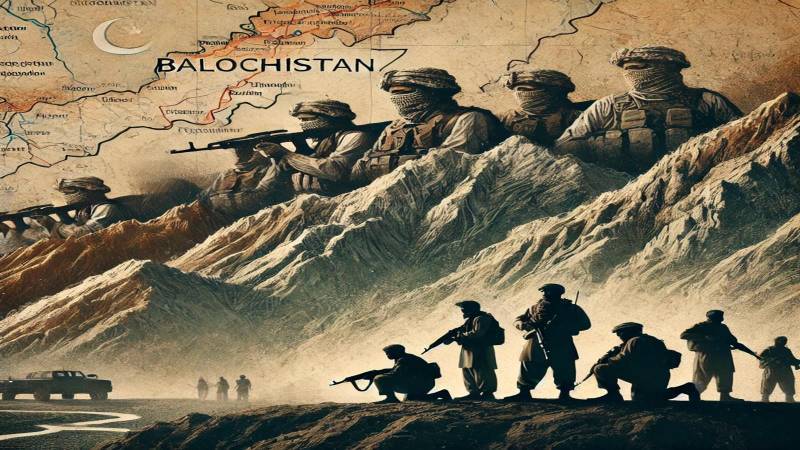
The recent rise in tensions in Balochistan presents yet another indication of the increasing gap between the state's security-centric approach and the aspirations of its local people.
Within a few years after the state decided to militarise Balochistan in the wake of Musharaf’s take-over, a policy that has its roots in the state´s formative years, the situation in the province has dramatically worsened. Aimed at containing what the state called miscreants, the military means has given birth to a low insurgency instead of integration.
Over the years, as the state has intensified militarisation, Balochistan has descended into further chaos, with disgruntled armed Baloch groups becoming more alienated. Notwithstanding the use of brutal force for years now, the state has failed to suppress unrest and restore peace. Reports suggest that main highways in Balochistan have become ungovernable during the night. As the state's flawed security approach unravels, it seems important to undertake a detailed political review to assess its approach.
Based on historical evidence, I argue that the persistence of political instability and violence in Balochistan is the product of state policies that have given priority to the use of force over political engagement and reconciliation. Among others, at the core, what has defined Pakistan's policy towards Balochistan is the essentialisation of Baloch´s legitimate demands as an external conspiracy, plotted by its arch-rival and neighbour India, that demands a military solution. The proponents of this approach also justify the use of force in Balochistan in defence of the geopolitical and security tensions in the region.
In his works, among other analysts and scholars, Rafiullah Kakar does not rule out the possibility of external interference, but he strongly asserts that, at the very foundation, it is a homegrown issue. Therefore, over the years, the use of securitisation instead of political inclusion by the state managers to achieve supposed national integration has spelled political, economic, and social disasters.
Here, it seems pertinent to decode the state´s securitisation of Balochistan. Basically, it has deployed two major tools which include Baloch-specific security narrative and the use of physical force. Its purpose is to delegitimise Baloch grievances and reinforce state domination by actively producing and reproducing their demands as a threat.
Tactics such as increased militarisation, arrests of Baloch leadership, and censorship of Baloch voices in mainstream media are deployed to quell the counter-narrative that has become increasingly popular in Baloch society
Ontologically, the state has framed Baloch’s resistance to their basic rights as a threat to national unity. From the perspective of critical security studies, such a security narrative tends to manufacture justifications, though morally untenable, for the use of physical force or vice versa. From traditional political leadership to the emerging new social movements like BYC and civil society activists, the state has criminalised Baloch dissenters as foreign agents. In return, the use of such a security framing allows the state the license to use extraordinary political and security measures in Balochistan with impunity. The use of physical force is evident in the form of disappearances, extrajudicial killings, and even, reportedly, death squads.
Both have been deeply institutionalised in the security sector in particular. They also seem to have an uncritical general acceptance of what some call proper Pakistan. Even more troubling, PPP, PMLN, and PTI, so-called state-wide parties, have also either supported it or ignored it whenever they have come into power. Little wonder that state officials and media play an important role in reinforcing the state narrative of securitising Balochistan.
Despite securitisation, the state has failed to pacify the conflict, widening the gap between the state and local people. Its repeated suppression of the Baloch demands for political and economic rights in the name of national security has exacerbated the existing grievances. It has given birth to what is called as counter-securitisation as a strategy of resistance that is predominantly ontological, political, and identity-based in nature. Among others, it is evident in the BYC´s movement, which under the leadership of Dr. Maharng Baloch, questions the state's security discourse and constructs its narrative embedded in historical oppression and injustice.
What is most alarming is that this policy has completely alienated and radicalised a section of the Baloch population that has gone to the extent of taking up arms. What is even terrifying is the reports suggesting that those who join the ranks of BLA are former students. However, one thing that securitisation does well is to benefit a section of propped-up military loyalists, but they seem to have no genuine support in their constituencies.
In response to the growing radicalisation, the state intensifies the use of both security narrative and violent force. Tactics such as increased militarisation, arrests of Baloch leadership, and censorship of Baloch voices in mainstream media are deployed to quell the counter-narrative that has become increasingly popular in Baloch society. Just a few days ago, the state arrested BYC´s leadership and did not allow BNP’s Long March to enter Quetta.
On the other hand, regardless of excessive militarisation, conflict persists and is likely to persist for two reasons. First, as long as the state uses securitisation as the primary approach to dealing with the Baloch demands, it generates counter-securitisation as a resistance strategy because its moral legitimacy is contested by the securitised subject. In the second place, it is the very political exclusion and economic marginalisation, denied by the state, that sustain their resistance. Therefore, the dialectics of state securitisation and countersecuritisation, particularly militant radicalisation, are potentially dangerous because they could further intensify the conflict to a point of no return.
It is important to note that equating Baloch’s demands with a security threat engenders a security dilemma that descends Balochistan into chaos. Instead, what is required is changing the approach. It would require the state managers to recognise the legitimacy of Baloch´s grievances as legitimate political claims that need accommodation or integration. For this to happen, there is no better place to start than with the deinstitutionalisation of the securitisation project in Balochistan. In deeply ethnically divided societies like Pakistan, there are no shortcuts to establishing interethnic harmony and long-term national integration without giving Baloch stakes in the power structure at the center.