

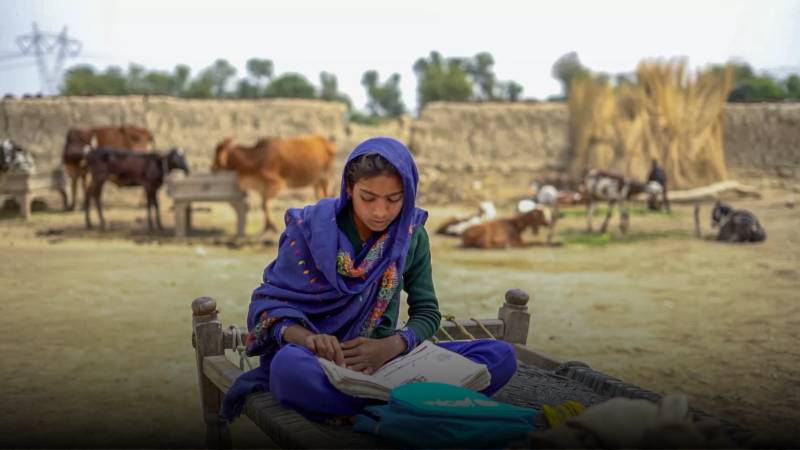
In 2016, as world leaders signed the historic Paris Agreement, debates still lingered globally: Is climate change real? Is the Earth truly heating up? Will we witness destruction on a scale we cannot yet imagine? While the global North hosted high-profile Conferences of the Parties (COPs), deliberating over carbon targets and green transitions, nations in the global South, like Pakistan, were already reeling from the consequences.
Over the last two decades, Pakistan has endured an estimated $100 billion in losses due to climate change. But beyond the numbers lies a quieter, more devastating toll: the erasure of education for thousands of children each year, especially in flood-prone districts like Rajanpur and Dera Ghazi Khan (DG Khan) in Southern Punjab.
In 2022 alone, devastating floods damaged over 22,000 schools and displaced millions. These floods did not just wash away homes – they erased childhoods, interrupted learning, and pushed thousands more children into the ranks of Pakistan’s already 22.8 million out-of-school children (OOSC).
A Cycle of Destruction and Displacement
Southern Punjab has remained one of the hardest-hit regions during recent floods. In 2024, riverine floods and torrential hill torrent rains once again ravaged Rajanpur and DG Khan, repeating a now-familiar cycle of displacement and destruction.
While the government has initiated re-enrolment campaigns and temporary interventions, the reality remains bleak. Each flood resets progress. Children who were once brought back into school slip away again – many permanently.
The Data Speaks: OOSC Crisis Deepens
According to rehabilitation efforts led by the National Rural Support Programme (NRSP) in 155 DG Khan schools post-2022 floods, a staggering 70% of the students were already out of school before the floods struck.
“This isn’t just about rebuilding a school,” shared Mr Ahmad Faraz, a representative from NRSP during an interview. “It’s about rebuilding trust in education. Parents don’t want to send their daughters to co-educational tents. And the heat, the cold – they make these learning centres unliveable. Every year we lose more children.”
Even the School Education Department (SED) Punjab’s re-enrolment drives have faced significant barriers in restoring normality. With repeated climate-induced displacements, children are left in a state of academic limbo. Many are never re-enrolled again.
What is being washed away each year isn’t just land or infrastructure; it is the future of Pakistan’s next generations
Why Temporary Learning Centres (TLCs) Aren’t Enough
Temporary Learning Centres (TLCs) were introduced to bridge educational gaps while permanent structures were rebuilt. But in the case of Southern Punjab, this model is faltering. Teachers and officials on the ground have reported three major challenges:
Inadequate Climate Adaptation
While TLCs function in moderate weather, they are poorly equipped for climate extremes. With no insulation or heating, they become unusable in winter, especially from November onwards. For regions like Rajanpur and DG Khan, where winters are harsh and facilities are exposed, this results in extended school closures and disrupted learning.
Cultural Barriers to Co-Education
In deeply conservative communities, the lack of gender-segregated spaces within TLCs has become a significant obstacle. Parents are reluctant to send their daughters to co-educational spaces, leading to alarmingly low attendance among girls.
Mr Ahmad from NRSP further explained, “Many mothers refuse outright. They say, if there’s no separate space for girls, we won’t send them at all. The TLCs need to reflect the cultural context they operate in.”
Lack of Monitoring and Data Collection
Despite a UNICEF-backed allocation of USD 11,155 per TLC, the absence of a standardised monitoring system has made it nearly impossible to track re-enrolment or dropout rates in these centres. Teachers repeatedly cited the lack of data as a critical gap that prevents targeted policymaking or proper resource allocation.
Can We Do Better?
While the TLC model may be faltering, it does not mean solutions do not exist. Here are some actionable recommendations that can pivot Pakistan’s education recovery in climate-hit zones towards long-term success:
Establish Climate-Resilient TLCs
TLCs must be reimagined for year-round use. Installing insulation and basic heating for winter use, and constructing them in elevated, flood-resistant areas, could ensure that children are not forced out of classrooms every few months.
These minor investments can vastly improve the continuity and reliability of learning.
Develop a Digital Data-Tracking System
To close the OOSC gap, we must know how big it is and where it lies. A real-time digital system for tracking re-enrolment, attendance, and migration of displaced students – built in collaboration with local governments and NGOs – can enable data-informed decision-making. This would allow resources to be channelled to the most at-risk communities and would support more targeted re-enrolment campaigns.
Expand Temporary Safe Spaces (TSS) as Rapid Response Units
While constructing permanent schools can take years due to land disputes and bureaucratic hurdles, Temporary Safe Spaces (TSS) offer a quicker alternative. At USD 11,155 per unit, these spaces can be erected in under a month, providing continuity of education in times of crisis. Located directly on flood-affected sites, they reduce disruption and create a structured, safe environment for learning until permanent infrastructure can be restored.
Education is often described as the great equaliser. But in climate-vulnerable areas of Pakistan, it is climate vulnerability itself that determines who learns and who never returns to the classroom. The children of Rajanpur and DG Khan cannot wait for more global conferences or symbolic pledges. Their futures depend on localised, adaptive, and urgent interventions. And now, even that narrow window of opportunity is shrinking.
According to the National Disaster Management Authority (NDMA)’s Situation Report, the ongoing monsoon spell from 26 June to 24 August 2025 has already claimed 798 lives, 165 of them in Punjab. The floods have also damaged 7,001 houses across Pakistan. With the rains still ongoing, infrastructure that had barely recovered from the 2022–2024 floods now faces the threat of destruction once again.
If we do not act now, we risk not just the collapse of buildings but the collapse of futures, as children in flood-hit areas are pushed further out of school – and further out of sight.
What is being washed away each year isn’t just land or infrastructure; it is the future of Pakistan’s next generations.