

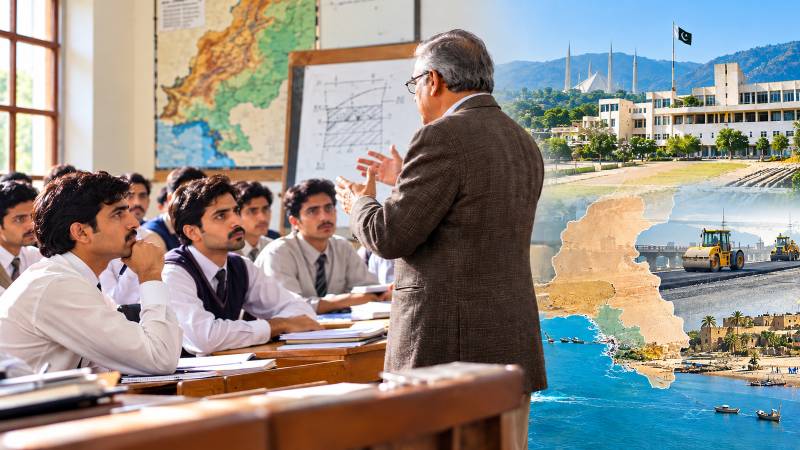
I remember the room. It was 1991. We were junior engineers on WAPDA induction training, young men from every province, meant to learn the same soils and the same discipline. A senior soil scientist left the subject and judged people. The engineers from Sindh and Balochistan, he said, knew nothing. They are far below those from Punjab and Khyber Pakhtunkhwa. Thirteen junior engineers from Sindh heard themselves dismissed in a federal classroom. The remark broke morale. It also taught a rule that no syllabus contained: in this country, competence can be read from a provincial label.
Then the examinations were held. First position went to Sindh. Third went to Sindh. Many of us believed second should have gone to Sindh as well. It was felt, instead, that someone from Punjab should stand there. Earlier batches showed the same pattern. The claim had been tested. It failed. The sentence did not die.
From 1991 to 2026 I have heard that sentence in Islamabad. Sometimes it is a whisper. Sometimes it is said aloud. People of Sindh are incompetent. They are corrupt. They are Sain Baba. A federal minister of planning, asked in Karachi why motorways were not being built in Sindh, said there is corruption here, and that is why the roads are missing. The National Highway Authority is a federal body. Those roads are federal roads. His answer was not an audit. It was a judgement on a people. I do not pretend Sindh has no problem of corruption. Corruption here has grown, and it must be named. What I refuse is the next step: turning a failure of government into the character of a nationality. That step is not a slip of the tongue. It is a method.
Henri Tajfel and John Turner called the method social identity. People take pride from their group. They stretch the gap between “us” and “them,” and they treat the other group as one type. “They are all alike” is not a finding. It is a habit of the mind. Michel Foucault added the political half. Power does not only shut people up. It decides what will count as knowledge: who is “technical,” which delay is planning, and which delay is said to be the nature of a people. Colonial officers had already sorted the country into martial and non-martial, advanced and backward. After 1857 Punjab became the heartland of army recruitment. Sindh did not. In the One Unit years, offices in the smaller provinces were often filled from Punjab. The habit outlived the policy.
The present share of federal jobs is not a rumour. A Senate committee was told in 2026 that of 13,133 staff in the Federal Secretariat, Punjab including Islamabad held 67.22 percent of posts. Sindh held 11.35 percent. This is not, by itself, a plot. It is a room. Talk in that room will sound like the majority of the room. The quota system was meant to correct the imbalance. It also became a stain. An officer from rural Sindh can still be called a “quota case,” even when he sat the same papers.
When a federal road fails in Sindh, the story becomes one of character and corruption; when the same failure occurs in Punjab, it is more readily explained as circumstance. That difference in framing is precisely what keeps institutions from being held accountable.
Results on the ground cannot be waved away. Literacy is 68 percent in Punjab and 58 percent in Sindh. In rural Sindh it is 39 percent. That is a failure of schools and local government, not proof that Sindhis cannot learn. Transparency International’s 2025 survey is mixed in the same way. Police were seen as most corrupt in Punjab. The share of people who had paid a bribe for a public service was highest in Sindh. Hospitals looked worst in Sindh. Two things are true at once. Sindh is not uniquely corrupt. Sindh has a real problem in how services reach people.
This week offered a fresh test. Sindh’s MDCAT 2026 results put no candidate from Karachi Division in the top 20. The first Karachi name stood at serial 21. A girl from Shikarpur scored 179 out of 180. Five students from Tharparkar entered the top twenty. Karachi still passed at a higher rate than the rest of the province, and 18 of its students reached the top 100. Last year the city took the first three positions. The headline will still be the empty top 20. In Islamabad that headline joins the file marked “Sindh.” In the city it joins the file marked “Karachi is finished.” Both miss the point. A district often called backward has just produced some of the highest scores in the province. Ability is not a stamp on a domicile.
Is this about power and resources? In part, yes. Those who sit in the institutions that define competence also decide who looks like an expert. Those who capture provincial offices create a system of favours that is real. It is not a defect of race. When a federal road fails in Sindh, the story is character. When the same failure occurs in Punjab, the story is circumstance. Water, the NFC award and the order of development schemes are what is at stake. If the other side is said to be unfit by nature, you do not repair institutions. You only lecture.
Four points follow. Drop the idea that skill belongs to a province. Keep the duty with the body that holds it: blame the National Highway Authority as a federal body, and blame the Government of Sindh where hospitals and schools fail. Name class and office, not blood: “Sain Baba” points to a landed elite, not a nation. See the story as a tool, not a truth. It was wrong in 1991, and it is still put to work. Set the facts side by side until the type has nowhere to hide. I was in that room in 1991. I heard the sentence. I saw the results. I have heard the sentence again for thirty-five years.
The thirteen engineers who were told they knew nothing, and who then took first and third positions, with seven places among the first ten, had already answered the question placed before them. Their results did not prove that Sindhis were better than anyone else. They proved something simpler: competence has no province. The question this federation has not answered is why the stereotype survived the evidence.