

In a bilateral relationship, both sides want to get something out of the relationship. Of course, America wants something, or rather some things, from Pakistan – and by the same token, Pakistan will want some things from the US as well.
That’s to be expected.
To those who are repeatedly saying that Pakistan will be asked to do something by the US, they are not aware that such a demand by another country, by the world’s most powerful country, is not exactly something new. Pakistan has been in this place before as well, and surely the doubters and naysayers should know that – unless their reading and understanding of history is based on YouTubers who happen to be supporters of Imran Khan and the PTI.
Also to all those asking why the army chief was in the meeting with Prime Minister Shehbaz Sharif as he met US President Donald Trump, one would ask whether they asked the same question when Imran Khan was accompanied by General Bajwa everywhere he went – and when foreign heads of state would meet General Bajwa directly or when Gen Faiz Hameed would go to various world capitals, in particular Kabul, and make overtly political statements where were the questions then – or do these people not remember those things?
Also, to all those who are saying that Pakistan should be careful, of course it should be careful – but should that mean that it should not engage at all with powerful nations that want to engage with it and further ties? Should it go and sulk in one corner and say, “Absolutely not?” Or should it engage with them and seek what is in its own national interest as well?
Do the naysayers understand that with the success of Operation Sindoor and the shooting down of seven Indian Air Force fighter jets, this is not the same Pakistan as before? Its military has now shown that it can very much hold its own in a conventional war against the Indian military, and its air force has shown that it is perhaps among the best in the world – after all, which air force has shot down four Rafale jet fighters, or even one? Its air battle with the Indians on the night of 6–7 May basically rewrote the playbook on air warfare and has opened the eyes of the world, with countries scrambling to enhance ties with it (Armenia just last week announced it will establish diplomatic ties with Pakistan).
In its current form, the plan is also likely to be rejected by Hamas, and in fact, reports quoting an unnamed senior Hamas official indicate this as well
The signing of the Strategic Mutual Defence Agreement with Saudi Arabia is concrete proof of this recognition of Pakistan’s rising military power and that its reach and influence are now moving beyond the South Asia region to the Middle East. In this context, the meeting that President Trump held on the sidelines of the UN General Assembly with leaders of eight key Arab and Muslim nations, including Pakistan, where a 21-point plan for achieving a peace agreement in Gaza was presented, would also indicate that Pakistan will have an important role to play now in the Middle East.
According to the US news website Axios, the plan seeks a phased withdrawal of all Israeli forces from Gaza, a freeze on settlements in the Occupied West Bank, and an “International Stabilisation Force” (ISF) to provide security and stability for Gaza’s reconstruction, with the contributions from the Muslim states in question present as peacekeepers. It is very likely that if such an arrangement does eventually materialise, then Pakistan and its military may play a leading role in it. That said, Pakistan has already expressed reservations on the proposal, with Foreign Minister Ishaq Dar saying at a press conference a few days ago that “this is not our proposal” and that Pakistan stands by the joint statement that was issued by the eight Muslim countries whose leaders met President Trump in New York along the UN General Assembly sidelines.
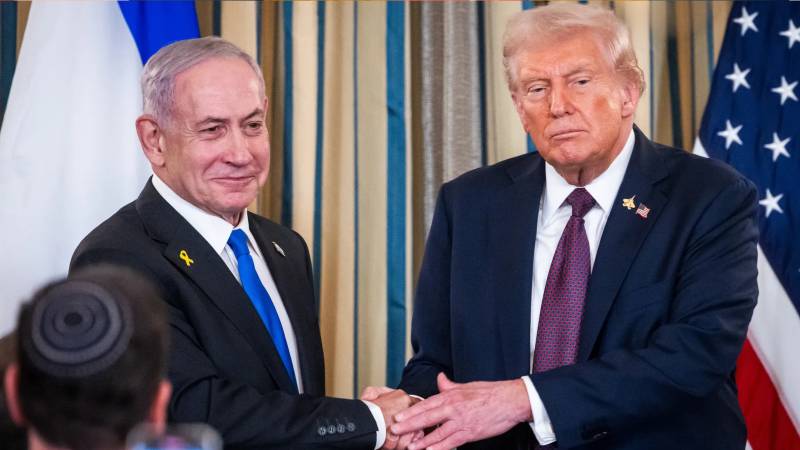
Axios also separately reported that the proposals announced by Trump (where Netanyahu was with him) were altered after the two met, and this ties up with Pakistan’s reaction that “this is not our proposal”. A critical look at the proposal suggests that there is nothing in it that holds Israel, its prime minister or its army to account for the mass devastation, deaths and destruction that they inflicted on Gaza and its people.
Furthermore, the responsibility, blame and consequences have been entirely shifted onto Hamas to disarm, surrender and seek no future role in the running of Gaza, or else face the might of the Israeli army. Of course, it has been facing the might of the Israeli army for many months now, and is more or less intact. There is also no clear mention of the establishment of an independent state of Palestine, though the plan says that if the measures contained in it are implemented, then eventually conditions may materialise for the formation of a state of Palestine.
Prime Minister Shehbaz Sharif welcomed the announcement of the plan by President Trump initially, and he was largely criticised for it within Pakistan. However, the day after his tweet welcoming the plan, the foreign minister’s press conference unequivocally showed that Pakistan had distanced itself from the plan, because it seemed to be quite different to what it and the other seven Muslim states (Saudi Arabia, Qatar, Jordan, Indonesia, UAE, Egypt and Türkiye) had agreed to with the US President.
In its current form, the plan is also likely to be rejected by Hamas, and in fact, reports quoting an unnamed senior Hamas official indicate this as well. It places no consequence or blame whatsoever on Israel, its prime minister or its military, so it is seen by most observers as lopsided and unfair.
As for Pakistan’s response, it has historically been that it supports a two-state solution in accordance with UN resolutions, which seek the creation of an independent and sovereign state of Palestine with the Palestinian people able to exercise their right of self-determination. There are several other conditions associated with this stand as well, so it remains to be seen how the plan will pan out.