

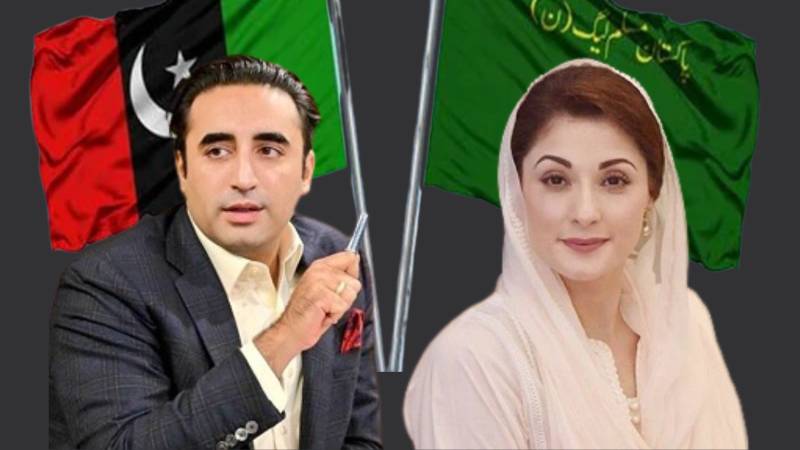
The recent verbal spat between the PML-N and PPP takes me back to a very different moment: 8 August 2019, when Bilawal Bhutto-Zardari stormed into the National Assembly, demanded the floor, and launched into a furious tirade against Imran Khan’s government for arresting Maryam Nawaz. He called the prime minister Imran Khan beghairat, shouting at treasury benches to “fight the men” if they had courage. It was raw, angry, and unforgettable; a young politician defending the dignity of his traditional rival in a moment of political humiliation.
That image of Bilawal’s unfiltered anger still lingers because it showed a rare spirit of solidarity. He did not stop to calculate whether his words would be reciprocated by PML-N in the future. He reacted instinctively, defending not just Maryam but a principle. This is worth recalling today, as the same parties now trade barbs instead of holding their horses, when civility would have served them, and the country far better.
Bilawal’s outburst that day was instinctive, almost reckless, but it carried a rare moral weight. He chose to defend Maryam even though history had taught him and certainly his father, Asif Ali Zardari, that PML-N rarely returns such favours. Zardari, with his long memory of Pakistani politics, has often warned against expecting reciprocity from Lahore. Yet Bilawal’s impulse was different: it was about dignity, not calculation.
The episode repeated in October 2020, when police barged into Maryam Nawaz and Captain Safdar’s hotel room in Karachi. Bilawal again sprang to her defence, calling the act shameful. The fallout was extraordinary: senior Sindh police officers staged a symbolic protest by applying for leave, and the army chief had to personally assure Bilawal of an inquiry. What was striking, however, was that Bilawal never displayed the same outrage when his own father, Asif Ali Zardari or aunt Faryal Talpur were arrested. His fury, it seemed, was reserved for moments when political dignity itself was at stake.
For much of this period, PML-N seemed paralysed with its senior leadership imprisoned or facing multiple cases, its options shrinking, its voice muted despite forming the Pakistan Democratic Movement, an opposition alliance. The alliance created noise but little pressure. When the moment of reckoning finally came with the no-confidence motion against Imran Khan in 2022, it was not PML-N but Bilawal and the PPP who took the wheel. PML-N hesitated; PPP drove the strategy.
Even an alleged SOS call by Imran Khan through property tycoon Malik Riaz reached Asif Zardari just days before the no-confidence vote, a plea Zardari refused. Had he chosen otherwise, Bilawal could easily have become prime minister, provided Zardari also managed the establishment’s anxieties about General Faiz’s ambitions.
An optics-driven government risks backlash if it appears to trivialise suffering
This was not the first time Zardari declined to aid Imran. During the 2014 sit-in in Islamabad, when the winds seemed stacked against Nawaz Sharif, PTI sought support through both the PPP and Altaf Hussain’s MQM. Zardari not only ignored the overtures but also visited Nawaz at Raiwind, assuring him he would not join any adventure. For optics, this was significant: relations between PPP and PML-N were hardly cordial, yet Zardari chose stability over opportunism.
Similarly, when the PML-N-led government faltered in securing consensus for the 26th Amendment despite its majority, Bilawal Bhutto-Zardari pressed hard. He threatened to use brute numbers but also negotiated with opposition parties, eventually playing a pivotal role in ensuring the amendment’s passage in October 2024.
What we see today, however, is not strategy but deflection, and a heavy dose of whataboutery. The Punjab government’s rhetoric has shifted away from the devastation in South Punjab after the floods, towards ribbon-cuttings and bus launches. Energy and resources that should have been dedicated to rehabilitation have instead been redirected towards more marketable optics.
On-the-ground reporters from South Punjab told me of the provincial government’s failures during the crisis. Laiba Zainab, a reliable voice from the field, who also hails from Multan, described how officials could not gauge the floods’ intensity or persuade villagers to evacuate. Pre-rescue communication collapsed: local MPAs were not mobilised, warnings were vague, and the result was chaos.
Yes, rural populations are often reluctant to abandon their homes, which is a well-documented human behaviour. But timely evacuation can mitigate loss. Here, the gap was not just in communication but in empathy: the government failed to bridge the divide between central Punjab’s politics and southern Punjab’s suffering.
What becomes clear is a yawning gap of coordination and communication, and above all, empathy between central Punjab and southern Punjab. In several conversations, I was struck by how easily this divide could have been eased with better planning and a sense of urgency. It also reinforced for me the need to consider multiple administrative units for more responsive governance. But that idea can only succeed if we shed the ethnic egos and turf wars that have long poisoned our politics.
Rescue operations, too, appeared reactive rather than proactive. Too often, they trailed behind Chief Minister Maryam Nawaz’s convoys. Jalalpur’s residents waited weeks until the CM arrived; nearby Ali Pur still waits. Optics, once again, trumped urgency. This clearly explains the failure of the Provincial Disaster Management Authority and other bureaucracy-led relevant authorities. Something we would not have seen under former Chief Minister Shehbaz Sharif, famous for getting work done through bureaucracy.
Contrast this with the Sindh floods of 2022. Bilawal’s presence on the ground, though politically convenient, also demonstrated seriousness. His persistence compelled then-Prime Minister Shehbaz Sharif to visit repeatedly with ministers in tow, not just in Sindh but also in Balochistan. It was an acknowledgement that disasters require not staged photo-ops but relentless engagement.
Punjab today needs the same spirit. When villages remain submerged and families live without shelter, photo-ops and bus inaugurations ring hollow. An optics-driven government risks backlash if it appears to trivialise suffering.
Maryam Nawaz’s aggressive posture may rally loyalists, but it carries risk. PPP provides crucial weight to the PML-N-led federal government; should it step back, the space will open for institutional players to “play their cards.” That could cost PML-N its federal grip. Does the Punjab CM want to gamble with her uncle’s prime ministership on poor counsel and short-term optics?
The most dangerous misstep would be to weaponise ethnic rhetoric. In a country where identity politics runs deep, words like “My water, my money, my choice” invite easy rebuttals: “our gas, our coal, our ports.” Such escalation would fracture not just alliances but the federation’s already fragile cohesion.