

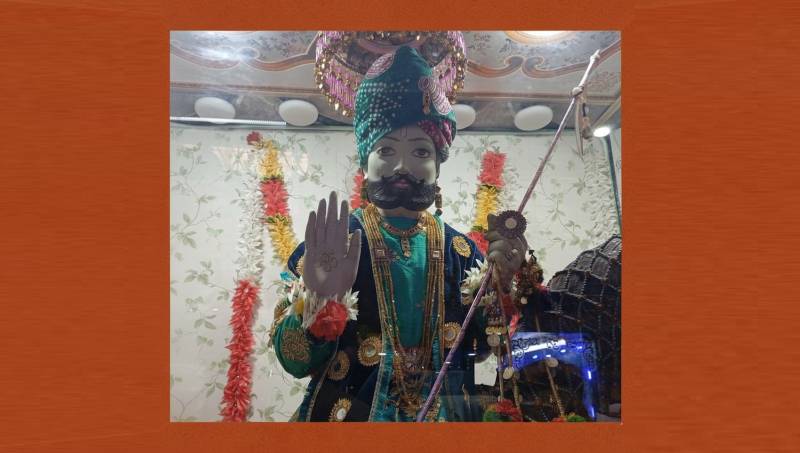
Last week, I walked Sri Ghat at dawn. Dusk still clung. Streetlights flickered over winding lanes. A cool breeze whispered from the north, sliced through alleys with a crisp edge. I paused and pondered: what would the sights and sounds have been before the 1947 Partition? Temples rang with bronze bells, clanging in joyful clamour. Mosques echoed azans, calls rising, weaving through the air. Churches tolled solemn chimes, deep and resonant. Greetings danced on lips: ram, ram. salam, salam. Harmony pulsed. Voices blended. Echoes faded into my memory’s haze.
I wandered the deserted lanes of Sri Ghat. Silence wrapped around me. Suddenly, my cell phone buzzed. It was my old university friend. He usually calls me after Fajir ji nimaz. We dove straight into memories. University days flooded back. We laughed hard. Adventures. Mishaps. All vivid. Classmates appeared in our talk. Those dashing boys – now bald and portly. The vibrant girls – hourglass figures vanished, reshaped by time. We admitted it. We had changed too. The years spare no one.
The call neared its end. He fired a question. “Why do you write about mandirs?” I paused. Then I responded, “It’s not just temples. I document Hyderabad, Sindh’s material heritage. Layers of history. Depths of culture.”
He paused. “Okay, we will continue this.”
It was his pet sentence, it means he wants to end the conversation. The call discontinued.
I stood before the massive, iron door of the Rama Pir Mandir at Plot No A-1094, Sri Ghat, Hyderabad. The gate loomed, a heavy, unyielding presence. Flanking it, the front walls gleamed with a mosaic of patched, pixel-like tiles, each one meticulously stitched together in an intricate pattern. Above the lintel, withered garlands of flowers sagged in a loose half-circle, their brittle, dried petals a silent testament to the heat since they were likely hung for the festival of diyari.
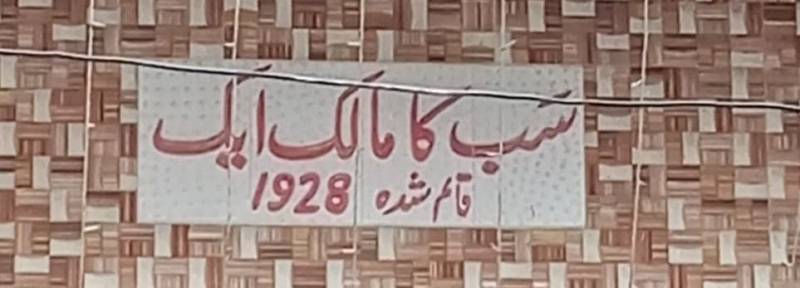
My gaze lifted to the upper panel. There, embossed across a rectangle of tiles, bold letters crisply declared: Sub ka Malik Ek (The Master of all is One). The phrase sat centred above the gate like a quiet, profound command. Just below it, etched in medium-sized numerals, “1928” stared back — a silent witness to the temple’s foundation. Interestingly, on both panels of the gate, Urdu warning posters with similar instructions— “Vehicle Parking is prohibited”—were displayed. I waited there, hoping for the arrival of a maharaj or any sevak to orient me.
While I was waiting, a man in his mid-forties turned to me. He introduced himself as Shankar Lala, identifying himself as part of the temple’s care-taking team. I reciprocated, explaining my desire to write a piece about the Rama Pir Mandir. He politely advised me to wait, then disappeared inside the temple. The time he took was considerable. As I waited there, my imagination pulled me back to Hyderabad before the Partition.
At the massive iron door of the Rama Pir Mandir, the phrase "Sub ka Malik Ek" (The Master of all is One) offers a silent, powerful contrast to the complex reality within
The atmosphere of the area, neighbouring Sonarki Bazaar gripped me tight. I saw a bangle slid onto the wrist of a beautiful Sindhi lady. A Muslim landlord pushed crisp notes and heavy coins across a counter; a Hindu Sonaro counted them. No one whispered the word Partition. The bazaar simply breathed. In the quiet of my wait, the image of Tilk Incline entered my mind’s eye. I could almost see the incline ending there, filled with the bright giggles of the girls from Kundanmal Girls High School as they walked the path.
Then, history’s harsh reality intervened. The Radcliffe Line—the ruthless boundary of Partition—slashed across the map and landed on our soil. The very next day, Hyderabad awoke to find itself deserted with a mournful emptiness. A spiritual void instantly settled, and the familiar rhythm of city life ceased.
I felt Shankar Lala's tap on my shoulder, a signal for me to follow him. I obeyed. We crossed the threshold and entered a cool verandah. I tilted my head up. A marble plaque gleamed over the lintel, its letters crisp and clear: Bahado Sadh Eka Dashi, Rama Pir Mandir, Jaisalmer, established in 1928 (Sambat 1985. Sochi Panchayat). I enquired from Shankar Lala about the temple’s history. He frankly told me that he only knew the temple was established in 1928. He and people his age—he paused to note that he was around 60 years—simply didn’t know the history in chronological order. He added that he had gathered some pieces: there had been a dispute within the Sochi community. The central contesting point was who should be the legal custodian of the temple. We entered the worship hall. My eyes swept over a wooden frame showcasing the idols of various bhagwans, matas and devis. However, the prominent ones were those of Kali Mata, Rama Pir, and Ganesh.
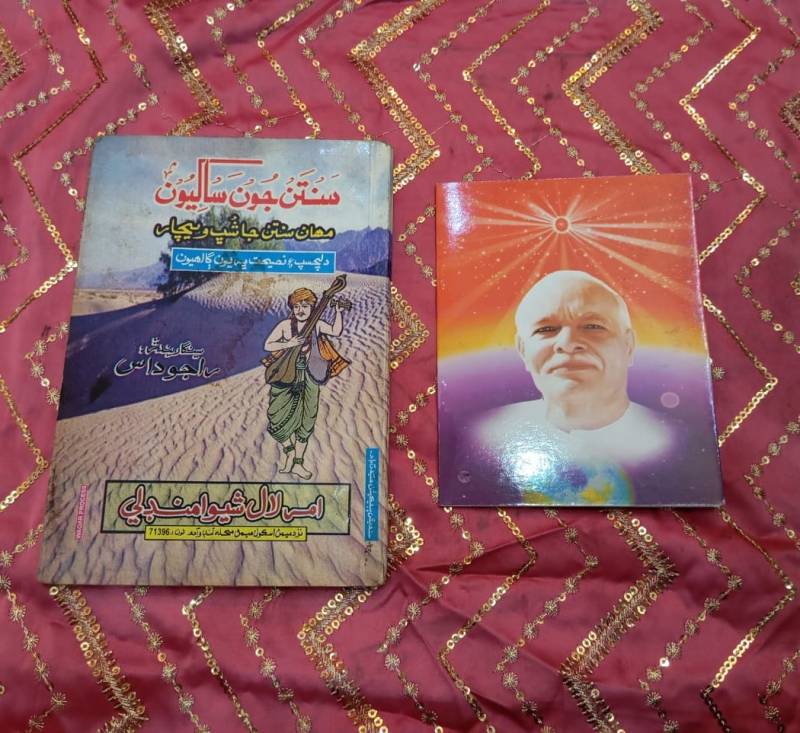
As we turned to the right, I spotted a cornered library holding a collection of books. It was directly opposite the place where the aarti items were kept. I requested Shankar Lal to allow me to look at the books. He smiled and said: budh katha ta pap latha, kar ganga shnan ta milio bhagvan. (Listen story to shade sins, dip into waters of Ganga to meet bhagvan). I quickly scanned the titles. Most of the publishers were from Tando Adam and Kotri. The small library contained various editions of Bhagavad Gita and The Ramayana. I also noticed several books about religious stories and Yoga. While I was holding the book ‘Santan Jo’n Sakhiyon – Mahan Santan Ja Shub bharion Galheyon’ (An interested and advisable anecdotes of Sants), Shankar volunteered to share that Maharaj Nanad Lal teaches Bhagavad Gita every Friday. He specified that the time for male and female devotees was divided.
The women come to attend the Geeta sermon from 3:00 pm to 4:00 pm, and the men take part in the Geeta discourse from 5:00 pm to 6:00 pm. He added that afterward, anyone interested might read some stories from these books, pointing to the one still in my hands. I asked him which story he liked most from the book. He spoke the name: the story of Layla and Majnun —“There is one story with the title of Majnun hek ya saveen (Majnun one or hundreds)” He voluntarily narrated the tale: “ Layla’s father was the king—say, well off,” he corrected himself. “He instructed all the shopkeepers that whatever Majnun purchases, he should not be billed. All accounts will be settled from the State treasury—the king did it just to keep his daughter happy.”

The youth of the city took it as an opportunity, presenting themselves as Layla’s lovers and taking what they needed from the shops. “One day,” Shankar continued, “The king called all of them into his palace and asked them for some portion of their flesh for Layla. He gave them a bowl and a knife.” All of them declined, except Majnun, who put some of his own flesh into the bowl. Shankar Lal added his interpretation: that the religious path— satya (truth)—needs sacrifice, not boasts and claims. He uninvitedly told me that the moral of the katha is that "There are too many people to claim that they are servants of Rama Pir or true followers, but few of them are the true Majnun, and others are just fake and opportunists.”
I noticed that Shankar Lala was in a mood to converse. I showed him another book with the title ‘Rajayoga,’ and identified it as a publication of Om Mandli (now the Prajapita Brahma Kumaris Ishwariya Vishwa Vidyalaya (fondly knows as Brahma Kumaris, with headquarters at Mount Abu, India. I told him how this small, women-led organisation had brought about significant changes in the traditional roles of Sindhi women, particularly in Hyderabad and Karachi. This was completely new information for him; his eyes widened with interest.
I thanked Shankar for his time and headed to my home. But I was a bit interested to know more about the temple. Therefore, next day I went to the municipal and court archives. In the Municipal Office’s record room I unearthed the official documents that straightened the history of the Rama Pir Mandir's ownership. The official records stated that original name of the place was not Rama Pir Mandir, but it was called Jaisalmari Sochis Panchayat. The plot was purchased. Later on, an initial committee was appointed to look after the temple's affairs. The documents revealed the names of the committee members appointed on 23 June 1958: Asandas Fojomal, Hatumal Panalal, Parsram Ropchand, Doultram Venomal, Ranomal Murlomal, Ranomal Bejomal, and Nuktmal Amolchand. original name Jaisalmari Sochis Panchayat. (The plot was purchased) Following this, a dispute erupted within the community over who held the legal ownership of the sacred site. The concerned parties pursued legal action and entered the Civil Court, Hyderabad. However, the litigation ended when the Court issued a decree on 20 July 1959, favouring Himalram Fojomal and Thanomal Hinomal. Since that definitive year, the descendants of both families have been managing all the temple’s affairs.
Afterwards, I went to the temple to meet Shankar Lal. My good luck, he was there, we discussed nature and status of Hyderabad. Soon, the conversation shifted to the Partition. He shared what he had heard from his elders: for some devastating months—August, September, October, and December of 1947—the city felt dead for the Hindus. “We lived in constant fear,” he mused. He then abruptly switched the topic, his expression turning grave, and told me that he had personally witnessed the violence of 7 December 1995. He added that if I had read the daily Kawish newspaper on 8 December 1995, I would have seen the pages full of stories detailing how mandirs were burned, demolished, and how shops and even the homes of Hindus were attacked.
“It was the second event after the Partition that pushed us into an abyss of fear and uncertainty,” he confided. He stressed that the only concern is that there should be peace in the region; this, he declared, is the only demand that makes our mandirs secure. "Agreed, there are rules and regulations," he admitted, "but what are we to do with the mob?" He disappointedly told me that mob actions thrive on rumours, tricks, and sheer volume—and all of us, public and private institutions, fail before them.
He paused for a moment, then corrected himself: "Only the Government could prevent mandirs from attacks, loots, and burnings, if it treats us as equal citizens of Pakistan."
His fear was palpable. He added a chilling thought: "When we came here for our workshop this morning, we really didn't know if we would return to our homes or if our wounded or dead bodies would land in the mortuary rooms of the hospital or Edhi’s Murda Khan. Because none of us know—when and where a religious event in the world could agitate the fanatics and they attack us." He suggested that perhaps the only strategy left is to remain invisible and be ready for whatever nature has kept in its secrets.
I excused myself and left. The first time, I realised that these community members are living in a dangerous zone. In their neighbourhood, I noticed the posters of religious fanatic organisations. These stark facts will always keep them apart from mainstream political or social phenomena. Perhaps, they have learned to live in fear, suppress their celebrations, and pay the cost of any folly that occurs around the globe in the name of religion.