

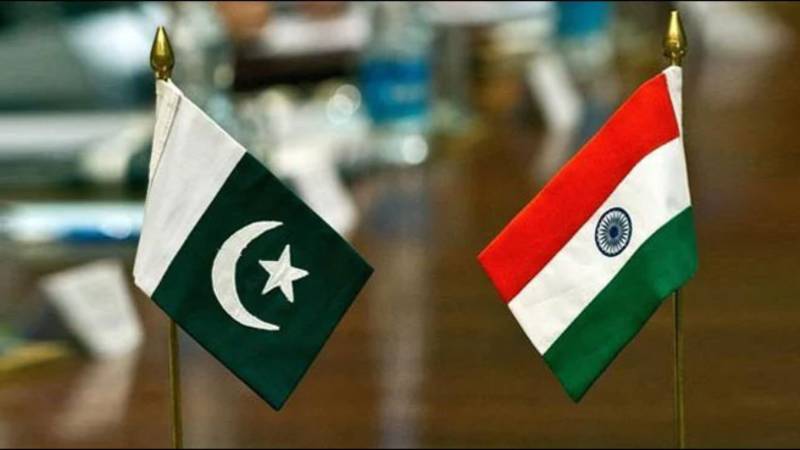
In January 2015, I was invited by the Indian High Commission to a diplomatic function. Dr T.C.A. Raghavan, who was serving as High Commissioner at that time, is a well-known historian. In a candid discussion with a few journalists who were present, he said that Pakistan-India relations are at a tipping point and a little push would result in massive improvement “in our relations”. He made a very interesting revelation that the then Prime Minister Nawaz Sharif and Prime Minister Narendra Modi knew each other intuitively and very soon this good rapport would result in a tremendous improvement in our relations. His prediction didn’t materialize instead we heard slogans such as “Mody Ka Jo yar ha Ghaddar Ha Ghadder Ha” (Whoever is friends with Moody is a traitor) became the popular slogan among opposition political parties in Pakistan. We developed a political culture where close relations with the heads of state and heads of government were seen as suspect. I sometimes wonder how India has managed to keep peace for so long with their political leaders not even on talking terms.
Two nuclear-armed states, with the two largest militaries, armed to the teeth existing, within a stone's throw distance from each other, even if they are not enemies cannot survive for long without some kind of misunderstanding developing, if they don’t have any kind of communications mechanisms in place. Of course, Pakistan and India's militaries communicate with each other every Tuesday the Director Generals of Military Operations of the two land forces talk to each other on the hotline. This brief conversation which never goes beyond the exchange of greetings and technical information about troops' movements on two sides of the international border, is the weak thread through which the relationship between two militaries hangs.
At the political level, the prime ministers of the two countries are not on talking terms. Any other bureaucratic or civil-political contact between the two countries doesn’t exist. During the height of the Cold War--only a situation slightly comparable to the India-Pakistan nuclearised equation that exists in South Asia--the Soviet and American political leaders’ contacts and interactions used to resolve the bureaucratic hurdles that were in the way of reaching broad disarmament agreements. In the case of Pakistan and India, there is no mechanism for interaction between the political leaders of the two sides even if the two rivals are gradually speeding on the slippery slope that ultimately steps into the most destructive conflict in the history of mankind.
The most sensitive aspect of this problem is Pakistan’s support for the Kashmir freedom struggle and the Indian government’s genuine concern that no terrorism should take place in the territory under its control and against its citizens
During the encounter with the Indian High Commissioner. TCA Raghavan in January 2015, I asked him how war be prevented in South Asia if there was another mass casualty attack in India. He was very clear that some kind of joint mechanism should be evolved to tackle the problem of terrorism. I asked him to develop a joint mechanism. There should be some kind of trust between the two countries, and who should build that trust? His spontaneous response was that the governments of India and the government of Pakistan should build that trust. Perhaps in those days, things had not deteriorated to the extent they are now. And the prospects of Pak-India relations improvement were within sight allowing the Indian High Commissioner to be so upbeat about the prospects of establishing joint mechanisms.
The most unfortunate aspect of the present crisis is the fact that there has been no official contact between the Pakistani and Indian governments since the Phalagam attacks. The only contact reported in the media was when the Indian Foreign Ministry summoned a Pakistani representative to New Delhi to protest. No exchange of information took place. No request for help in the investigation. No political contact to defuse the military situation has taken place. Pakistani and Indian prime ministers and members of the two-state machinery have been talking to the whole world, instead of talking to each other--the two parties that are directly and allegedly related to the Kashmir attack and the military situation that has been developing in South Asia.
No one in the world could help India in investigating the incident of the attack more effectively than Pakistan. I think the Pakistan government and seeking help from Pakistan in investigating is India’s best bet. Trust issues are there especially if seen in the light of the long history of the Intelligence agencies of two countries undertaking hostile activities on each other’s soil since independence.
Let's examine the options for India: India’s Western allies can’t help it on the ground in terms of providing them with intelligence information or providing a protective wall against religiously inspired militant groups in the region. The intelligence agencies of Western countries had remained dependent on the Pakistani premier intelligence service, ISI, for intelligence information related to terror groups in the region during the long war on terror. In this situation, the Pakistani government offers the best possible option for India in evolving a joint mechanism to counter-terrorism in the region. It is understandable that for India, It would be a hard pill to swallow and harder for the Pakistani security establishment to cooperate with India. However, in the present circumstances, nothing else would work. It is, however, a moot question whether the Pakistani government could make the Pakistani security establishment cooperate with the Indian security establishment.
Any sane person pursuing a counter-terrorism agenda in the region would not consider the option of war or even a limited military option as a counter to terror attacks
The world has changed around. But in our case, hate and prejudices mutate into something more dreadful than their original form. Hindu-Muslim enmity in British colonial India bequeathed a legacy to the states of Pakistan and India in which the state machinery of the two new independent states adopted an artificially created legacy of social enmity between Hindu and Muslim communities in some parts of Colonial British India into enduring state policies. Cold War mutated this legacy further into the military rivalry between the two most well-equipped militaries in the world. When the Afghan Mujahideen struggled with Soviet occupation and later the War on Terror came, India and Pakistan state developed the most elaborate intelligence services in the world. Now they learned the most destructive techniques of espionage and sabotage from their Western allies. These techniques were later transferred to terror groups in the region with horrendous consequences for everyone.
One option for Pakistan and India is to continue on this path of destruction (rather self-destruction) and the horrors of terrorism by using these techniques against each other. The result would be horrendous, and the possibility of full-scale war would level Northern India and the whole of Pakistan to the ground. The other option--in fact, the two countries would have to evolve this option with incremental steps--is to cooperate against terrorism. Both countries have peculiar political situations, and the political situation in both countries is extremely sensitive to what policy their governments adopt toward terrorism. The most sensitive aspect of this problem is Pakistan’s support for the Kashmir freedom struggle and the Indian government’s genuine concern that no terrorism should take place in the territory under its control and against its citizens. This is a very hard and ticklish problem to resolve especially with conventional mindsets. But remember the alternative to this is a deadly military conflict that is in nobody’s interest.
During the past ten days, I have seen video clips uploaded on social media from both sides of the border--they are full of hate against each other, without even the slightest realisation in their assertions of who they are talking against. From their assertions, I realised that Indian loudmouths on social media don’t know Pakistan or Pakistani society. Had they known Pakistani society they would have loved it and would not have hated it--I have several Indian friends who vividly recount their shopping experience in Lahore Anarkali with relish, where they were showered with love and affection the moment they informed the shopkeepers they were Indians. I have visited India on three occasions to cover diplomatic events.
However, I would not claim that I know India from those brief visits. I am a very serious student of Indian history and civilisation and this history and civilisation strongly fascinates me. The very idea of the Pakistani military dropping bombs on Indian cities--the vestiges and continuities of Indian civilisation makes my skin cold. And I am sure if Indians come to know Pakistani society at a deeper level they would never think of dropping bombs on Pakistani cities. Pakistanis are loveable people. The idea of mass casualty attacks is alien to Pakistani culture. This culture is a product of the amalgamation of hatred that fundamentalist interpretation of religion spawned with the technology and techniques that Western security and intelligence apparatus provided to these fundamentalists. Pakistani society is a victim of this evil marriage between Western technology and fundamentalist interpretation of religion and history.
The situation demands a more mature response to any mass casualty anywhere in the region. The political ruling elites in both Pakistani and India should move away from creating war hysteria in their respective societies. They should introduce reforms--both in the thought process and organisational structures of security apparatuses--in their security services to protect their societies from the horrors of full-fledged war. Any sane person pursuing a counter-terrorism agenda in the region would not consider the option of war or even a limited military option as a counter to terror attacks. Unless he is unduly influenced by post-911 American examples of imposing war on Afghanistan, in which the Americans miserably failed to achieve their objectives. Anyone aiming to destroy the Pakistani state or destroy part of the state’s capacity to administer the territory under its control or defend its territory from foreign invasion should start working out a plan to face the horrors of confronting a vast anarchy that Pakistan would become in such a situation--a horror that you could not even contemplate in your wildest imagination. Cooperating with the Pakistani government is your best bet under present circumstances. And for that, you have to reduce war hysteria in your society.