

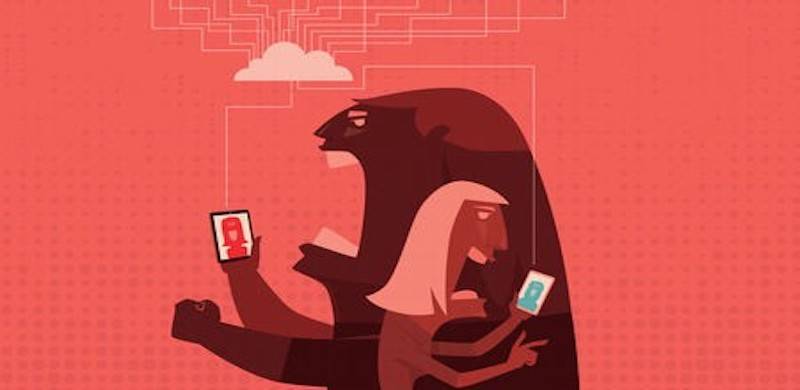
In recent years, Pakistan has witnessed the growing emergence of a troubling phenomenon: the rise of pseudo-intellectualism. In an age where information is abundant and social media platforms have democratised expression, the line between genuine intellectual discourse and superficial, performative knowledge has blurred significantly. Pseudo-intellectualism defined as the presentation of seemingly deep or critical ideas without substantial understanding or evidence has crept into public forums, academic spaces, and television debates. This trend not only dilutes the quality of national dialogue but also threatens to distort public understanding of complex social, political, and economic issues.
At the heart of this rise lies a cultural tendency to equate verbosity and English fluency with intelligence. In many elite circles, individuals who articulate vague ideas using complex jargon are celebrated as thought leaders, even when their arguments lack coherence or empirical grounding. Television talk shows, which often prioritise drama and ratings over informed analysis, provide a glaring example of this trend. “Analysts” with questionable credentials are invited to discuss on everything from geopolitics to theology, often peddling half-baked theories with supreme confidence. Rather than enlightening the public, these performances obscure facts and cultivate cynicism among viewers.
Social media has further exacerbated this problem. With platforms like Twitter, Facebook, and YouTube serving as arenas for public intellectual engagement, anyone with a large following is now perceived as a credible voice, regardless of academic rigor or professional expertise. Memes, Instagram reels, and TikTok snippets reduce nuanced debates to catchy one-liners. Individuals brand themselves as experts on everything from feminism to foreign policy after reading a few articles or watching a documentary, then go on to share ill-informed takes as if they were conclusions drawn from decades of study. The result is an information ecosystem dominated by opinion rather than inquiry where echo chambers flourish and dissenting views are mocked rather than debated.
This elitism discourages grassroots voices from participating in discourse, reinforcing the idea that intelligence is the monopoly of the urban
The education system itself bears part of the blame for nurturing this culture. With an emphasis on rote memorisation and exam performance rather than critical thinking or analytical reasoning, students are rarely trained to question, critique, or engage deeply with material. Many private universities and colleges in Pakistan now produce graduates who are more focused on crafting resumes and LinkedIn profiles than on intellectual development. Seminars are attended for certificates, not knowledge. Reading habits have declined drastically, replaced by superficial scanning of online content. This produces a generation more equipped to perform intelligence than to practice it.
Apart from this rapid change over the last few years, Pakistan has a long history of not recognising the individuals that had excellent intellectual capabilities. Abdus Salam felt hostile within his own country, while economists like Atif Mian fled due to religious fanaticism. At the same time, religious intellectuals like Maududi and Ghamidi faced persistent repercussions for being actively outspoken, while umpteen number of intellectuals fled this nation to speak freely. Pakistani society always tended to encourage intellectuals with little to no depth besides surface level, but they continued to remain rewarded for their excellent orator skills, developing ambiguous links between state narratives, religion and intellectual ideas, and evoking youth purely based on emotion and not reason.
Moreover, pseudo-intellectualism is often rewarded rather than challenged in society. Primarily because genuine critical thinking tends to disrupt dominant narratives, be they political, religious, or cultural, they continue to remain sidelined or censored. Pseudo-intellectuals, on the other hand, often play it safe. They couch their commentary in buzzwords, avoid taking strong or unpopular stances, and align themselves with prevailing power structures. As a result, they are welcomed on mainstream platforms and sometimes even offered positions of influence. This creates a cycle where mediocrity is celebrated, while genuine thinkers are pushed to the margins.
There is also a deeply ingrained issue of class in this phenomenon. The ability to quote European philosophers or drop references to academic texts becomes a badge of honour, even if the references are misused or taken out of context. This elitism discourages grassroots voices from participating in discourse, reinforcing the idea that intelligence is the monopoly of the urban, English-speaking elite. In reality, some of the most insightful critiques of society come from those who have lived its injustices firsthand, but these voices often go unheard or unacknowledged.
The rise of pseudo-intellectualism is not just a cultural concern; in fact it has real political implications. Misinformed commentary on national security, economic policy, religious identity, and constitutional law can influence public opinion and even policymaking. Politicians increasingly rely on media-dominant “experts” for legitimacy, using their shallow endorsements to justify complex decisions. This reduces policymaking to spectacle, where substance is sacrificed at the altar of optics. It also limits the space for constructive opposition, as critical voices are drowned out by louder, flashier ones who cater to the public’s thirst for sensationalism.
What makes this situation more dangerous is the diminishing public trust in traditional intellectuals - academics, researchers, and policy analysts who often operate within the constraints of evidence, peer review, and cautious reasoning. In a culture obsessed with immediacy, such individuals are seen as too slow, too abstract, or too inaccessible. Their reluctance to offer absolute answers or make sweeping statements is mistaken for weakness, while the confidence of the pseudo-intellectual is mistaken for competence. This inversion of values poisons not just public discourse but also civic engagement, as it nurtures a population less interested in truth than in performance.
To reverse this tide, a cultural shift is needed towards one that values humility, curiosity, and genuine scholarship over pretension. Educational institutions must play a more active role in promoting critical thinking, interdisciplinary study, and intellectual honesty. Media organisations must be held accountable for the experts they platform and should prioritise depth over entertainment. The public, too, must learn to question credentials, assumptions, and reward substance over style. Encouraging reading, dialogue, and respectful disagreement is essential for cultivating a more thoughtful and resilient intellectual culture.
Ultimately, the fight against pseudo-intellectualism is a fight for intellectual integrity. It is about reclaiming the space of thought from those who have commodified it and turning it back into a space for inquiry, discovery, and dissent. Pakistan’s future - socially, economically, and politically depends on the strength of its ideas and the integrity of those who produce and debate them. In a time of noise and confusion, the need for genuine thinkers has never been greater.