

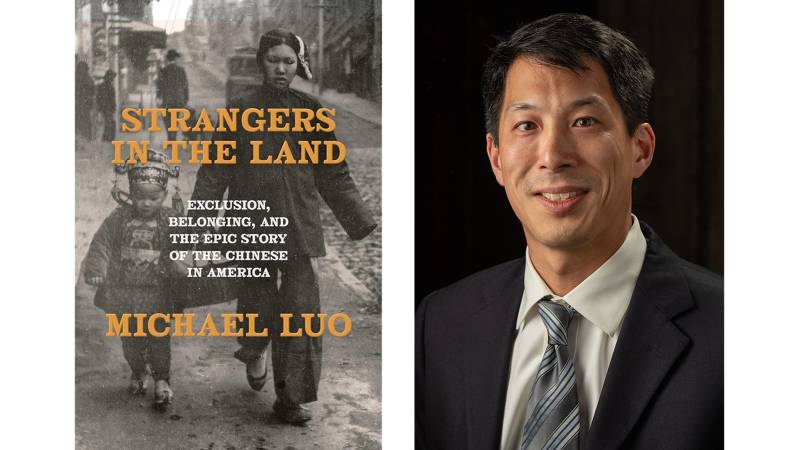
Strangers in the Land is Michael Luo’s exemplary analysis of Chinese immigration to the United States and how they were treated, usually quite poorly, once they arrived there. Luo, a child of Taiwanese immigrants himself, is an executive editor at The New Yorker and writes regularly for the magazine on politics, religion, and Asian-American issues. He has spent thirteen years at The New York Times, as a metro reporter, national correspondent, and investigative reporter and editor. He is a recipient of a George Polk Award and a Livingston Award for Young Journalists. His writing flows and he has full command over his rather extensive narrative. Strangers in the Land is a thoroughly detailed book, much needed, on a topic on which not enough is written.
And if we are for once, to judge a book by its cover, this one’s is captivating, taking one back to period dramas of Chinatown. So, all is all, I’d say Luo has everything going for him.
Strangers in the Land is an exploratory book that has depth and miniscule detail and delves into the key question of the history of Chinese immigration to the United States, underscoring the experiences of Chinese immigrants and their descendants, and hence the impact of discriminatory policies like the Chinese Exclusion Act. Luo’s detailed analysis examines how this history continues to shape the American comprehension of immigration and race till today. The book starts off by describing the initial wave of Chinese immigrants who came to the United States in the mid-19th century, and often sought work in gold mines and on the railroads. It describes how this work was laborious, long hours but the Chinese labourer’s were diligent and hardworking workers, getting paid the high wage of 30/35 dollars per day for their work at one point because their labour was so sought after.
Luo interlaces personal stories and his own family history to demonstrate the human impact of these historical events and policies
The book then explores the passage of the Chinese Exclusion Act in 1882, which barred Chinese labourers from entering the country and denied citizenship to those already living there. Luo highlights the widespread anti-Chinese racism and violence that Chinese immigrants faced in the United States, including economic bias and mob attacks.
At one point a housing official went so far as to call the Chinese a “moral leper in our community.” Luo explores how the legacy of exclusion continues to affect Chinese Americans, even after the repeal of the Chinese Exclusion Act and the opening of immigration in 1965. He argues that understanding the history of Chinese immigration is crucial in appreciating the complexities of United States’ multiracial democracy and the ongoing struggles for racial justice. Luo interlaces personal stories and his own family history to demonstrate the human impact of these historical events and policies, in a way that is palpable by the reader and easy to follow. The book links the historical patterns of marginalisation of Chinese to modern-day debates about immigration and race, emphasising the need for a more inclusive and equitable society.
The book is titled Strangers in the Land ironically because it explores the historical experience of Chinese immigrants in the United States, who were often viewed and treated as outsiders, or “strangers,” despite their varied and often large contributions and presence in the country. The title depicts the nagging feeling of ‘otherness’ and exclusion faced by Chinese immigrants, even as they sought to build lives and communities in the United States. It is taken from a quote by Supreme Court Justice Stephen J Field, who, in an 1889 decision, referred to Chinese immigrants as “strangers in the land” when upholding their exclusion from certain rights and protections. This phrase summarises the core theme of the book: the ongoing tension between the promise of belonging in United States and the reality of exclusion and prejudice faced by Chinese immigrants all through their history.
The book examines the historical context of Chinese immigration, including the initial welcome, then the rise of anti-Chinese sentiment, the violence and persecution they faced, and their subsequent fight for recognition and inclusion. It examines how, despite these challenges, Chinese immigrants persisted and contributed to American society, while also wrestling with issues of identity and belonging.
The title Strangers in the Land serves as a powerful reminder of both historical and ongoing struggles of Chinese immigrants to find their rightful place in the United States, highlighting the gap between the ideals of inclusivity and the realities of exclusion.
After reading Luo’s book, the key question that I feel citizens of the United States must ask themselves is: are non-Caucasian nationalities all simply ‘Strangers in the land’ or will there come a day when they will be included as equal citizens of the United States of America?
One would beg to argue the Native Americans hold greater claim than anyone to belonging truly to the land. Are all new arrivals just ‘Strangers in the land’ trying to make do daily, drawn to the American Dream that never was?