

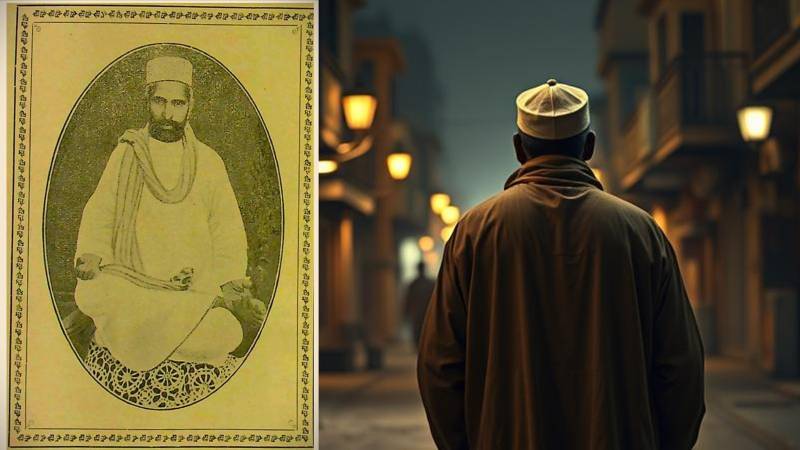
In the third week of June 2025, I went to old part of Hyderabad city in search of Gidwani Ghittee (street). This street was renowned before Partition. I consulted with elderly residents and explored their suggested locations. However, none were certain about the precise beginning or end of Gidumal Street, despite its namesake being a distinguished minister Diwan Gidumal of the Talpur Amirs of Sindh
Last Sunday morning, I revisited Pako Qilo and Shahi Bazaar. I saw two elderly gentlemen seated on the steps of a closed shop. After polite salutations, I inquired about Gidwani Street. They exchanged glances, then shook their heads from left to right, then right to left, unequivocally signalling “no." Perhaps they were not in a conversational mood. I presented them with a city survey map, on which Gidwani Street was clearly marked. They scrutinised the map, and one of them remarked, “Hameen Pata Naheen Hae, Bhai” (We don’t know, brother). I indicated the street with my pen. At this point, one of the men, appearing to be in his 80s, pushed the map away. He gazed blankly at the deserted street and whispered, “Koe Bania Yaha’n Naheen Rahta” (No Bania lives here). After a brief pause, he whispered, “Kaghaz to Kaee Bhe Bana Sakta Hae” (Anyone can make a map).
I departed from them, resolving to revisit the area on another day. The serene tranquillity of the morning roads prompted a recollection of an incident I had read in EF Schumacher’s book A Guide for the Perplexed. Schumacher recounted visiting Leningrad (Moscow) in August 1968, where he saw churches before him. Yet, there was no trace of them on his map. An official interpreter later explained that they deliberately omitted living churches from their maps.
There is no direct resemblance between the Moscow and Hyderabad experiences. However, students of history, anthropology, and political science can still discern the underlying reasons for such discrepancies. In Moscow’s case, the omission of churches from its official maps undeniably stemmed from political motives, reflecting the Soviet Union's anti-religious stance. However, Hyderabad presents a different scenario where the official map indicates Gidwani Street, but its existence is denied by local residents. This contrasting situation suggests that in Hyderabad, new residents appear to deny or disengage from the city’s historical past. Or they were never taught or told that Hyderabad was among the vibrant and culturally rich cities of the South Asian Subcontinent, even before 1947.
Let us set aside such a deep discussion for a moment. Now, consider this: when you read what I wrote in the preceding paragraphs, did you wonder why I was so intent on finding Gidwani Street? Well, whether you thought about it or not, let me tell you the purpose. I planned to write about Bhai Kalachand, who was also called Bhai Kalachand Swami. He lived on Gidwani Street. I wanted to go there to feel what it was like and imagine life in Hyderabad back in his time.
I believed that visiting the street would help me write his story better. So, I finally found the street with help from Saeen Imtiaz Mangi. Gidwani Street starts where Hyderabad’s Shahi Bazar begins. It is also right next to Juman Shah Jo Pirr. I went there three times: early in the morning, in the middle of the day, and late at night. Each visit – particularly the one during the wee hours – spiritually enriched me. I truly believe it would have been very hard to write an authentic story about Bhai Kalachand without seeing Gidwani Street for myself.
Here, now, is the profile on Bhai Kalachand’s life, depicting his sainthood and charity.
Bhai Kalachand was born on 6 April 1868. His father was Dewan Ramchand Gidwani, and their family home was on Gidwani Street. From his earliest years, Bhai Kalachand possessed a free spirit, consistently cheerful. A passing yogi once told his mother that her son had been a pious man in a previous life, touched by divine grace. He continued his formal education up to “Third Class English,” as it was termed in that era. By the age of 14, he would often leave home without announcement, to visit forests and desolate places, seeking inner peace. Beyond his inclination for solitude, music was another early fascination. Various accounts describe his musical inclinations. One frequently cited example involves an incident in Karachi. While observing a musical event there, he became so deeply engrossed by the sublime melodies, the vivid stanzas of the sung poems, and the rhythmic movements of the performers that he entered a state of ecstasy and fainted. Afterwards, even at his home, before the statue of Kirshan Bhagwan, he would weep, dance, and experience a similar trance, as though he were in communication with the divine.
Alongside his companions, he bravely walked through the streets, offering assistance to victims of the plague. He also sang bhajans for their spiritual solace and joy, bringing hope in dark times
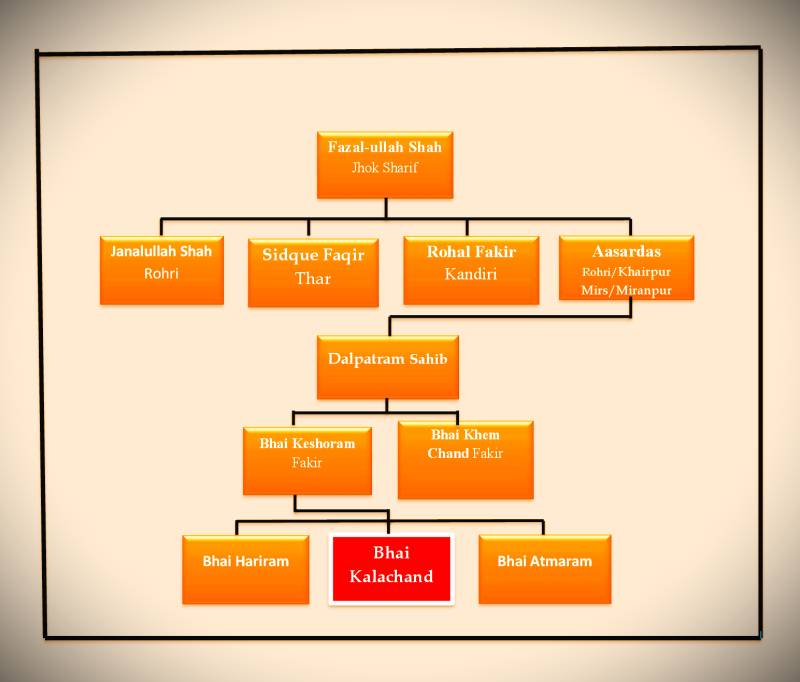
He spent most of his time at Bhagat Moli’s residence, which was also situated on Gidwani Street. There was a separate room, integral to the house, that was reserved for worship and religious discourses. Bhai Kalachand’s personal journey indicates that following his periods of solitude and devotional dance, he immersed himself in religious study, seeking spiritual enlightenment. It is widely believed that Bhai Keshoram Sahib was instrumental in encouraging and guiding him to comprehend the deeper meanings of sacred books, revealing universal truths. Bhai Keshoram Sahib was a revered disciple of the spiritual lineage of Jhok Sharif. Bhai Hariram and Bhai Kalachand diligently read sacred texts and gradually forged a strong friendship, bound by shared devotion. Their other like-minded companions included Swai Sachanand and Maharaj Atamnand of Jacobabad. All of them embarked on journeys together to major teeraths (pilgrimage sites) across India, further deepening their spiritual quest. Bhai Kalachand was a truly pious man, detached from worldly affairs, living with a higher purpose.
To illustrate his detachment, consider this example: his brother, a tapedar (a junior revenue official) in the Revenue Department, once took a month’s leave. As an arrangement, he requested Kalachand to perform his duties. In those days, temporary substitutions were permissible. Bhai Kalachand performed his tasks with remarkable dedication. Consequently, after one month, he was offered a permanent position in the department, which he respectfully declined, showing his renunciation of material gain.
On another occasion, his mother thought that perhaps marriage might break his prolonged silence and habit of solitude. Therefore, she insisted that he get married. He refused. His elder brother Rijhomal then playfully remarked that his engagement could be arranged without his consultation, and asked as to what he could possibly do about it. It was indeed true that in those times, young men were rarely consulted about their engagements; elders considered it their prerogative to decide. Bhai Kalachand remained silent initially, but then, with conviction and unwavering resolve, he firmly told his brother that in such a situation, he would harm himself. His brother smiled, questioning as to how anyone could take such an extreme action and willingly abandon a life of luxury. These words deeply wounded Bhai Kalachand. He immediately retreated to his abode, a room at Bhagat Moli’s place. There, he took an earthen pot, added some tola of opium, mixed it with oil, stirred it, and drank it. He then returned home and silently fell asleep in a room. After some time, he felt uneasiness. He called his mother and recounted the entire story, adding that perhaps his time had not yet come, suggesting a divine intervention. This dire situation created an immediate crisis within their close-knit family. Promptly, his brother, Nandi Ram, summoned a doctor. The doctor administered medicine to induce vomiting. The medicine took effect, and Bhai Kalachand’s condition improved, a testament to his destiny.
Bhai Kalachand lived a largely segregated life until 1890. However, he established a practice of keeping the door of his kutia (a small, secluded room) open at specific times in the morning and evening. This allowed devotees to have his darshan (a sighting of a holy person) and receive blessings. Gradually, he emerged from his solitude and spent more time interacting with his disciples, sharing his spiritual wisdom. Soon, a bhagat (devotional gathering) commenced, with katha (religious storytelling) as a central component. Furthermore, on designated days, he began Jagar (awakening sessions) for the youth. In these gatherings, he expounded upon the virtues of a righteous life, service to poor and peaceful coexistence between Hindus and Muslims, promoting harmony and understanding. Several books record his most cherished quote: “Our birth in a Hindu or a Muslim family is chosen act; and none of the religions stop us from serving humanity.” Beyond fostering unity among the residents of Hyderabad, another characteristic of his service was organising street bhagats, where bhajans (devotional songs) were sung and devotional dances performed, creating an atmosphere of joyful devotion. During that era, he was also renowned for his ability to resolve people’s social conflicts. It was widely believed that if a grieving person seeks justice, then he must reach Bhai Kalachand, and justice would invariably delivered. Throughout his lifetime, no party ever refused his summons when called for an amiable resolution or truce. Even Muslims readily accepted his decisions, recognising his spiritual authority.
In preparing this profile, I consulted various books in Sindhi and English to uncover Bhai Kalachand’s social contributions. I identified two primary roles he played. One was his stand against deti-leti (dowry). This practice involved the bridegroom demanding exorbitant sums of money from the bride’s family. This custom regrettably left many marriageable young girls without prospects because their families were unable to meet these financial demands. In the 1800s, this tradition was particularly prevalent among the Amils of Hyderabad. Bhai Kalachand organised the community to oppose this tradition. He began delivering powerful sermons against it, advocating for fairness and compassion. To further his cause, he authored a booklet titled Barahn Sawan Wari Bandi (A Booklet of Twelve Hundred Rupees). He prescribed some rules and regulations and fixed amount that has to be spend on marriage. This booklet quickly gained popularity and became widely known as Kalachand Sahib Wari Bandi (a Booklet of Bhai Kalachand) becoming a symbol of his social reform.
Bhai Kalachand further demonstrated his sainthood during the Maha Mari (an outbreak of plague) in 1897. In that year, the city was in a state of panic. Some residents were abandoning their homes, while others felt guilt-ridden because the quarantine imposed by the health department or the commissioner’s office in Karachi prevented them from attending to their relatives. Day by day, the death toll continued to climb, and no health attendants or volunteers were capable of managing the overwhelming number of cases. The city presented a deserted appearance, and fear had completely seized control of the town. However, in this dire situation, Bhai Kalachand began to deliver sermons to instill resilience and patience in the distressed citizens, offering spiritual comfort. The impact of his lectures was profound. Alongside his companions, he bravely walked through the streets, offering assistance to victims of the plague. He also sang bhajans for their spiritual solace and joy, bringing hope in dark times. He regularly visited the hospital to sing holy verses and narrate sacred stories to those afflicted. His compassionate presence helped patients handle their fears and frustrations in the face of death, providing solace in their final moments.
Bhai Kalachand’s role during this crisis was multifaceted. He assumed full responsibility for patients’ treatment, ensuring the provision of food and spiritual enrichment, truly embodying selfless service. He even took the initiative to secretly visit the masan (cremation ground) just to confirm that all deceased bodies were fully cremated. He did so because doctors had warned that a half-burned body might spread plague germs. In those times, the city was rife with rumours. People were recounting their imaginative scenarios as personal experiences, and these fabricated lies multiplied and spread, gaining acceptance as truth.
Some of the rumours from that period, particularly concerning dead bodies, alleged that there was no wood at the masans, leading to bodies being thrown into waterways. Another rumour claimed that wood from the masan was stolen at night. Furthermore, it was said that more than two dead bodies were sometimes piled together for burning, resulting in one or two not being fully cremated, and that the ruhs (spirits) of half-burned persons wandered around in the masans. One night, Bhai Kalachand, accompanied by his disciple, entered the masan at a late hour from the back. The individuals already present there mistook them for free spirits of dead bodies. They then thought that the rumours were indeed true. They changed their minds when they recognised Bhai Kalachand and his companions. And then, they learned that Bhai Kalachand was there to uncover the truth about rumours that bodies were either half-burned or thrown into the water.
He was a deeply sensitive person. Both natural beauty and tragic stories moved him a lot. In his later days, a dramatic company from Kutch staged several religious plays in Hyderabad. One such production was a “Radha and Krishna” play. The citizens received it enthusiastically, and some of its dialogues and scenes became the subject of widespread conversation. Everyone praised the performance. One night, Bhai Kalachand also attended the play. It is recounted that the scene depicting the separation of Radha and Krishna moved him immensely, causing him to weep like a child. Following that play, he remained silent for a couple of days. He showed no interest in his routine activities, absorbed in spiritual contemplation.
Bhai Kalachand was also a poet, his pen name was “Kalyan.” The anthology of his poetry is known as Kalyan Mala (presently it not available). Beyond his religious and social services, his poetry was popular among people of all faiths, spreading messages of devotion. One of his poems, “Pir Paghambar Mir Muhammmad..,” was particularly cherished by Muslims of Hyderabad. Most of his poetry was sung in “Kalyan Thaat” (a subset of Hindustani Raag traditionally performed in the early afternoon, late evening, early night, and early morning). Another musical form he chose was “Bhairavi” (traditionally sung in the early morning and at the end of musical performances). Undoubtedly, Bhai Kalachand was a Sant, yet he was also a staunch traditionalist, valuing ancient wisdom. One event frequently cited is that before his death, he summoned his disciples and instructed them on the appropriate actions has to be taken after his demise. The instruction included reciting “Hari Ram, Hari Ram” and keeping of the Gurugranth Sahib and Bhagavad Gita beside his dead body until the time of cremation. One disciple expressed an objection about the Bhagavad Gita, but Bhai Kalachand stopped him, advising that it must not be forgotten that the Bhagavad Gita had played a crucial role in the spiritual enrichment of our elders, he emphasised its timeless importance and relevance.
In May 1909, Bhai Kalachand first experienced a mild kidney pain. By December, its duration expended and pain intensified. However, after two years, the pain became unbearable, yet he endured it in silence, a testament to his fortitude. On 13 May 1911, pain kept him awake throughout the night. But in the morning, he was calm, radiating inner peace. He mentioned the names of several poor families and instructed his disciple that they should be assisted. On the evening of the same day, he passed away peacefully. Even after his passing, whenever Bhai Kalachand’s name was spoken, the people of Hyderabad used to utter, with heartfelt reverence, “Om Shanti, Om Shanti,” a deep acknowledgment of his sacred memory.
He was, without a doubt, a guiding star for Hyderabad, a beacon of hope and spirituality who stood steadfastly by its people through every joy and every tribulation life presented.