


I studied at Catholic schools in Hyderabad, Sukkur and Karachi. I first heard the words, “Roman Catholic” at St Bonaventure’s where I did my primary grades. I assumed that simply meant Christians.
That continued to be my impression during my middle school years at St Mary’s. Things changed when I was doing my ninth and tenth grades at St Patrick’s. That’s when I came to know that not all Christians were Catholics, and even within Catholicism there was the Roman Catholic church and the Eastern Orthodox Church which was based in Constantinople (later Istanbul).
In ninth grade, we were assigned Shakespeare’s play, Julius Caesar. A few of us had to memorise Mark Antony’s funeral oration and deliver it to the class. The opening lines would forever be riveted in my brain:
“Friends, Romans, countrymen, lend me your ears;
I come to bury Caesar, not to praise him.
The evil that men do lives after them;
The good is oft interred with their bones;
So let it be with Caesar. The noble Brutus
Hath told you Caesar was ambitious:
If it were so, it was a grievous fault,
And grievously hath Caesar answer’d it.”
Years later, I would see the play being performed on stage in the US and in Australia. Shakespeare’s dramatisation of Caesar’s assassination kindled a desire to visit Rome. The desire was amplified when I saw the film Gladiator. I was mesmerised with the stunning images of the Colosseum. Along the way, I read several books about the Roman Empire, which augmented my desire to see Rome with my own eyes. Finally, the day arrived when our flight landed in Rome. But, first, we headed to Venice since it was Easter weekend and we assumed Rome would be super crowded with worshippers.
A week later we were back in Rome. In my mind was Edward Gibbons' book, The Decline and Fall of the Roman Empire. Seated among the ruins of the Capitol in Rome, Gibbons had conceived the idea of writing the classic. He was situated on Capitoline Hill, the smallest but the most significant of Rome’s seven hills. From there, one gets a sweeping view of the Roman Forum.
So, checking into the Sofitel hotel, we headed off to see the Roman Forum. After viewing the arches and other sites, I discovered a muddy grave. Someone had covered it with flowers.
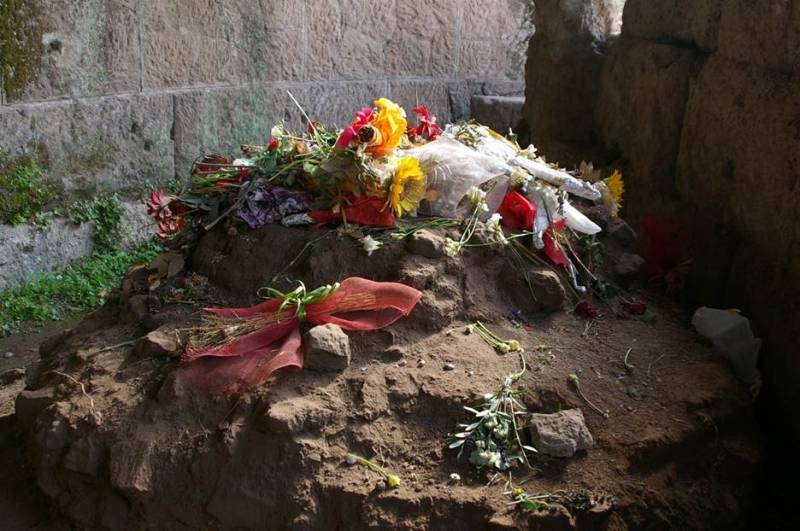
Then came the shock. The muddy grave housed the remains of Julius Caesar, who was cremated and not buried, as per the terms of his will. There was no shortage of grand monuments in Rome. Not too far away was the grand mausoleum of Octavian, Caesar’s adopted son, who is regarded as the man who founded the Roman Empire and took on the title of Augustus.
So why did Caesar not get a fancy mausoleum? Later, I discovered that a temple had been built over his grave but eventually it disintegrated. It is the only place in the Roman Forum where fresh flowers are placed every day. It has become a popular pilgrimage site.
Caesar had been a superb general and politician who had expanded the boundaries of the Roman Republic all the way into present day England. Caesar was also a great writer, recording the events of his life in incredible detail. The Civil War is a tense and gripping depiction of his struggle with Pompey over the leadership of Republican Rome - a conflict that spanned the entire Roman world, from Gaul and Spain to Asia and Africa. He lived from 100 to 44 BC and only governed Rome from 46 to 44 BC.
Ironically, his death at the hands of the Roman senators replaced a republic, ruled by the consuls and the Senate, with an empire, reigned over by emperors and their hereditary successors.
But my mind would not let go of what I had read about Caesar. He had been murdered in the Roman Senate because some senators, led by Brutus, thought he was an ambitious man who dreamt of becoming an emperor. They thought by murdering him, they would preserve the republic.
Little did they know that they were the ones who were murdering the republic. By killing Caesar, they created the Roman Empire, an empire so vast in its geographical reach that a friend, on learning that I was about to commence a tour of Rome, told me that “Europe was as one vast Roman ruin.”
He was right but what he said was an understatement. In its heyday, the Roman Empire also included most of North Africa and the Levant, which encompasses today’s Israel, Jordan, Lebanon, Palestine, and parts of Turkey.
As I did my research, I learned that some of the best Roman ruins were to be found in Algeria. In fact, after Italy, that country has more Roman ruins than any other country in the world. Like most empires, the Roman Empire grew through conquest. The destruction of Carthage in modern Tunisia is one of the many blemishes on Roman history. Pax Romana, or Roman Peace, was only established after the enemy had been vanquished.
As further evidence of the impact of Rome on global culture, it is useful to note that the English language is written in the Roman alphabet. So are all the “Latin” languages: French, Italian, Portuguese, Romanian, and Spanish.
Caesar’s murder turned him into an immortal. Even though he never wore a crown, kings and emperors in other countries adopted his name as their title. In Germany, his name evolved into Kaiser. In Russia, it evolved into Czar or Tsar. The month of July is named after him, and the month of August is named after his adopted son.
Even the birth of children that occurs through surgery is termed Caesarean-section, or C-section, because Caesar is said to have been born that way.
The Sofitel where we stayed was located across the street from Villa Borghese. A short walk took us to the Spanish Steps. These wide steps, comprising three majestic tiers, are one of Rome’s most distinct landmarks. At sunset, they offer an incomparably beautiful view of Rome’s seven hills. They derive their names from the Spanish Embassy which occupied a nearby palace in the 19th century. John Keats, the English poet, lived and died in a neighbouring house.
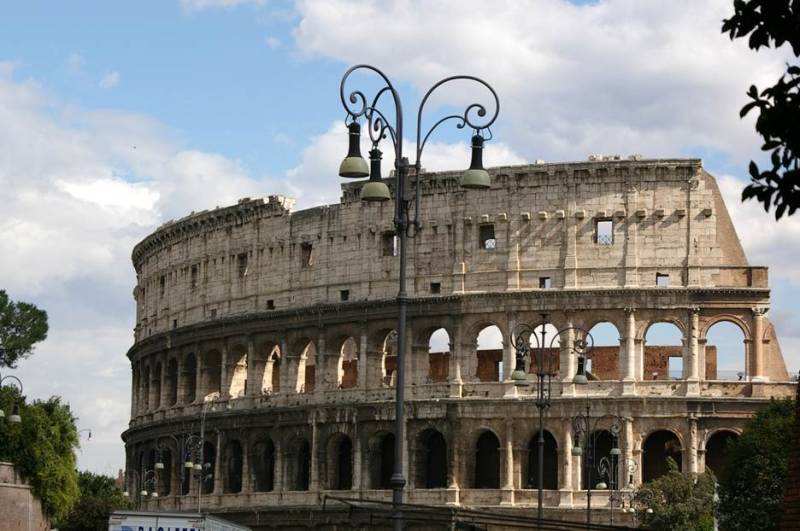
The Colosseum, which for long has been an icon of Rome’s imperial glory, was just as dramatic as seen in the films. It was built two millennia ago.
The Trevi Fountain, in a triumph of baroque art, depicts the statue of Neptune standing on a chariot drawn by winged steeds.
The Pantheon is the most complete ancient Roman building standing today and truly an architectural masterpiece. Its dome is a marvel of symmetry, exactly as wide as it is high, supported by pillars hidden in the walls.
The Arch of Constantine is a triumphal arch located along the route of the triumphal procession between the Roman Forum and the Colosseum. It has a large inscription above the central passage proclaiming Constantine as the liberator of Rome. This triple arch is similar in size and design to the Arch of Septimius Severus in the Roman Forum built a century earlier.
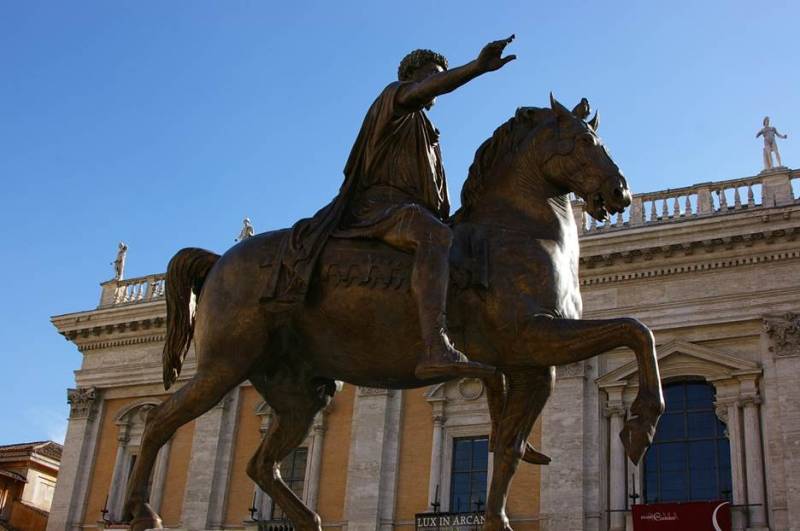
There is a dramatic replica of the Statue of Emperor Marcus Aurelius upon his horse on top of the Capitoline Hill in Rome. The original is stored in a museum.
Rome is world famous for its food and its restaurants. We sampled the cuisine at a few of these. It lived up to its reputation. Even the street cafés were remarkable, not just for the food or service but for the attire of the gardeners who were working nearby. They were dressed in suits.
A couple of weeks after returning from Rome to the US, I travelled to Washington, DC on a business trip. It is a city of monuments. I had seen them several times before. But this time they looked different. Why? Because I had just seen their precursors in Rome.
The White House betrays a strong Roman influence through its exterior arches and columns. So do the Capitol, the Supreme Court and the Jefferson Memorial. The Capitol features a dome which emulates the Roman Pantheon. So do Capitol buildings in most states, and San Francisco’s City Hall. In New York, the Federal Hall features Doric columns. Many stadium designs throughout the US are based on the Colosseum.
The influence of Roman architecture is not limited to the US. The Arc de Triomphe and the Place Vendome are just two examples in Paris, France.
Ancient Roman architects, building on the work of ancient Greeks, Egyptians and Persians, had changed the shape of architecture for all time. What made Roman architecture unique was the use of concrete, which was stronger than marble and could be decorated more easily.
The only difference between the monuments in Washington, DC and those in Rome is that the monuments in Rome have lost their shine. They have stayed there for centuries. Their imitations in Washington were relatively new. Whoever called Rome the eternal city was spot on. Not only has Rome proven to be eternal in its original location. It has proven to be eternal globally through its architectural imitations.