

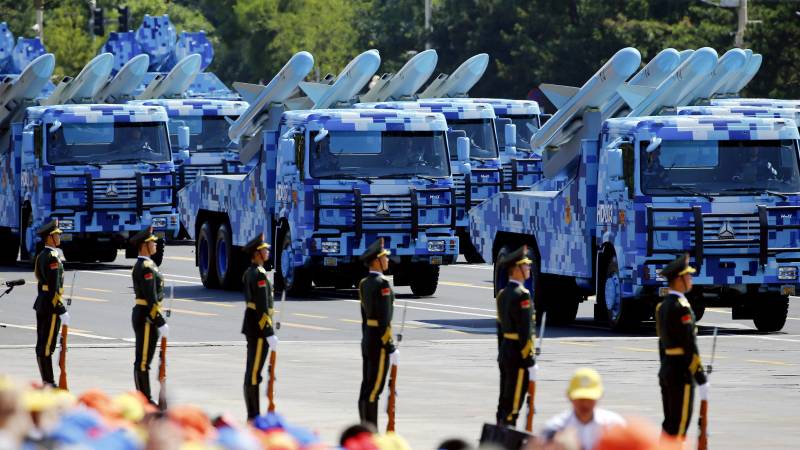
China’s 2025 white paper, “China’s Arms Control, Disarmament, and Nonproliferation in the New Era”, reasserts long-standing themes while introducing sharper geopolitical and technological emphases. The document delivers a sweeping critique of great-power behaviour, warning that “hegemonism, power politics, and unilateralism pose a severe threat to the nuclear order” and calling for their elimination. Beijing reiterates that it maintains a national defence posture that is “defensive in nature,” vowing never to seek hegemony or expansion and to only “strike after being attacked.” This claim reinforces itself by referencing historically restrained force levels, controlled defence spending, and repeated troop reductions.
Nuclear policy remains the centrepiece of China’s strategic identity. The 2025 white paper reaffirms its no-first-use (NFU) doctrine, stating that China has “always remained committed” to NFU under all circumstances and will never use or threaten nuclear weapons against non-nuclear states or nuclear-weapon-free zones. It describes NFU as the most “stable, consistent, and predictable” element of its nuclear strategy and pledges to maintain its arsenal at the “minimum level required for national security,” citing a limited testing record and steady disarmament measures.
A major innovation in the 2025 paper is its treatment of emerging technologies and battlefields (outer space, cyberspace, and artificial intelligence) classified as “new frontiers” of strategic security. China calls for preventing militarisation and urges all states to “promote peaceful uses” of these technologies, opposing space weaponisation and exclusive blocs. In cyberspace, it advocates a governance model rooted in sovereign equality and its “community with a shared future” vision.
The white paper also denounces double standards and politicised export controls, arguing that unilateral sanctions and the abuse of national-security justifications undermine legitimate development needs, particularly in the Global South. China links arms control to its broader foreign-policy identity, portraying disarmament as integral to building a “community with a shared future for humanity” and positioning itself as a leading defender of UN-centred multilateralism, especially for developing countries whose representation it urges to expand in emerging-tech governance.
The preface states that China, guided by “Xi Jinping Thought” on Socialism with Chinese Characteristics, advances modernisation while playing a constructive role in global arms control
China’s 1995 and 2005 arms control white papers established enduring doctrinal foundations that continue to shape its strategic posture. The 1995 document reaffirmed that China “does not seek world or regional hegemony,” emphasised a defensive national strategy, and presented unilateral reductions in force size, defence budgets, and military industrial activity as proof of its commitment to global stability. It criticised major power dominance, called for the elimination of hegemonism and power politics, urged deeper reductions by the largest nuclear weapon states, and warned against non-proliferation double standards that restrict the peaceful use of nuclear technology by developing countries. It also reaffirmed China’s confidence in the UN and pledged to remain a reliable actor for world peace.
The 2005 document continued this orientation. It repeated that China would never seek hegemony, framed policy around peaceful development and a new security concept based on mutual trust, and highlighted major troop reductions between 1985 and 2000 along with restrained defence spending. It reiterated China’s permanent commitment to the NFU doctrine, called for diplomacy and universal participation in non-proliferation regimes, and stressed balance between disarmament and the peaceful use of technology. It also highlighted China’s participation in multilateral regimes, including the CTBT, the fissile material negotiations, and UN disarmament processes.
The 2025 white paper introduces a new ideological dimension by explicitly linking China’s arms control policy to its socialist identity and to Xi Jinping Thought. The preface states that China, guided by “Xi Jinping Thought” on Socialism with Chinese Characteristics, advances modernisation while playing a constructive role in global arms control. It further asserts that China’s arms control approach derives from its “cultural tradition of harmony, its socialist nature, and its strategic commitment to peaceful development,” a framing absent from the 1995 and 2005 white papers, which referred to socialist modernisation but did not present arms control as an ideological expression. It embeds China’s initiatives, including the Global Security Initiative, within a socialist narrative of “common values of all humanity” and a “shared future for humankind.”
Yet the ideological emphasis lacks a clear operational definition. “Socialist nature” remains a virtue-laden concept without clear policy prescriptions, unlike concrete commitments such as NFU. The rhetoric recalls Cold War patterns where ideological signalling infused arms control discourse, though China frames it in a less confrontational and more self-referential way. Incorporating arms control into Xi Jinping Thought enhances the consistency of domestic policy. China’s arms control choices might resonate with developing states that question Western double standards, but external analysts could view the strategy as vague or propagandistic, which generates uncertainty about the role of ideology in shaping future decisions.
China’s 2025 arms-control white paper combines continuity and innovation, presenting a defensive and non-hegemonic posture infused with ideology that integrates socialist identity, NFU consistency, NPT treaty adherence, and Xi-era assertiveness, resulting in a rhetoric of revived certitude and stable modern policy.