

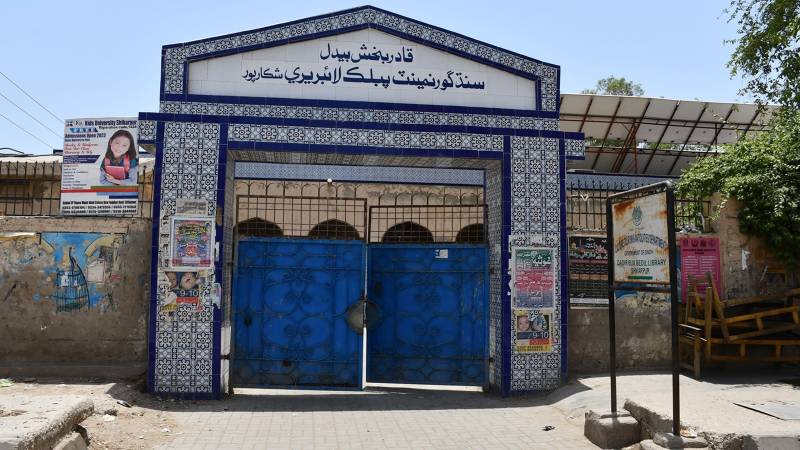
Shikarpur was once home to many libraries in Sindh, primarily privately owned. These libraries were established either in seminaries or in the private homes of educators, political leaders, religious leaders, scholars, merchants, philanthropists, and publishers. From the 17th to the 20th century, Shikarpur experienced rapid growth in library development throughout the town, not only in Shikarpur itself but also in various other villages and towns in the Shikarpur district.
Some of the prominent libraries of Shikarpur included Alaviyya Library, Ashiyana Adab Library in Garhi Yasin, Humayuni Library in Humayun Sharif village, Khwaja Pir Nizamuddin Sarhandi Library, Qazi Muhammad Library, Mula Sahib Dino Library, Muhammad Arif ‘San’at’ Library, Munshi Atta Muhammad Library, Pir Muhammad Umer Library, Agha Ghulam Nabi Sufi Library, Molvi Abdul Kareem Chishti Library, Faqir Ghulam Ali Masroor Library, Molvi Abdul Rehman Library, Khalifa Yar Muhammad and Khalifa Ghulam Hyder Library, Qari Fateh Muhammad Panipati, Molvi Abdul Hakeem Soomra Library, Haji Moula Bakhsh Library, Lutafullah Badvi Library, Habibullah Bhutto Library, Professor Jhamandas Bhatia Library, Usman Ali Ansari Library, Molvi Illahi Bakhsh Soomro Libray, Molvi Abdul Sattar Library, Molvi Abdul Fateh Siddiqi Library, Shaikh Sahibdad Library, Muhammad Saeed Siddiqi Library, Khali Morayani Library, Wahid Bakhsh ‘Ashiq’ Library, Government High School No 1 Library, New Era High School Library, C&S Government College Library, Al-Farooq Islamic Library, Madrasa Arabia Qasimiyya Library Library in Garhi Yasin and many others.
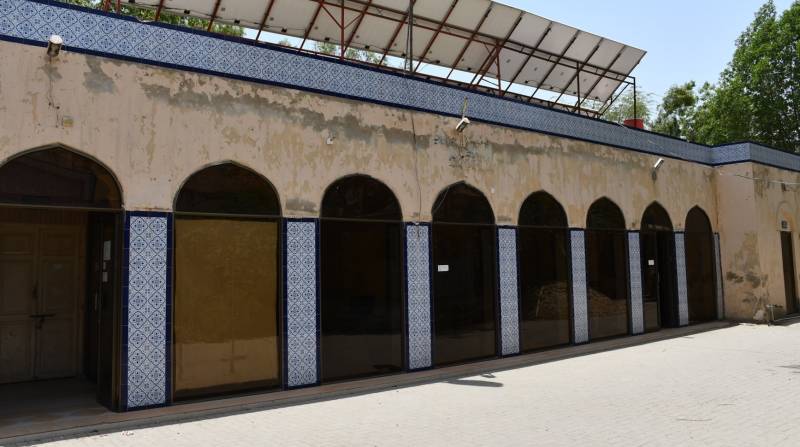
Those who owned these literary treasures played a significant role in promoting a reading culture in Shikarpur. In addition to privately owned libraries, a few were established for the general public to access these resources. There were several libraries in Shikarpur, but most have lost their collections and no longer exist.
From the rule of the Daudpotas to the Kalhoras, the Talpurs and the British, each era saw a notable increase in the establishment of libraries. Scholars were drawn to Shikarpur because of its expanding business networks, which connected to Central Asia and even Europe. The merchants of Shikarpur not only brought skills from these regions but also introduced various books and materials to the town, mirroring the lifestyle that Karachi and Hyderabad had at that time.

By the first quarter of the 18th century, Shikarpur had become the economic hub of Sindh, connecting it to global traders. Several libraries were established during the British Raj in Shikarpur. One such library began as the ‘Friends Society Reading Room’ and later became the main library of Shikarpur town. This library was founded by Jagan Nath in 1873. It was one of the earliest libraries in colonial Shikarpur. It started in Narain Jagan Nath's house. He was connected to the education department, serving as an Assistant Education Inspector and later as a Deputy Education Inspector. Recognising the importance of education and libraries, he played a pivotal role in raising awareness in the community about the need to build libraries and schools for the better future of Shikarpur's residents. It is said that the business community and other elites of Shikarpur responded positively to his sincere efforts.
From the rule of the Daudpotas to the Kalhoras, the Talpurs and the British, each era saw a notable increase in the establishment of libraries
In 1876, a new building was constructed with donations from philanthropists in Shikarpur. The library was named after Jagan Nath in recognition of his efforts, who first made an effort to establish a small library. Moreover, his collection in the ‘Friends Society Reading Room’ was moved to the new library. During the interview with the local community, I learned that it was a two-storey building housing a large and rare collection of books on various subjects. Soon after the partition, the building fell into disrepair, and the condition of the books began to deteriorate. The books and other literary materials were subsequently moved to the Shikarpur Municipality building, where they were designated as the Municipal Library.
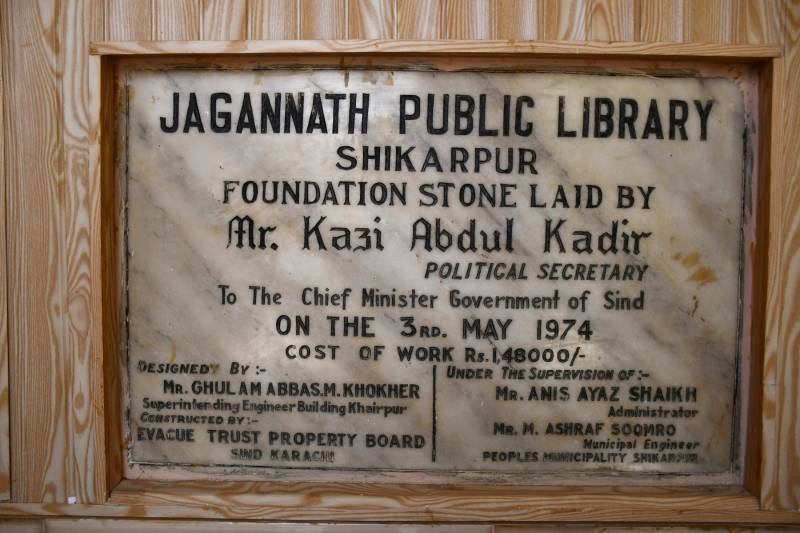
As indicated by some of the plaques on the walls of the library, the foundation of the new library building was laid by Mr. Kazi Abdul Kadir, a political secretary to the Chief Minister of Sindh, on 3 May 1974. This plaque also displays other details, including the cost of construction, as well as the names of administrators and engineers who completed the project. On the plaque is written the name Jagan Nath Public Library, Shikarpur. Later in 1979, the library building was inaugurated on 12 Rabi' al-Awal, 1399 AH (9 April 1979), by Ahmedullah Faruqi, Deputy Commissioner of Shikarpur. In 1988, the library came under the administration of the Sindh Culture Department. It was renamed after the nineteenth-century Sufi poet Qadir Bux Bedil, whose shrine is located in Sukkur’s Rohri.
The Qadir Bux Bedil Library is the only public library in Shikarpur town that accommodates hundreds of competitive examination aspirants who visit daily. This library serves as a haven not only for those preparing for competitive exams but also for scholars writing on various subjects. Additionally, the library offers an e-library service (ELS) provided by the Culture, Tourism, Antiquities, and Archives Department of the Government of Sindh.

The library houses over 15,000 books. It has three reading halls: one for males, one for females, and a third hall dedicated exclusively to scholars for research and writing on various subjects. Unfortunately, much of the original collection belonging to Jagan Nath, like many private libraries, has been lost over time.
Shikarpur, like other towns and villages in Sindh, is known for its reading culture. Several individuals are actively working to promote this culture by establishing libraries in the area. Among them is Professor Dr Sharif Ahmed Shad Soomro, who founded the Shah Abdul Latif Libraries Association (Shola) in 1983 with the goal of establishing libraries in villages and towns throughout Shikarpur. The main library established by this association is located in Rutom town and contains more than 6,000 books on a variety of subjects and languages. Additional libraries set up by the association can be found in Abdu, Mian Jo Goth, Chak, and Lakhi.
These individuals dedicate their time and resources to spreading knowledge, and they truly deserve recognition as the real heroes of our society! Likewise, we need to celebrate the community and philanthropic initiatives of individuals who have worked to reform society. The Qadir Bux Bedil Public Library of Shikarpur should keep its original name in honour of its founder, Jagan Nath.