

“I wish children would be temporarily elevated to the skies until the war ends
Then they would return home safe
And when their parents would ask them,
Where were you? They would say,
We were playing in the clouds.”
(Ghassan Kanafani, Palestinian author and militant)
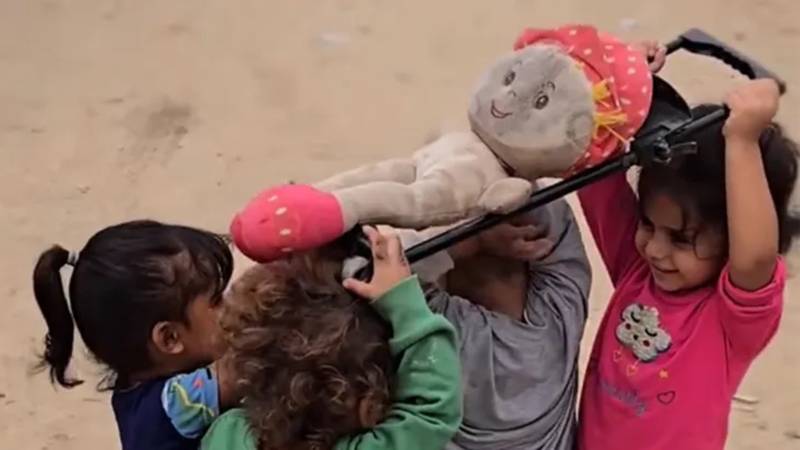
The viral image of a Palestinian child so exhausted by life that he is seeking death in a video circulating on social media, only breaks the heart into a million pieces.; a clip, also posted by Al Jazeera and other media platforms, features children re-enacting a funeral procession during play in Gaza, as they lay a doll on a frame and lift it up, pretending to carry babies like themselves to their graves, is heart-rending to say the least.
In another viral video, a small child barely walks alone through an empty Gaza street, while carrying two heavy water canisters, as he stops to put his load down and catch a breath. How wars strip the surviving children of their childhood and the unencumbered privileges that childhood entails, and how the breath they pause to catch is rendered so heavy and acrid that it, perhaps, becomes exceedingly noxious for them to even inhale.
And yet, such clips and news only barely reflect the ground realities affecting children in Gaza and other conflict-torn territories around the world.
Exhausted and exterminated, struggling to put their lives back together amid breathers that come in the form of fickle ceasefires but are hardly so, children continue to be the most ready, uninformed, unprotected, and unsullied victims of war. Through direct targeting, as well as, in terms of collateral losses, children endure and survive the unimaginable brunt of adults’ wars.
With their spirits, lives, and limbs broken, one may pose the most painful question regarding those whose lives are miraculously spared by crippling wars that we have unleashed: are children who survive these ‘deluges of aggression’ worthy of being called lucky to be alive and are their ensuing lives worth living?
Lucky to be alive, but only so to lead a life worse than death, perhaps, as despair and debilitation bring children to a point where some wish for an end to their lives.
Those who die are at peace; those surviving mutilated and starved, parched and petrified, are the ones undergoing never-ending tribulations.
The harshest outcomes of war and occupation are endured by children, as the multiple burdens that they have to carry were never meant for their cherubic faces or fragile bodies that now radiate unbearable pain, grief, and loss, instead of hope and happiness.
Decades of constant conflict and occupation have stripped entire child populations of resources, security, and any hope for a normal future
In Gaza and parts of the West Bank, with constant war and atrocities accompanying Israeli occupation of the territories for decades, the contours of children’s lives have been rendered darker and grimmer, as the surviving child population barely pulls through amid rubble and ruins, totally stripped of resources or hope for a future that could have been.
In other parts of the Middle East, from Iran to Syria to Lebanon, the same disastrous pattern has long unfolded where children are being killed, maimed and displaced in numbers that are difficult to determine, in complete defiance of humanity, international law and regard for child rights.
Battered by constant wars, a student’s dream in Iran, Gaza, Syria, Lebanon or Ukraine may no longer be to achieve high grades or go through exams but to earn enough to sustain their younger siblings and family, or to secure a couple of litres of clean water to quench their thirst and wash-off.
What does this say about a world and the stone-heartedness of its people, when the most vulnerable and voiceless amongst humans, the ones marginalised and mauled by our earthly standards, are deemed so expendable. There are red lines in wars but, unfortunately, modern imperialistic, expansionist warfare has completely obliterated those lines.
What is even more disheartening is that there is little evidence of restraint, less of remorse among the world leadership perpetuating this permanent persecution. Children shouldn’t have to live in constant fear of the buzzing of drones and the boom and bang of explosions. Laws meant to govern armed conflicts should be invoked, especially when it involves the safety, security and lives of children in countries or regions being attacked.
No political objective or self-satisfying claims of self-defence or children being used as human shields justify the systematic killing of children and their childhood by targeting schools, hospitals, residential neighbourhoods and displacement camps. The acts are nothing less than the horrible malfeasance of ethnic cleansing.
World chiefs speak the language of security, sustainability and strategy, but their actions betray a chilling callousness towards protecting the frail, defenceless and unarmed populations amid the wars they wage; the most non-combatant among humans.
I will not quote a lot of war-affected child statistics here, because we have become so attuned to these abstract numbers that they have become meaningless and lost their impact. Though, numbers regarding war-affected children have a concrete presence that is manifested in their absence; the empty classrooms, the quiet homes, the silent playgrounds and the erased futures are all a tangible rendition of those tragic war numbers.
These are adults’ wars imposed on children, while the latter’s silent suffering becomes our unforgivable sin. Children in war zones endure treatments that shell-shock the conscience and, yet, global outcry against such atrocities has been dominated by plain indifference. The UN Charter, multilateral rights organisations and the international community have not succeeded in curtailing children’s slaughter and abuse; all that is done is rhetorical condemnation.
How do children even understand war, too young to comprehend what territories or governments or borders are and why they need to be conquered, changed or guarded? How do they look at a world shaped and driven by adults with their, greed, hubris, and vengeance; with their innocence-inundated eyes must they be wondering why there’s pain, why the bombs blast, missiles pummel and pound, why the world is what it is, and if they are to learn from the adult world, what are they to learn?
Children flooded with fear, sadness, anger, regret and anxiety, apart from how the war makes their lives unliveable, is the most inevitable toll that war takes. It devastates, starting off by causing immediate physical danger, followed by injuries, loss of families, displacement, and extreme long-term mental health issues, including Post Traumatic Stress Disorder, depression, and anxiety.
Adding to all this is imminent starvation, lack of education, potential exploitation, stripping them of their childhood and developmental potential, and leaving behind emotional scars that gravely affect their ability to learn, socialise, and thrive into adult life.
An image from Tehran , circulating online, showing a child’s foot hanging from the side of a house, after a US-Israeli missile struck civilian homes, is not a rare sight as official figures speak of more than 200 children killed in the first 25 days of US-Israeli strikes on Iran, with thousands injured.
In Lebanon, over 370,000 children have been driven from their homes in less than a month since the Iran war started, according to media reports. That is an entire generation displaced literally within weeks.
Are these children seen as less deserving of life and dignity in the eyes of those who wield power and authority? Perhaps, yes, as, mostly, these children belong to the weaker or poorer nations of the developing world. Geopolitics define their lives and worth, just like that of their homelands.
As we condemn war violence taking children’s lives or debilitating them, we must also castigate our collective failure to put a stop to it. This child massacre will continue unless all children are considered children of the world and their loss, a collective loss for the world, whatever the geoeconomic, geopolitical or geostrategic relevance or worth of the countries they reside in.
Aggressors that prioritise war gains over avoiding war crimes and still continue to evade accountability, pose a concern as troubling as the stark realities of the warring world’s child population.